
[論文レビュー] The Rise of Faint, Red AGN at $z>4$: A Sample of Little Red Dots in the JWST Extragalactic Legacy Fields
この論文は、z~2–11にわたる341個の faint, red AGN candidates(Little Red Dots, LRDs)のJWSTベース大規模サンプルを提示し、連続スペクトルのスロープ、コンパクトな形態、 obscured AGNの性質を詳細に示す。赤shift分布、宇宙密度、X線およびNIRSpec確認を分析し、以前のLRDサンプルと比較する。
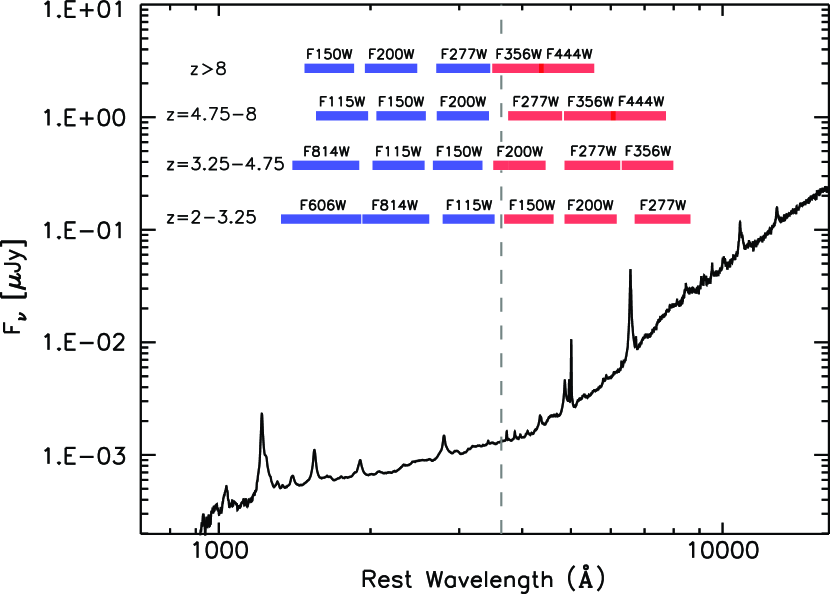
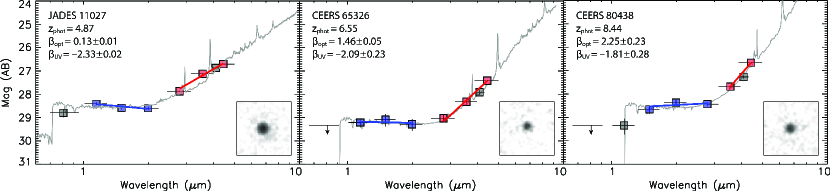
We present a sample of 341 "little red dots" (LRDs) spanning the redshift range $z\sim2-11$ using data from the CEERS, PRIMER, JADES, UNCOVER and NGDEEP surveys. Unlike past use of color indices to identify LRDs, we employ continuum slope fitting using shifting bandpasses to sample the same rest-frame emission blueward and redward of the Balmer break. This enables the detection of LRDs over a wider redshift range and with less contamination from galaxies with strong breaks that otherwise lack a rising red continuum. The redshift distribution of our sample increases at $z<8$ and then undergoes a rapid decline at $z\sim4.5$, which may tie the emergence of these sources to the inside-out growth that galaxies experience during this epoch. We find that LRDs are $\sim1$ dex more numerous than X-ray and UV selected AGN at z~5-7. Within our sample, we have identified the first two X-ray detected LRDs. An X-ray spectral analysis confirms that these AGN are moderately obscured with $\log\,(N_{ m H}/{ m cm}^{2}$) of $23.3^{+0.4}_{-1.3}$ and $22.72^{+0.13}_{-0.16}$. Our analysis reveals that reddened AGN emission dominates their rest-optical light, while the rest-UV originates from their host galaxies. We also present NIRSpec observations from the RUBIES survey of 17 LRDs that show broad emission lines consistent with AGN activity. The confirmed AGN fraction of our sample is 71\% for sources with F444W<26.5. In addition, we find three LRDs with blue-shifted Balmer absorption features in their spectra, suggesting an outflow of high-density, low-ionization gas from near the central engine of these faint, red AGN.
研究の動機と目的
- 高赤方偏移で高度に reddened AGN の潜在的候補として、広範囲にわたる形質観測選択によりコンパクトな赤色光学/青紫外領域源の集団を特定する。
- JWSTの深いフィールドにおける赤shift分布、宇宙密度、および明るいクエーサーや他のAGN選択との比較を定量化する。
- X線検出とNIRSpec分光による確認されたAGNの性質を特徴づけ、 obscurationとホスト銀河の寄与を理解する。
- LRDの発生頻度が銀河の成長と初期宇宙時代のAGN給餌とどう関連するかを評価する。
提案手法
- Balmerブreakの青側および赤側のバンドを用いた写真観測フィットにより、rest-frame UVおよび光学連続スペクトルの斜面β_UVとβ_optを推定する(平滑帯域の関係式を用いたマイニング)。
- F444WでSNR>12、β_optが正、β_UVが-2.8〜-0.37の範囲にある赤色光学/青紫外compact源を選択する。
- 半光半径r_h < 1.5 × r_{h,stars}というコンパクト形態のカットを設け、拡張系の汚染を除去する。
- β_UV < -2.8で潜在的な brown dwarfs を除外し、β_F277W-F356Wおよびβ_F277W-F410Mのカットを用いて強い線放出によってβ_optが過大評価される源を除去する。
- χ^2最適化を用いたgalaxy+AGN成分のSEDフィッティングと、可視化のためのハイブリッドモデル(galaxy + reddened AGN)を適用する(サンプル選択には使用しない)。
- GO-4233のサブセットでEAZYによるフォトメトリック赤方偏移とNIRSpec RUBIES分光で redshiftを検証し、広い発光線と obscured AGNの署名を特定する。
実験結果
リサーチクエスチョン
- RQ1JWST深部領域におけるLRDの出現頻度と赤shift分布はどの程度か(z~11まで)?
- RQ2LRDは高赤方で明るいクエーサーやX線・UV選択AGNと比較して宇宙密度はどうか?
- RQ3LRDは主に覆われたAGNであり、 rest-frame optical/UV光とホスト銀河の発光にどのように寄与しているか?
- RQ4LRDにおけるAGN活性とフィードバックを示すスペクトル特徴(広い線、吸収アウトフロー)は何か?
- RQ5LRDの人口統計は初期ブラックホール成長と銀河の共進化モデルにどのような示唆を与えるか?
主な発見
- 341個のLRDがPRIMER-UDS, PRIMER-COSMOS, CEERS, JADES, UNCOVER, NGDEEPを横断して同定され、赤shiftはz~2–11。
- LRDはz~5–7で明るいクエーサーより2–3 dex多く見つかるが、これらの赤shiftでのX線およびUV選択AGNと比較すると宇宙密度は0.6–1 dex高い程度。
- LRDの最初のX線検出はz=3.1とz=4.66で見つかり、遮蔽は中等度:log(N_H/cm^2) = 23.3^{+0.4}_{-1.3}および 22.72^{+0.13}_{-0.16}。
- X線スペクトル解析では reddened AGN の放射が rest-optical 光を支配し、rest-UVは主にホスト銀河の放出であることが示唆される。
- 17個のLRDに対するNIRSpec RUBIES分光でAGN活動と整合する広い発光線が確認される。
- F444W < 26.5 mag のソースで confirmed AGN の割合は71%であり、3つのLRDでは Balmer線の青方偏移吸収(outflows)を示す狭線が観測された。
より良い研究を、今すぐ始めましょう
論文設計から論文執筆まで、研究時間を劇的に削減しましょう。
クレジットカード登録不要
このレビューはAIが作成し、人間の編集者が確認しました。