
[論文レビュー] The role of interior dynamics and differentiation on the surface and atmosphere of lava planets
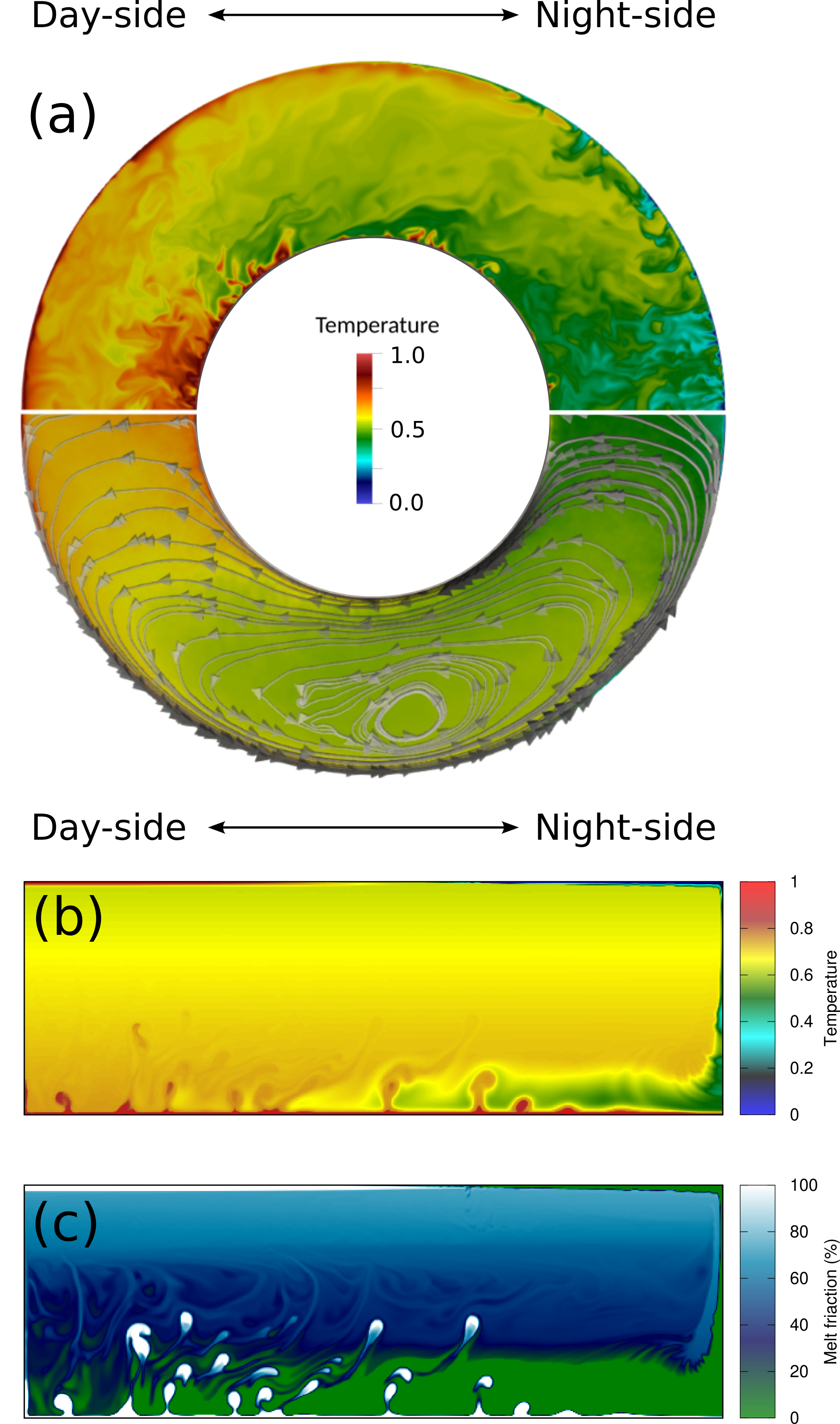
本研究では、2次元および3次元の数値シミュレーションを用いて、内部ダイナミクスと固体-液体分離が溶岩惑星の長期的進化に与える影響を調査し、2つの明確に異なる進化レジームを明らかにした。1つは、重力不安定な夜側クルストが存在する高温で完全に溶融した内部、もう1つは、浅い日側マグマ海洋とナトリウム、カリウム、酸化鉄(II)を欠いた精製された大気を有する冷却された大部分が固体の内部である。これらの状態はジェイムズ・ウェッブ宇宙望遠鏡(JWST)の観測によって区別可能である。
Lava planets are rocky exoplanets that orbit so close to their host star that their day-side is hot enough to melt silicate rock. Their short orbital periods ensure that lava planets are tidally locked into synchronous rotation, with permanent day and night hemispheres. Such asymmetric magma oceans have no analogs in the Solar System and will exhibit novel fluid dynamics. Here we report numerical simulations of lava planet interiors showing that solid-liquid fractionation in the planetary interior has a major impact on the compositional structure and evolution of the planet. We explored two styles of dynamics that depend primarily on the interior thermal state : 1) a hot fully molten interior, and 2) a mostly solid interior with a shallow day-side magma ocean. In the hot interior scenario, the atmosphere reflects the planet's bulk silicate composition and the night-side crust is gravitationally unstable and constantly replenished. In the cool interior scenario, the distilled atmosphere will lack Na, K and FeO, and the night-side mantle is entirely solid, with a cold surface. These two end-member cases can be distinguished with observations from the James Webb Space Telescope, offering an avenue to probe the diversity of terrestrial exoplanet evolutions.
研究の動機と目的
- ヘミスフェアマグマ海洋を有する溶岩惑星の進化を支配する内部ダイナミクスとケイ酸塩マントル内の相転移の役割を理解すること。
- 熱的状態、対流、相転移が惑星の構造と大気組成に与える影響を調査すること。
- 溶岩惑星の長期的進化が、観測可能な差異を示す明確なエンド・メンバー状態に至るかどうかを特定すること。
- 自転、乱流、球対称幾何学的形状が潮汐ロックされた系外惑星におけるマグマ海洋のダイナミクスに与える影響を評価すること。
- 将来のジェイムズ・ウェッブ宇宙望遠鏡(JWST)の観測を用いて、惑星の進化経路を区別するための検証可能な予測を提供すること。
提案手法
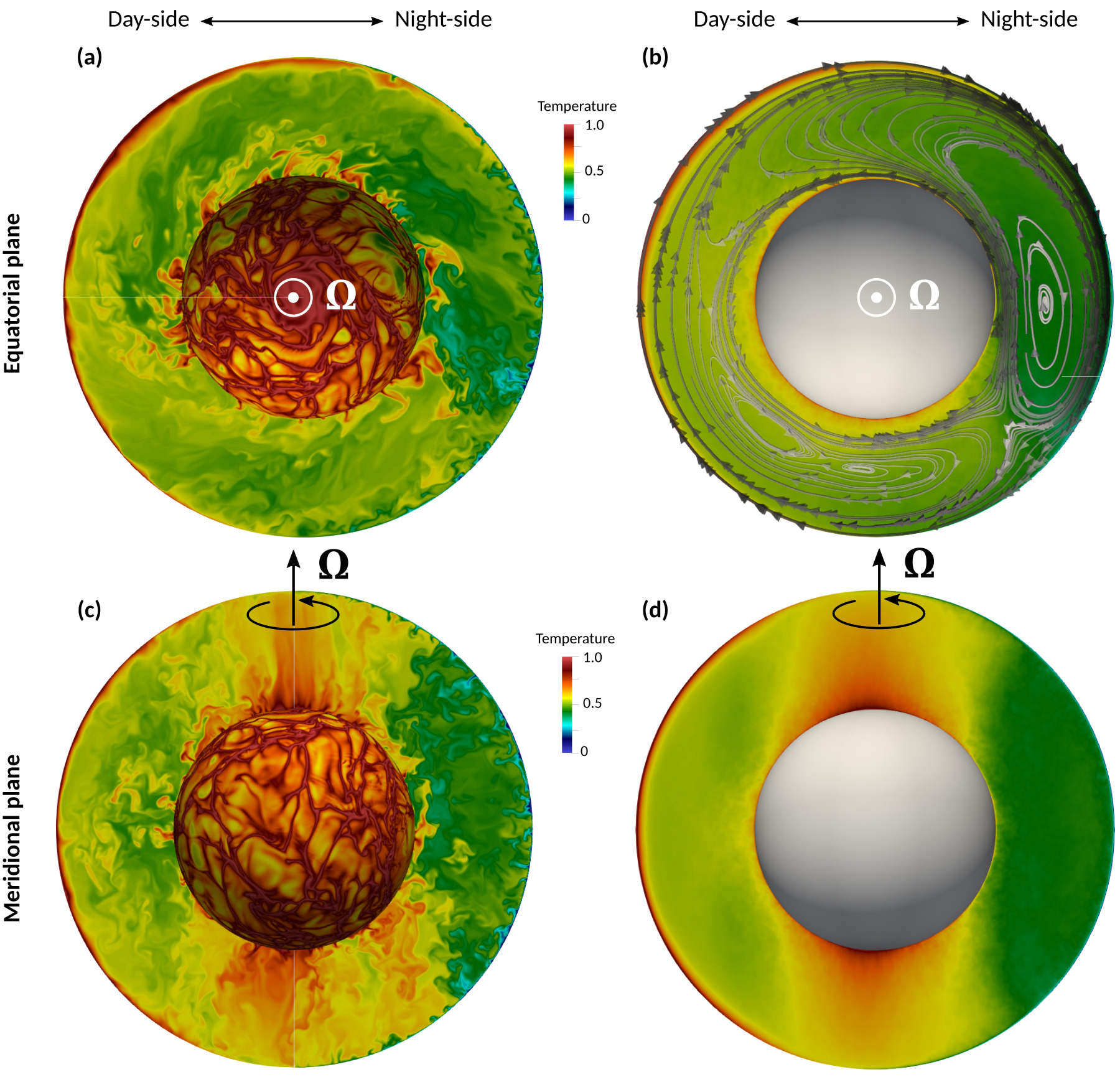
- ボウシーヌス効果近似に基づく回転する球殻内における乱流熱対流をモデル化するため、MagICコードを用いた数値的シミュレーション。
- 恒星放射の影響に基づく不均一な表面温度境界条件の導入。特に、天球の最接近点(子点)が最も高温で、反対側(反対点)が最も低温となるように設定。
- 物理的状態をスケーリングし、浮力と回転の力のバランスを保つために、次元なしパラメータ(レイノルズ数、エクマン数、プラントル数、ロスビー数)を用いる。
- 2つの補完的モデル:球対称幾何学における3次元乱流流動(相変化なし)、および2次元カーテシアンモデル(相変化あり、融解曲線の緩和を含む)。
- 空間離散化にスリップ自由境界条件と、テイラー多項式および球面調和関数を用いた擬スペクトル法を適用。
- 時間積分には、混合クランク・ニコルソン法と2次精度アダムス・バシフォース法を用い、収束を確実にするための長時間積分を実施。
実験結果
リサーチクエスチョン
- RQ1固体-液体相変化の存在が、溶岩惑星のマグマ海洋内における温度分布および対流パターンにどのように影響を与えるか?
- RQ2完全に溶融した内部と、浅い日側マグマ海洋を有する大部分が固体の内部との間で、惑星の構造的特徴および大気組成にどのような主要な差が生じるか?
- RQ3自転と乱流が、潮汐ロックされた溶岩惑星における半球マグマ海洋のダイナミクスに、どの程度の影響を及ぼすか?
- RQ42つのエンド・メンバー進化状態(高温のグローバルマグマ海洋と冷却された固体状態マントル)は、大気組成の観点から区別可能か?
- RQ5次元なしパラメータ(例:ロスビー数)は、回転と対流の相対的寄与度をどのように反映しているか?
主な発見
- 高温で完全に溶融した内部レジームでは、乱流対流が温度を均一化するが、日側と夜側の間に明確な温度対比が残存する。
- 相変化を伴う場合、ケイ酸塩の融解曲線が温度を緩和し、より効果的な熱的均一化をもたらし、超アディアバティック勾配が低減される。
- 高温内部レジームにおける夜側クルストは重力不安定であり、組成的オーバーツールによって連続的に補充される。
- 冷却された内部レジームでは、夜側マントルは完全に固体のままであり、大気はナトリウム、カリウム、酸化鉄(II)といった揮発性元素が枯渇している。
- ロスビー数(Ro_c ≈ 1.6)は、回転効果と浮力力が同等の強さであることを示しており、シミュレーションに回転項を含める正当性が裏付けられる。
- 2つのエンド・メンバー状態は、異なる大気組成を示し、ジェイムズ・ウェッブ宇宙望遠鏡(JWST)による観測による区別が可能である。
より良い研究を、今すぐ始めましょう
論文の読解から最終レビューまで、研究時間を劇的に削減しましょう。
クレジットカード登録不要
このレビューはAIが作成し、人間の編集者が確認しました。