
[論文レビュー] The second data release from the European Pulsar Timing Array: IV. Implications for massive black holes, dark matter and the early Universe
この論文は European Pulsar Timing Array's second data release を分析し、巨大ブラックホール、ダークマター、初期宇宙に関する含意を探る。DR2 が関連する物理をどのように制約するかについて論じる。
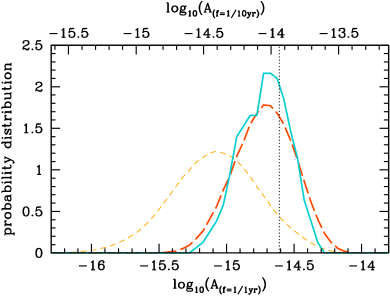
The European Pulsar Timing Array (EPTA) and Indian Pulsar Timing Array (InPTA) collaborations have measured a low-frequency common signal in the combination of their second and first data releases respectively, with the correlation properties of a gravitational wave background (GWB). Such signal may have its origin in a number of physical processes including a cosmic population of inspiralling supermassive black hole binaries (SMBHBs); inflation, phase transitions, cosmic strings and tensor mode generation by non-linear evolution of scalar perturbations in the early Universe; oscillations of the Galactic potential in the presence of ultra-light dark matter (ULDM). At the current stage of emerging evidence, it is impossible to discriminate among the different origins. Therefore, in this paper, we consider each process separately, and investigate the implications of the signal under the hypothesis that it is generated by that specific process. We find that the signal is consistent with a cosmic population of inspiralling SMBHBs, and its relatively high amplitude can be used to place constraints on binary merger timescales and the SMBH-host galaxy scaling relations. If this origin is confirmed, this is the first direct evidence that SMBHBs merge in nature, adding an important observational piece to the puzzle of structure formation and galaxy evolution. As for early Universe processes, the measurement would place tight constraints on the cosmic string tension and on the level of turbulence developed by first-order phase transitions. Other processes would require non-standard scenarios, such as a blue-tilted inflationary spectrum or an excess in the primordial spectrum of scalar perturbations at large wavenumbers. Finally, a ULDM origin of the detected signal is disfavoured, which leads to direct constraints on the abundance of ULDM in our Galaxy.
研究の動機と目的
- European Pulsar Timing Array's second data release が 巨大ブラックホール の理論にどのように情報を提供するかを動機づけ、定量化する。
- パルサー時刻測定データでアクセス可能なダークマターの署名を評価する。
- PTA 観測から導かれる初期宇宙物理の限界を調査する。
提案手法
- European Pulsar Timing Array DR2 データセットを用いて時刻残差を研究する。
- クロスパルサー相関分析を適用して、確率的背景と信号モデルを探る。
- 巨大ブラックホール、ダークマター効果、初期宇宙シナリオの理論モデルを PTA データの解釈に組み込む。
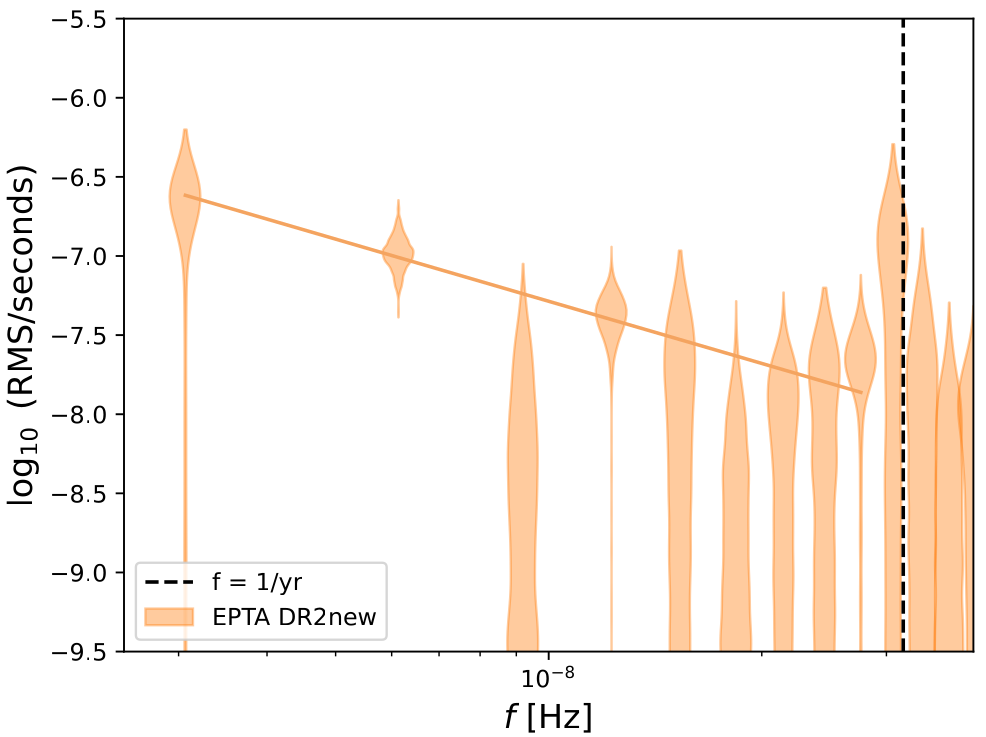
実験結果
リサーチクエスチョン
- RQ1DR2 データセットは、パルサー時刻測定で検出可能な巨大ブラックホールの集団と特性にどのような制約を課しているか。
- RQ2DR2 はパルサー時刻測定に関連するダークマター相互作用や分布の制限や署名をどのように示しているか。
- RQ3DR2 は PTA 観測を通じて初期宇宙モデルにどのような情報を提供するか。
主な発見
- DR2 は PTA 周波数帯における巨大ブラックホールの役割に関する新しい知見を提供する。
- データはパルサー時刻測定におけるダークマター関連効果の最新の見解を提供する。
- PTA の時刻残差と確率的背景の文脈で初期宇宙物理への含意が検討される。
より良い研究を、今すぐ始めましょう
論文設計から論文執筆まで、研究時間を劇的に削減しましょう。
クレジットカード登録不要
このレビューはAIが作成し、人間の編集者が確認しました。