
[論文レビュー] The SN 2023ixf Progenitor in M101: I. Infrared Variability
本研究は、M101銀河に発生したII型超新星SN 2023ixfの前身星における赤外変動を、19年間にわたるスパイitzerおよび地上赤外データを用いて分析する。光曲線に1091±71日周期の周期的変動を特定し、これが脈動不安定性に起因することを示し、前身星の視等級をM_K = -11.58±0.31等と導出し、初期質量が20±4 M☉であると示唆する。これは、現在までに観測された核崩壊型超新星の前身星の中でも最も質量の大きなものの一つである。
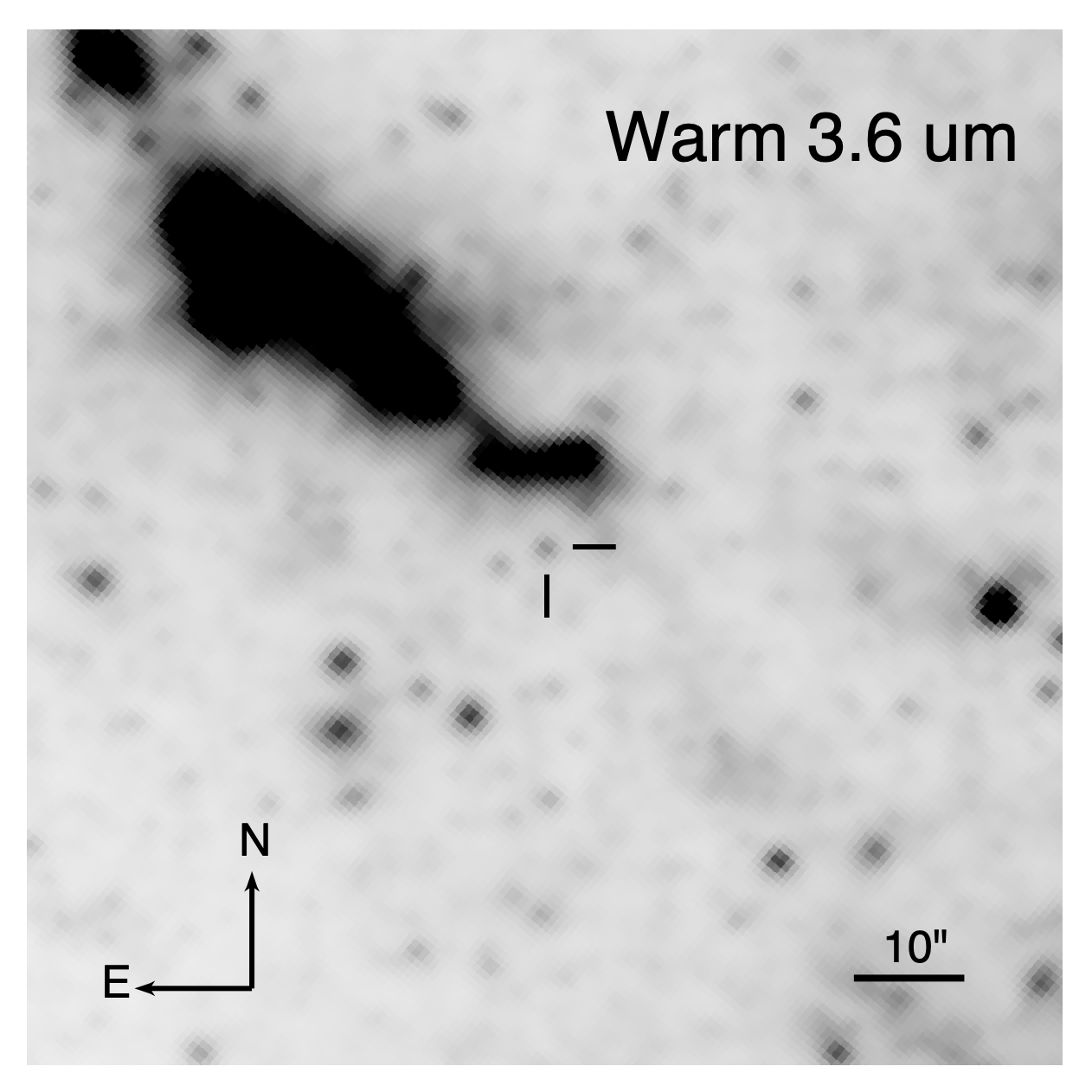
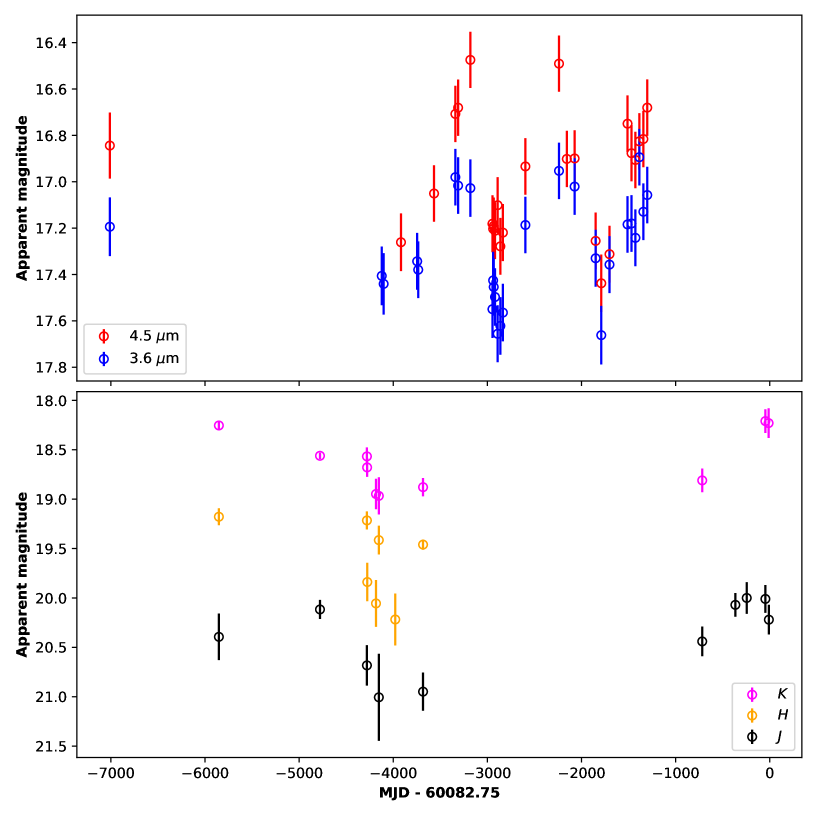
Observational evidence points to a red supergiant (RSG) progenitor for SN 2023ixf. The progenitor candidate has been detected in archival images at wavelengths (>0.6 micron) where RSGs typically emit profusely. This object is distinctly variable in the infrared (IR). We characterize the variability using pre-explosion mid-IR (3.6 and 4.5 micron) Spitzer and ground-based near-IR (JHKs) archival data jointly covering 19 yr. The IR light curves exhibit significant variability with RMS amplitudes in the range of 0.2-0.4 mag, increasing with decreasing wavelength. From a robust period analysis of the more densely sampled Spitzer data, we measure a period of 1091+/-71 days. We demonstrate using Gaussian Process modeling that this periodicity is also present in the near-IR light curves, thus indicating a common physical origin, which is likely pulsational instability. We use a period-luminosity relation for RSGs to derive a value of M_K=-11.58+/-0.31 mag. Assuming a late M spectral type, this corresponds to log(L/L_sun)=5.27+/-0.12 at T_eff=3200 K and to log(L/L_sun)=5.37+/-0.12 at T_eff=3500 K. This gives an independent estimate of the progenitor's luminosity, unaffected by uncertainties in extinction and distance. Assuming the progenitor candidate underwent enhanced dust-driven mass-loss during the time of these archival observations, and using an empirical period-luminosity-based mass-loss prescription, we obtain a mass-loss rate of around (2-4)x10^-4 M_sun/yr. Comparing the above luminosity with stellar evolution models, we infer an initial mass for the progenitor candidate of 20+/-4 M_sun, making this one of the most massive progenitors for a Type II SN detected to-date.
研究の動機と目的
- アーカイブ化されたスパイザーおよび地上赤外データを用いて、SN 2023ixfの前身星の赤外変動を特徴づけること。
- 観測された変動の物理的起源を特定すること、特にそれが脈動不安定性によって駆動されているかどうかを検証すること。
- 距離および赤道外の影響を考慮しない周期-光度関係を用いて、前身星の光度と初期質量を独立に導出すること。
- 経験的周期-光度に基づく手続きを用いて、爆発前の質量放出率を推定すること。
- 質量関係の観点から前身星の初期質量を独立に制約し、大質量星の進化および超新星前身星の統計的特徴の理解を深めること。
提案手法
- 英国赤外望遠鏡(UKIRT)、ジェミーニ・ノース、WFCAMからのJHKsバンドの地上赤外データと、スパイザーのミッド赤外(3.6および4.5 μm)データを19年分統合した。
- スパイザーの高密度サンプリング光曲線に対して、強固な周期解析を実施し、1091±71日という支配的周期を特定した。
- ガウス過程モデリングを近赤外光曲線に適用し、ミッド赤外周期と整合性があるかを検証した。その結果、共通の物理的起源があることが確認された。
- 赤超巨星の周期-光度関係を用いて、M_K = -11.58±0.31 magを導出し、赤道外および距離の影響を排除した。
- T_eff = 3200–3500 Kにおける前身星の光度を推定し、log(L/L☉) = 5.27±0.12 から 5.37±0.12 の範囲を得た。
- 周期と光度に基づく経験的質量放出率のプロトコルを適用し、爆発前の段階で(2–4)×10⁻⁴ M☉ yr⁻¹の質量放出率を推定した。
実験結果
リサーチクエスチョン
- RQ1SN 2023ixfの前身星で観測された赤外変動の性質と起源は何か?
- RQ2ミッド赤外光曲線に観測された周期的変動が近赤外域にも継続的に存在するか。これは共通の物理的メカニズムを示唆するか?
- RQ3赤道外および距離の推定値に依存しない、前身星の固有の光度は何か?
- RQ4脈動周期と光度に基づいて、前身星の初期質量は何か?
- RQ5爆発前の段階での質量放出率は何か。また、その値は星の脈動的性質とどのように関係しているか?
主な発見
- SN 2023ixfの前身星は、波長が短くなるに従い増加する0.2–0.4等のRMS振幅を示す顕著な赤外変動を示している。
- スパイザーのミッド赤外光曲線に、1091±71日という支配的周期が検出され、これは脈動不安定性を示唆している。
- ガウス過程モデリングにより、この周期が近赤外光曲線にも存在することが確認され、共通の物理的起源を支持する。
- 赤超巨星の周期-光度関係を用いて、前身星の絶対的Kバンド等級がM_K = -11.58±0.31等と導出された。
- 前身星の光度は、T_eff = 3200 Kのときlog(L/L☉) = 5.27±0.12、T_eff = 3500 Kのとき5.37±0.12に相当し、赤道外および距離の影響を排除した。
- 星の進化モデルから、初期質量が20±4 M☉であると示唆され、これはII型超新星の前身星として観測された中で最も質量の大きなものの一つである。
より良い研究を、今すぐ始めましょう
論文の読解から最終レビューまで、研究時間を劇的に削減しましょう。
クレジットカード登録不要
このレビューはAIが作成し、人間の編集者が確認しました。