
[論文レビュー] The $z \gtrsim 9$ galaxy UV luminosity function from the JWST Advanced Deep Extragalactic Survey: insights into early galaxy evolution and reionization
この論文は JWST/JADES を用いて z>9 で rest-frame UV ラ luminosity function を推定し、Muv ~ -17 に到達、明るい端の過剰と微弱端の急 steep slope を見出し、初期銀河の進化と再電離への影響を示す。
The high-redshift UV luminosity function provides important insights into the evolution of early galaxies. JWST has revealed an unexpectedly large population of bright ($M_\mathrm{UV} \lesssim -20$) galaxies at $z\gtrsim10$, implying fundamental changes in the star forming properties of galaxies at increasingly early times. However, constraining the fainter population ($M_\mathrm{UV} \gtrsim -18$) has been more challenging. In this work, we present the $z\gtrsim9$ UV luminosity function from the JWST Advanced Deep Extragalactic Survey. We calculate the UV luminosity function from several hundred $z\gtrsim9$ galaxy candidates that reach UV luminosities of $M_\mathrm{UV}\sim-17$ in redshift bins of $z\sim9-12$ (309 candidates) and $z\sim12-16$ (63 candidates). We search for candidates at $z\sim16-22.5$ and find none. We also estimate the $z\sim14-16$ luminosity function from the $z\geq14$ subset of the $z\sim12-16$ sample. Consistent with other measurements, we find an excess of bright galaxies that is in tension with many theoretical models, especially at $z\gtrsim12$. However, we also find high number densities at $-18\lesssim M_\mathrm{UV} \lesssim-17$, suggesting that there is a larger population of faint galaxies than expected, as well as bright ones. From our parametric fits for the luminosity function, we find steep faint end slopes of $-2.5\lesssimα\lesssim-2.3$, suggesting a large population of faint ($M_\mathrm{UV} \gtrsim -17$) galaxies. Combined, the high normalization and steep faint end slope of the luminosity function could imply that the reionization process is appreciably underway as early as $z=10$.
研究の動機と目的
- JWST/NIRCam 画像 from JADES を用いて z>9 の rest-frame UV ラン luminosity function を制約する。
- -17 程度までの微弱端領域を Probe し、全体の銀河集団を理解する。
- 宇宙再電離への意味を持つ UV 光度密度の進化を評価する。
- 観測と理論的銀河形成モデルを比較して緊張点と可能な説明を特定する。
- LF 測定に基づく再電離過程が進行中の赤方偏移範囲を特徴づける。
提案手法
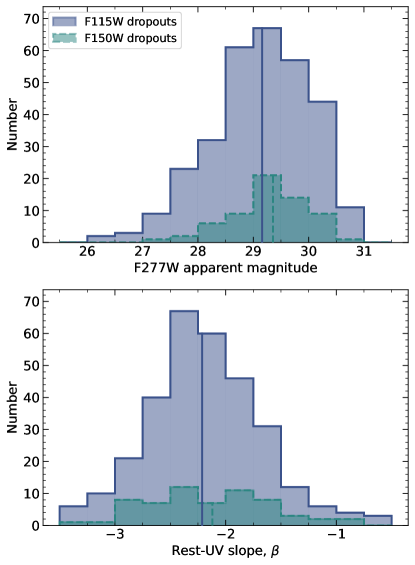
- F115W, F150W, F200W での photometric dropout 選択により z~9-17 銀河候補を同定。
- BEAGLE スペクトルエネルギー分布適合により photometric redshifts と確率的赤方偏移後方分布を推定。
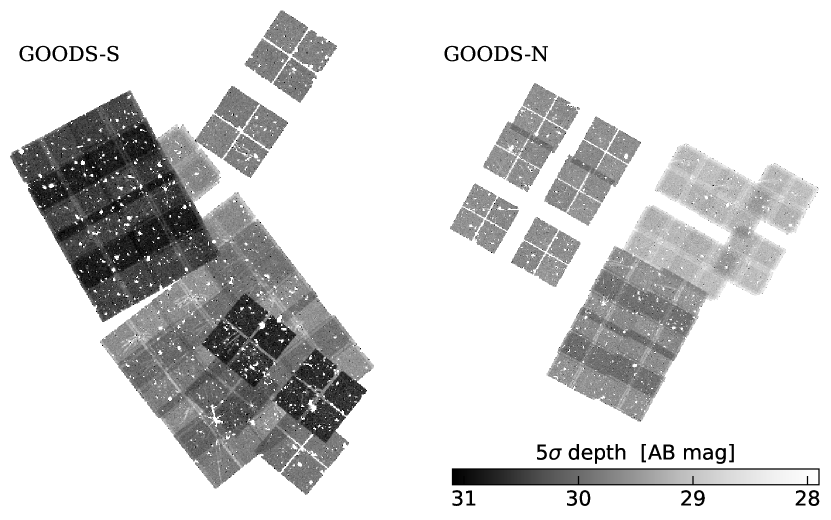
- 8 個の JWST/NIRCam フィルター(F090W–F444W)を用いて rest-frame UV 光度測度と LF を構築。
- 赤方偏移区分 z~9-12 および z~12-16 で UV ライ luminosity function を計算し z>16 で上限を設定。
- 赤方偏移とともに rest-UV 輝度密度の進化を推定。
- 深さと調査領域の変動を組み込み、LF の微弱端を制約。
実験結果
リサーチクエスチョン
- RQ1z~9-12 および z~12-16 での rest-frame UV luminosity function の形状と正規化はどのようか。
- RQ2理論モデルと比較して z>12 で明るい銀河の過剰はあるのか、初期星形成に何を示すのか。
- RQ3z>9 での UV LF の微弱端の勾配 α はいくつか、微弱銀河は UV 輝度密度を支配しているのか。
- RQ4より高い赤方偏移に向けた UV 輝度密度の進化はどのようで、宇宙再電離の時系列にどのような影響をもつのか。)
主な発見
- z>12 における明るい銀河の過剰は多くの理論モデルと対立している。
- -18 ≲ Muv ≲ -17 の高い数密度が存在し、微弱銀河集団が substantial であることを示す。
- パラメトリック適合は急な微弱端の勾配を示し、-2.5 ≲ α ≲ -2.3、Muv ≳ -17ほどの多くの微弱銀河を示唆。
- 高い正規化と急な微弱端の勾配の組み合わせは z ≈ 10 で再電離が進行中である可能性を示唆。
- z~16-22.5 の候補は見られず、これらの赤方偏移で UV LF の上限を設定。
- z>9 の結果は z~13 まで明るい銀河の緩やかな進化と一致し、幅広い輝度が UV 輝度密度に寄与することを示す。
より良い研究を、今すぐ始めましょう
論文設計から論文執筆まで、研究時間を劇的に削減しましょう。
クレジットカード登録不要
このレビューはAIが作成し、人間の編集者が確認しました。