
[論文レビュー] Thermal Conductivity Predictions with Foundation Atomistic Models
この論文は、基盤となる機械学習ポテンシャルとウェグナー形式の熱輸送を組み合わせたフレームワークを提案し、第一原理レベルの精度を低コストで実現可能な形で、 diverse solids の非調和振動特性と熱伝導率を予測する。さらに精度を高めるためのファインチューニングも含む。mp-fMLPをDFTデータとベンチマークテストし、WTEが正確な伝導予測においていつどのように必須になるかを示す。
Advances in machine learning have led to the development of foundation models for atomistic materials chemistry, enabling quantum-accurate descriptions of interatomic forces across chemically diverse compounds at reduced computational cost. Hitherto, the accuracy and utility of these models have been assessed relying on descriptors based on formation energies or idealized harmonic atomic vibrations. Yet, the rigorous and physically interpretable quantification of their capability to describe both realistic anharmonic atomic dynamics and technologically relevant observables remains a pressing problem. Here, we address this problem, leveraging the Wigner formulation of heat transport and the Grüneisen approach to thermal expansion to connect the atomic-physics awareness of foundation models to their utility in predicting experimentally observable thermomechanical properties, presenting standards and fine-tuning protocols needed to achieve first-principles accuracy. We apply our framework to a database of 103 solids with diverse compositions and structures, demonstrating that it overcomes the major bottlenecks of current methods for designing heat-management materials -- high cost, limited transferability, or lack of physics awareness -- and its potential to discover materials for next-gen technologies ranging from thermal insulation to neuromorphic computing.
研究の動機と目的
- ファウンデーションMLポテンシャル(fMLP)を用いて非調和振動特性と熱特性の第一原理レベルの精度を予測可能にする Motivate and enable first-principles accuracy in predicting anharmonic vibrational and thermal properties using foundation ML potentials (fMLPs).
- 伝導予測の精度とコストのトレードオフを評価するベンチマークと指標を開発する。
- ゼロショットのfMLP予測が性能不足の場合に高精度を達成するためのファインチューニング手順を提供する。
- 多様な固体データベース上でフレームワークを紹介し、熱管理材料の発見可能性を示す。
提案手法
- 近似的に普遍的な化学空間で訓練されたfMLPを用いて、調和的および三次の非調和振動特性を取得する。
- Wigner輸送方程式(WTE)を用いて、粒子様成分と波動様成分を組み合わせた熱伝導率を計算する。
- phononDB-PBEデータベースの103化合物について、DFT-PBE参照データとゼロショットのfMLP予測をベンチマークする。
- 微視的および巨視的な精度を定量化するために、対称相対誤差(SRE)と対称相対平均誤差(SRME)といった精度指標を導入する。
- LiBrを用いたDFT-PBEフレームセットを用いたファインチューニング手順を適用し、第一原理レベルの精度に達することを示す。
実験結果
リサーチクエスチョン
- RQ1基盤MLポテンシャルは、多様な材料において量子レベルの非調和振動特性と熱伝導率を予測できるか。
- RQ2fMLPからの伝導予測の物理 drivenness 精度を正確に反映するベンチマークと指標は何か。
- RQ3波動要素が顕著な材料において、ウェグナー熱輸送フレームワークはボルツマン輸送と比較してどのような差を示すか。
- RQ4少ない追加データとコストでmp-fMLPsをファインチューニングして第一原理精度を達成できるか。
- RQ5半古典的BTEが失敗する材料はどれで、WTEフレームワークの方が適しているか。
主な発見
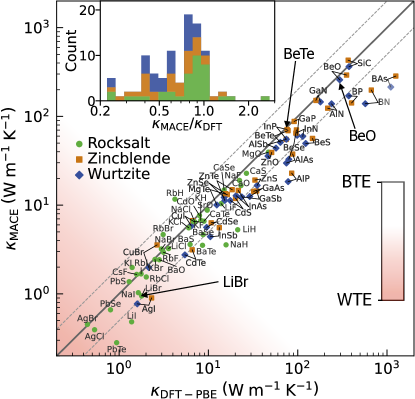
- ゼロショットの mp-fMLPs(MACE-MP-0、SevenNet、CHGNet、M3GNet)は、phononDB-PBE の103化合物のうち約69%について、300 Kの伝導率をDFT-PBEの約2倍程度の精度で予測する。
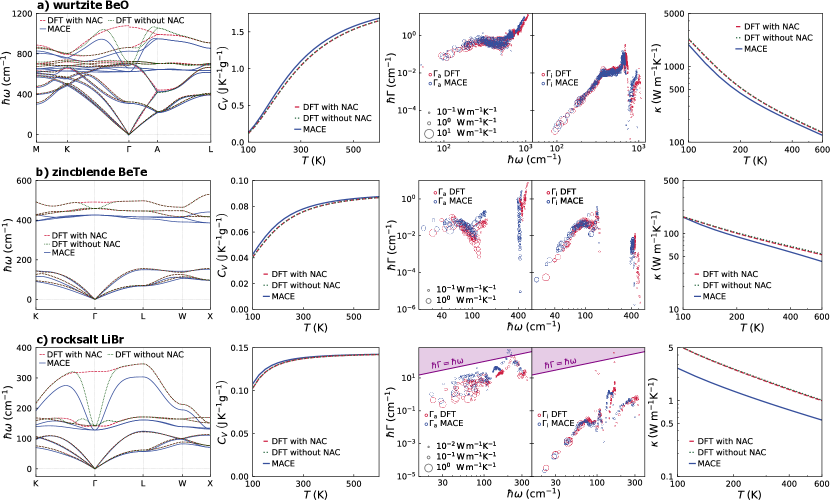
- 伝導率の乖離は高周波フォノンの過小評価から生じることがあり、材料によって誤差の相殺により緩和または補正されることがある。
- WTEフレームワークは、粒子様伝導と波動様伝導の両方を捉え、特にBTEが低伝導率で熱輸送を適切に記述できない材料にとって不可欠である。
- LiBrを小規模でターゲットを絞ったDFT-PBEフレームセット(3フレーム)でファインチューニングすると、300 KでDFT-PBEの2%以内の伝導率予測が得られ、フォノンおよびライン幅予測が改善される。
- ファインチューニング済みモデルを用いた100–800 Kでの予測は、実験的トレンドとaiMDベンチマークと一致し、物理意識的アプローチを検証する。
より良い研究を、今すぐ始めましょう
論文設計から論文執筆まで、研究時間を劇的に削減しましょう。
クレジットカード登録不要
このレビューはAIが作成し、人間の編集者が確認しました。