
[論文レビュー] Time-Varying Graph Mode Decomposition
本稿では、時間変動するグラフ信号を、時間、周波数、トポロジカル構造の各側面で振動成分を捉える複数のグラフモードに分解するデータ駆動型変分最適化手法を提案する。ADMMおよびプライマル・デュアル最適化を用いて時間的・スペクトル的・グラフベースの制約を統合することで、多スケールの機能的結合性と信号ダイナミクスの共同解析が可能となり、EEG、電力消費、産業プロセスのデータに対して実証された。
Time-varying graph signals are alternative representation of multivariate (or multichannel) signals in which a single time-series is associated with each of the nodes or vertex of a graph. Aided by the graph-theoretic tools, time-varying graph models have the ability to capture the underlying structure of the data associated with multiple nodes of a graph -- a feat that is hard to accomplish using standard signal processing approaches. The aim of this contribution is to propose a method for the decomposition of time-varying graph signals into a set of graph modes. The graph modes can be interpreted in terms of their temporal, spectral and topological characteristics. From the temporal (spectral) viewpoint, the graph modes represent the finite number of oscillatory signal components (output of multiple band-pass filters whose center frequencies and bandwidths are learned in a fully data-driven manner), similar in properties to those obtained from the empirical mode decomposition and related approaches. From the topological perspective, the graph modes quantify the functional connectivity of the graph vertices at multiple scales based on their signal content. In order to estimate the graph modes, a variational optimization formulation is designed that includes necessary temporal, spectral and topological requirements relevant to the graph modes. An efficient method to solve that problem is developed which is based on the alternating direction method of multipliers (ADMM) and the primal-dual optimization approach. Finally, the ability of the method to enable a joint analysis of the temporal and topological characteristics of time-varying graph signals, at multiple frequency bands/scales, is demonstrated on a series of synthetic and real time-varying graph data sets.
研究の動機と目的
- 動的データにおける複雑なチャネル間結合パターンを捉えることのできない従来の多次元信号分解手法の限界を克服すること。
- 時間変動するグラフ信号におけるグラフ信号処理とデータ駆動型ハーモニック解析を統合すること。
- 時間領域およびグラフ領域における事前定義された基底関数を必要としない、完全にデータ駆動型の方法を構築すること。
- 複数の周波数スケールにおける時間的ダイナミクスとトポロジカル構造の共同解析を可能にすること。
- 不規則なネットワーク化データにおける振動成分とその機能的結合性を同定するフレームワークを提供すること。
提案手法
- グラフモードに時間帯域幅、スペクトル局在性、トポロジカルスムージングの制約を組み込んだ変分最適化問題を定式化する。
- 非凸最適化問題を効率的に解くために、プライマル・デュアル前進後退フォワード・アルゴリズムを用いる。
- 問題を扱いやすい部分問題に分解するため、交替方向乗数法(ADMM)を適用する。
- グラフラプラシアン行列と隣接行列を用いて、モードのグラフ測地線に沿ったスムージングを強制する。
- データ駆動的に完全な信号再構成とバンド制限付きの振動成分を制約する。
- 近接作用素と勾配ステップを用いて、最適化プロセスにおいてプライマル変数とデュアル変数を反復的に更新する。
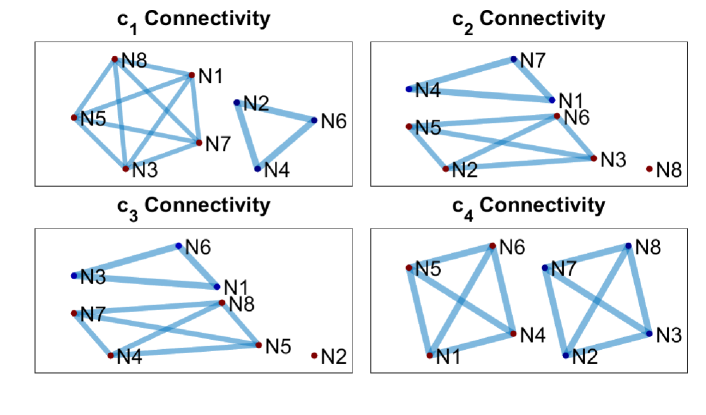
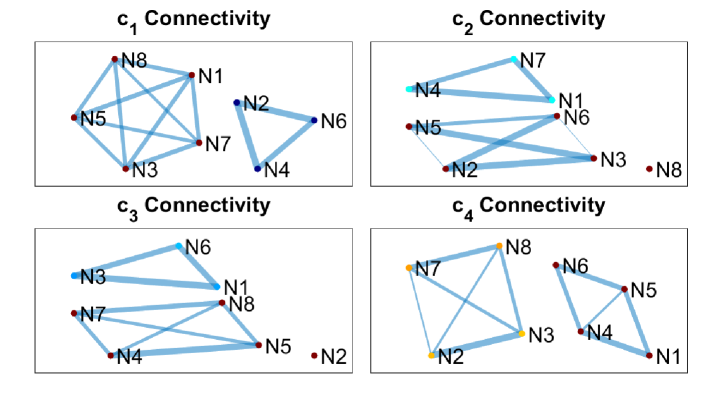
実験結果
リサーチクエスチョン
- RQ1データ駆動型分解手法は、トポロジカル構造を保持したまま、時間変動するグラフ信号からの振動成分を抽出できるか?
- RQ2時間的・スペクトル的・トポロジカル特性を統一的なフレームワーク内でどのように共同でモデル化できるか?
- RQ3提案手法は、実世界のデータにおいて、異なる周波数帯域における機能的結合パターンをどの程度局在化できるか?
- RQ4グラフベースの結合性を用いて、休息状態EEGからアルファ波を正しく分離できるか?
- RQ5エネルギー消費や産業プロセスのような非定常系において、動的結合パターンを同定する能力はいかがなものか?
主な発見
- 本手法は、休息状態EEGデータからアルファ波を正しく分離し、頭頂部および頭後部脳領域におけるその発生源を的確に局在化した。
- 電力消費データにおいて、明確なマルチスケール結合パターンを明らかにし、異なる時間スケールでのユーザー単位のエネルギー使用状況の分析を可能にした。
- フラクショネーションプラントのデータセットに対して、意味のある結合性グラフを生成し、セルグループ化を支援することで故障診断に貢献した。
- 事前仮定のない状態で、完全な信号再構成とバンド制限付きの振動成分の分離を達成した。
- プライマル・デュアルに基づくADMMソルバーは、合成データおよび実世界データにおいて信頼性高く収束し、ロバスト性とスケーラビリティを示した。
- 時間的ダイナミクスとトポロジカル相互作用の両方を同時に捉える点で、標準的な多次元分解手法を上回った。
より良い研究を、今すぐ始めましょう
論文の読解から最終レビューまで、研究時間を劇的に削減しましょう。
クレジットカード登録不要
このレビューはAIが作成し、人間の編集者が確認しました。