
[論文レビュー] Topological Mixed Valence Model for Twisted Bilayer Graphene
この論文は、マジック角ツイスト二層グラフェンの Song–Bernevig トポロジカル heavy fermion 像を混合価値アンダーソン格子として再定式化し、高エネルギー・低エネルギーの Kondo 格子挙動を分析し、ドーピング・格子振動(フォノン)による混成化への renormalization 効果を議論する。
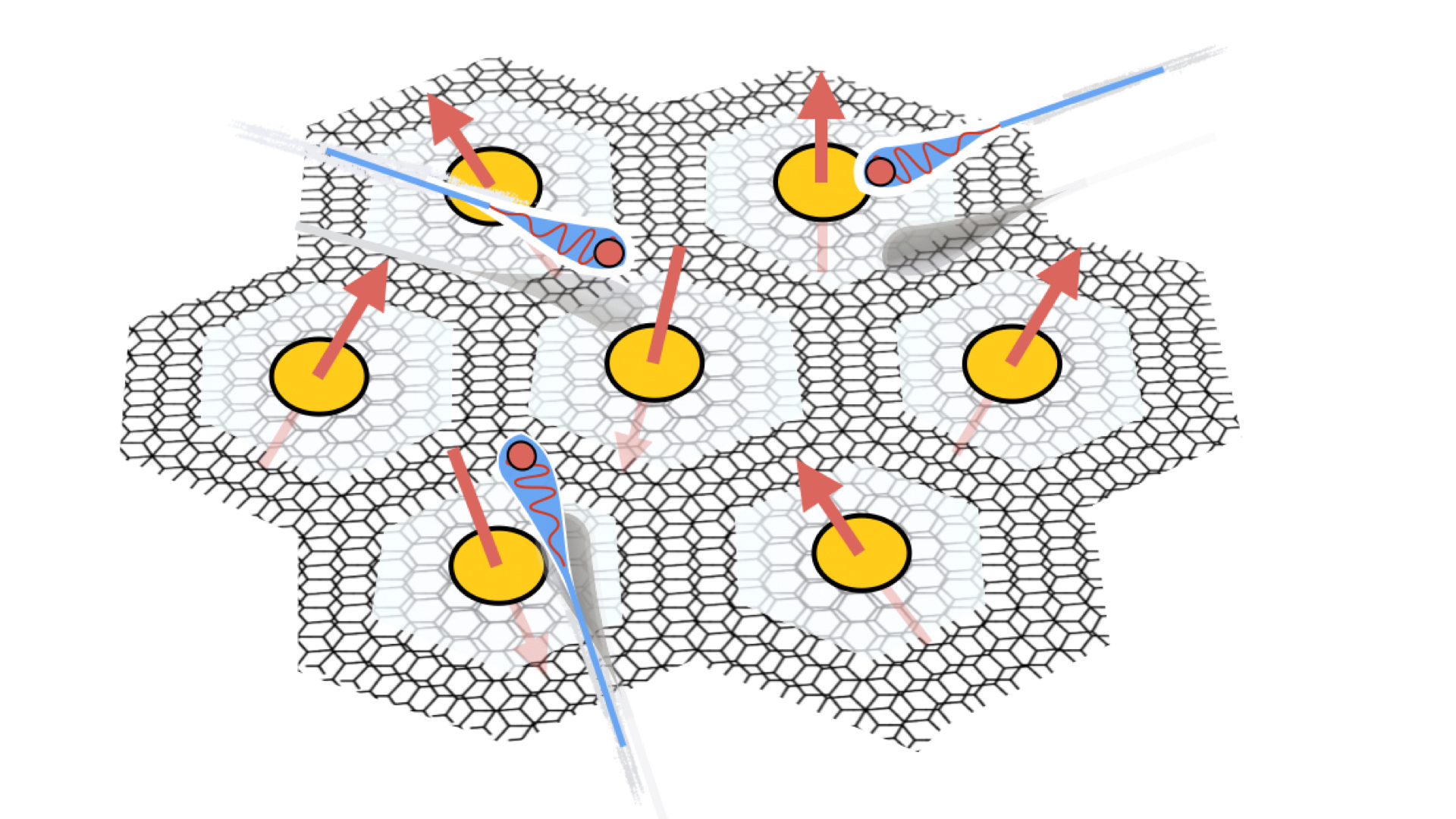
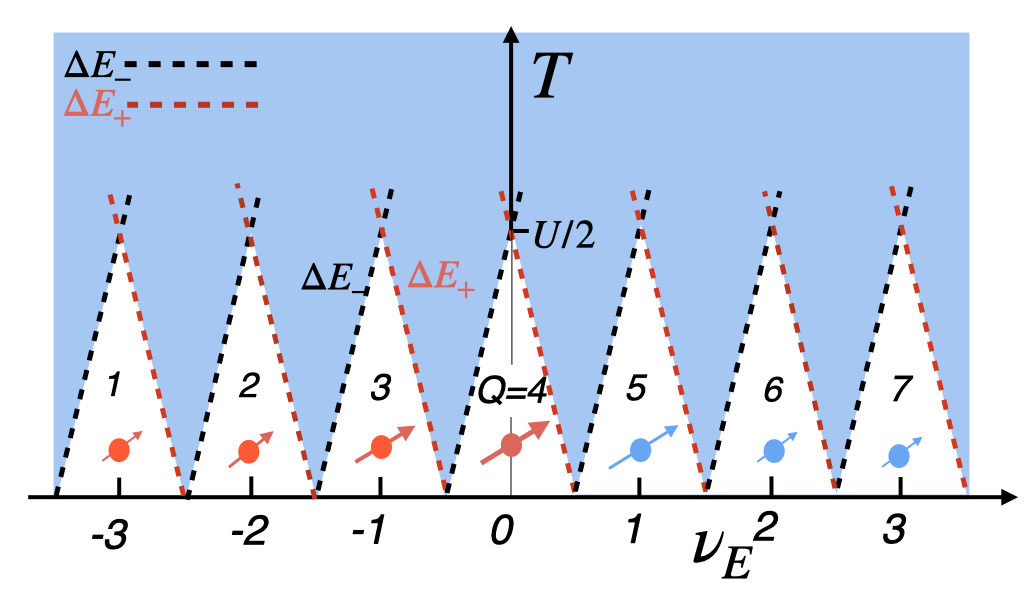
Song and Bernevig (SB) have recently proposed a topological heavy fermion description of the physics of magic angle twisted bilayer graphene (MATBG), involving the hybridization of flat band electrons with a relativistic conduction sea. We explore the consequences of this model, seeking a synthesis of understanding drawn from heavy fermion physics and MATBG experiments. We identify a key discrepancy between measured and calculated onsite Coulomb interactions, implicating renormalization effects that are not contained in the current model. With these considerations in mind, we consider an SB model with a single, renormalized onsite interaction between the f-electrons, containing a phenomenological heavy fermion binding potential on the moiré AA-sites. This feature allows the simplified model to capture the periodic reset of the chemical potential with filling and the observed stability of local moment behavior. We argue that a two stage Kondo effect will develop in MATBG as a consequence of the relativistic conduction band: Kondo I occurs at high temperatures, establishing a coherent hybridization at the $Γ$ points and a non-Fermi liquid of incoherent fermions at the moiré K-points; at much low temperatures Kondo II leads to a Fermi liquid in the flat band. Utilizing an auxiliary-rotor approach, we formulate a mean-field treatment of MATBG that captures this physics, describing the evolution of the normal state across a full range of filling factors. By contrasting the relative time-scales of phonons and valence fluctuations in bulk heavy fermion materials with that of MATBG we propose a valley-polaron origin to the Coulomb renormalization and the heavy fermion binding potential identified from experiment. We also discuss the possibility that the two-fluid, non-Fermi liquid physics of the relativistic Kondo lattice is responsible for the strange metal physics observed in MATBG.
研究の動機と目的
- MATBGをリアルスペースで、局所モーメントと対称性異常を捉えるトポロジカルな記述で動機づける。
- Song–Bernevigモデルをバリュエンス変動を持つアンダーソン格子として再定式化する。
- 高エネルギーの U(8) および低エネルギーの U(4) Kondo格子挙動とそれらが帶帯構造に与える影響を分析する。
- エネルギーと充填に対する混成化とハバード帯幅がどのようにスケールするかを予測し、フォノンによる renormalization 効果を論じる。
提案手法
- Song–Bernevig ハミルトニアンを、局所 f 様の Wannier 状態とトポロジカルな c バンドを組み合わせて出発点とする。
- 混成化 H_fc を強さ γ0 と φ^(η)(k, γ0) という形因子で定義し、f 部分と c 部分を結ぶ。
- 価電子変動を混合価値 (b, t) ボソン表現へマッピングし、Anderson 格子作用を導出する。
- 価電子変動の平均場近似を行い、SU(8) の軌道を持つトポロジカル Kondo 格子を導出する。
- Doniach 型の Kondo スクリーニング (T_K) と RKKY (T_RKKY) の対立を論じ、整数充填周辺の相図を概説する。
実験結果
リサーチクエスチョン
- RQ1SB のトップological heavy fermion 像を MATBG に対して混合価値アンダーソン格子として再構成できるか?
- RQ2価電子変動と混成化は低エネルギーのバンド構造と局所モーメント形成にどのような影響を与えるか?
- RQ3充填に対するエネルギースケール(Kondo、RKKY、Hubbard)は何であり、それらは整数充填の周辺で相図をどのように組織するか?
- RQ4bare hybridization γ0 はフォノン(ポラロン)効果で再正規化されて、局所モーメントの観測結果を説明できるか?
- RQ5高エネルギー(U)および低エネルギー(Kondo)リミットは SU(8) から SU(4) のKondo格子描写へ写像されるか?
主な発見
- 伝導海との相互作用は高エネルギーで U(8) Kondo格子、低エネルギーで U(4) Kondo格子として振る舞う。
- 基礎となる混成化スケールとハバード帯幅は、エネルギーに対して線形にスケールする(μ ~ Uν および状態密度を介して)。
- SBモデルで予測される裸の混成化 γ0 は、整数充填で観測される局所モーメント挙動を説明するには大きすぎる。フォノン駆動の再正規化を示唆する。
- 混合価値型の定式は、SU(8) の複合体を持つトップロジカル Kondo 格子と、調整可能な Kondo スケール T_K を提示し、RKKY 相互作用と競合する。
- この研究は、磁気的谷-スピン相、重いフェルミ液体領域、そして Song–Bernevig Fermi 液体の弱結合領域の可能性を含む Doniach 型相図を予期している。
より良い研究を、今すぐ始めましょう
論文設計から論文執筆まで、研究時間を劇的に削減しましょう。
クレジットカード登録不要
このレビューはAIが作成し、人間の編集者が確認しました。