
[論文レビュー] Towards Unifying Medical Vision-and-Language Pre-training via Soft Prompts
本稿では、学習可能で可変可能な視覚的・言語的ソフトプロンプトを用いて、単一のモデルが画像のみ、テキストのみ、画像・テキストペアの入力を処理できる統合型医療ビジョン・言語前処理フレームワークであるPTUnifierを提案する。融合エンコーダとデュアルエンコーダの両アプローチの目的関数を統合し、スケーラビリティを高めるためにプロンプトプールを導入することで、タスク固有の適応なしに、単モodal、クロスモーダル、マルチモーダルな医療タスクで最先端の性能を達成する。
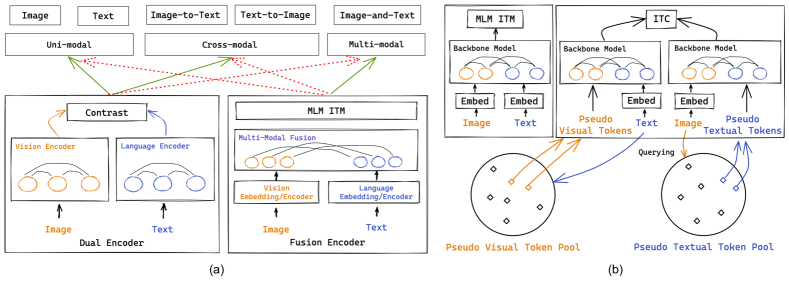
Medical vision-and-language pre-training (Med-VLP) has shown promising improvements on many downstream medical tasks owing to its applicability to extracting generic representations from medical images and texts. Practically, there exist two typical types, extit{i.e.}, the fusion-encoder type and the dual-encoder type, depending on whether a heavy fusion module is used. The former is superior at multi-modal tasks owing to the sufficient interaction between modalities; the latter is good at uni-modal and cross-modal tasks due to the single-modality encoding ability. To take advantage of these two types, we propose an effective yet straightforward scheme named PTUnifier to unify the two types. We first unify the input format by introducing visual and textual prompts, which serve as a feature bank that stores the most representative images/texts. By doing so, a single model could serve as a extit{foundation model} that processes various tasks adopting different input formats ( extit{i.e.}, image-only, text-only, and image-text-pair). Furthermore, we construct a prompt pool (instead of static ones) to improve diversity and scalability. Experimental results show that our approach achieves state-of-the-art results on a broad range of tasks, spanning uni-modal tasks ( extit{i.e.}, image/text classification and text summarization), cross-modal tasks ( extit{i.e.}, image-to-text generation and image-text/text-image retrieval), and multi-modal tasks ( extit{i.e.}, visual question answering), demonstrating the effectiveness of our approach. Note that the adoption of prompts is orthogonal to most existing Med-VLP approaches and could be a beneficial and complementary extension to these approaches.
研究の動機と目的
- 既存の医療ビジョン・言語前処理モデルが、融合エンコーダ型またはデュアルエンコーダ型のいずれかに限定されており、特定のタスクタイプでは優れた性能を発揮するが、両方を同時に満たせないという限界を解決すること。
- 融合エンコーダとデュアルエンコーダの能力を統合し、画像のみ、テキストのみ、画像・テキストペアの入力形式をすべて対応できる、統一的かつ互換性のあるアーキテクチャを構築すること。
- 各モダリティごとの静的プロンプトではなく、プロンプトプールを導入することで、モデルのスケーラビリティと表現の多様性を向上させること。
- アーキテクチャ的・タスク固有の変更なしに、単モダリティ(例:画像/テキスト分類)、クロスモーダル(例:リtrieval)、マルチモーダル(例:VQA)タスクにおいて、効果的に性能を発揮できるようにすること。
- 既存のMed-VLP手法とは直交的かつ補完的であり、アーキテクチャの再設計なしに、より広範な適用性を高められる軽量でアーキテクチャに依存しない拡張手法を提供すること。
提案手法
- 画像のみ、テキストのみ、画像・テキストペアの入力を、視覚的・言語的ソフトプロンプトを用いて統一的な入力形式に変換し、共通の表現空間に統合すること。
- 入力タイプに応じて動的に選択可能な、モダリティ固有のプロンプトプール(視覚的および言語的)を構築し、代表的な埋め込みを格納すること。
- 融合エンコーダの目的関数(マスク言語モデル化(MLM)と画像・テキストマッチング(ITM))と、デュアルエンコーダの目的関数(画像・テキスト対照(ITC))を組み合わせて、統合モデルを事前学習すること。
- プロンプトプールを用いて、モダリティ固有のインダクティブバイアスを注入することで、同じバックボーンモデルがアーキテクチャの変更なしに異なる入力タイプに適応可能になるようにすること。
- 汎用的な表現を学習するために、大規模な医療データセット3つ(ROCO、MedICaT、MIMIC-CXR)を用いて学習すること。
- 特定のタスクに特化した微調整なしに、さまざまなタスクに統合モデルを適用し、プロンプトベースの適応と共有表現学習に依存すること。
実験結果
リサーチクエスチョン
- RQ1統一フレームワークを用いて、単一の医療ビジョン・言語前処理モデルが、画像のみ、テキストのみ、画像・テキストペアの入力を効果的に処理できるか?
- RQ2融合エンコーダとデュアルエンコーダの両アプローチの目的関数を統合することで、多様な医療ビジョン・言語タスクにおける性能が向上するか?
- RQ3静的プロンプトと比較して、プロンプトプール機構がモデルのスケーラビリティと表現の多様性を向上させるか?
- RQ4本手法が、単モダリティ、クロスモーダル、マルチモーダルのベンチマークにおいて、タスク固有のモデルや既存のMed-VLP手法をどれほど上回るか?
- RQ5本手法が既存のMed-VLPアーキテクチャと直交的かつ補完的であり、アーキテクチャの再設計なしに、より広範な適用性を有するか?
主な発見
- PTUnifierは、評価されたすべてのタスクで最先端の性能を達成し、画像分類(CheXpertで88.7% AUROC)、テキスト分類(89.0% AUROC)、マルチモーダルVQA(80.0%正答率)で優れた結果を示した。
- MLM、ITM、ITCのすべての目的関数を用いて事前学習したモデルが、すべてのベンチマークで最高の性能を発揮し、融合エンコーダとデュアルエンコーダの目的関数を統合することで相乗効果が得られることを示した。
- MIMIC-CXRデータセットでは、オープンエンドドVQAで84.6%の正答率、クローズドエンドドVQAで78.3%の正答率を達成し、R2Gen や WGSum などの先行手法を上回った。
- 学習データの1%のみを用いても、ITC目的関数で事前学習したモデルはクローズドエンドドVQAで10.7%の正答率を達成し、優れた少データ一般化能力を示した。
- ITC目的関数は、ビジョンオンリータスクおよびクロスモーダルタスクの性能を顕著に向上させるが、テキストオンリータスク分類には向上効果がないことから、モダリティ間で非対称な監視が行われていることが示唆された。
- アブレーションスタディの結果、MLM、ITM、ITCの目的関数を併用することで、最も優れた転移性能が得られ、両アーキテクチャの統合が有効であることが裏付けられた。
より良い研究を、今すぐ始めましょう
論文の読解から最終レビューまで、研究時間を劇的に削減しましょう。
クレジットカード登録不要
このレビューはAIが作成し、人間の編集者が確認しました。