
[論文レビュー] Transparency and Privacy: The Role of Explainable AI and Federated Learning in Financial Fraud Detection
本論文は、金融機関におけるデータの機微性とモデルの透明性を課題とする、フェデレーテッドラーニング(FL)に基づく不正検出システムを提案する。顧客データを中央集権的に共有せず、各銀行のデータをローカルで学習し、暗号化されたモデル更新のみを共有することで、プライバシーを保持しつつ、希少な不正取引を93%の正確性で検出する。SHAP分析により、解釈可能で信頼できる予測が可能となる。
Fraudulent transactions and how to detect them remain a significant problem for financial institutions around the world. The need for advanced fraud detection systems to safeguard assets and maintain customer trust is paramount for financial institutions, but some factors make the development of effective and efficient fraud detection systems a challenge. One of such factors is the fact that fraudulent transactions are rare and that many transaction datasets are imbalanced; that is, there are fewer significant samples of fraudulent transactions than legitimate ones. This data imbalance can affect the performance or reliability of the fraud detection model. Moreover, due to the data privacy laws that all financial institutions are subject to follow, sharing customer data to facilitate a higher-performing centralized model is impossible. Furthermore, the fraud detection technique should be transparent so that it does not affect the user experience. Hence, this research introduces a novel approach using Federated Learning (FL) and Explainable AI (XAI) to address these challenges. FL enables financial institutions to collaboratively train a model to detect fraudulent transactions without directly sharing customer data, thereby preserving data privacy and confidentiality. Meanwhile, the integration of XAI ensures that the predictions made by the model can be understood and interpreted by human experts, adding a layer of transparency and trust to the system. Experimental results, based on realistic transaction datasets, reveal that the FL-based fraud detection system consistently demonstrates high performance metrics. This study grounds FL's potential as an effective and privacy-preserving tool in the fight against fraud.
研究の動機と目的
- 中央集権的なデータ共有が規制的・機関的制約に反するため、金融不正検出におけるデータの機微性の課題に対処すること。
- 不正取引が希少であるため検出が困難な取引データセットにおけるクラスの不均衡を克服すること。
- 解釈可能な予測を提供するため、説明可能なAI(XAI)技術を統合することで、モデルの信頼性を向上させること。
- 生の顧客データを共有しないで、共同でのモデル学習が可能な分散型の不正検出フレームワークを構築すること。
- 実際の取引データセットを用いて、XAI統合型FLシステムの性能を評価し、正確性、適合率、再現率、F1スコアに注目すること。
提案手法
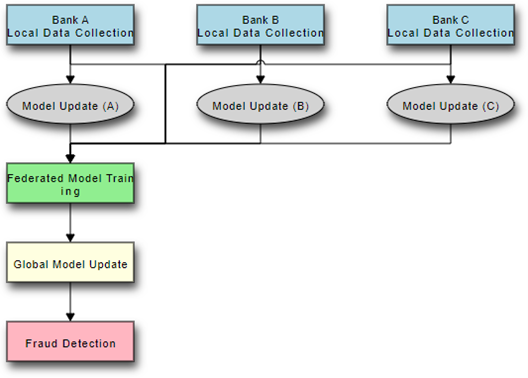
- フェデレーテッドラーニング(FL)を用いて、生の取引データを共有せずに複数の金融機関間でグローバルな不正検出モデルを学習する。
- 各クライアント(銀行)は、独自の不均衡な取引データセット上でローカルなニューラルネットワークを学習し、更新されたモデル重みのみを中央サーバーに送信する。
- 中央サーバーは、FedAvg(フェデレーション平均化)を用いてこれらのモデル更新を集約し、グローバルモデルを形成する。このプロセスを繰り返すことで、全クライアントのパフォーマンスが段階的に向上する。
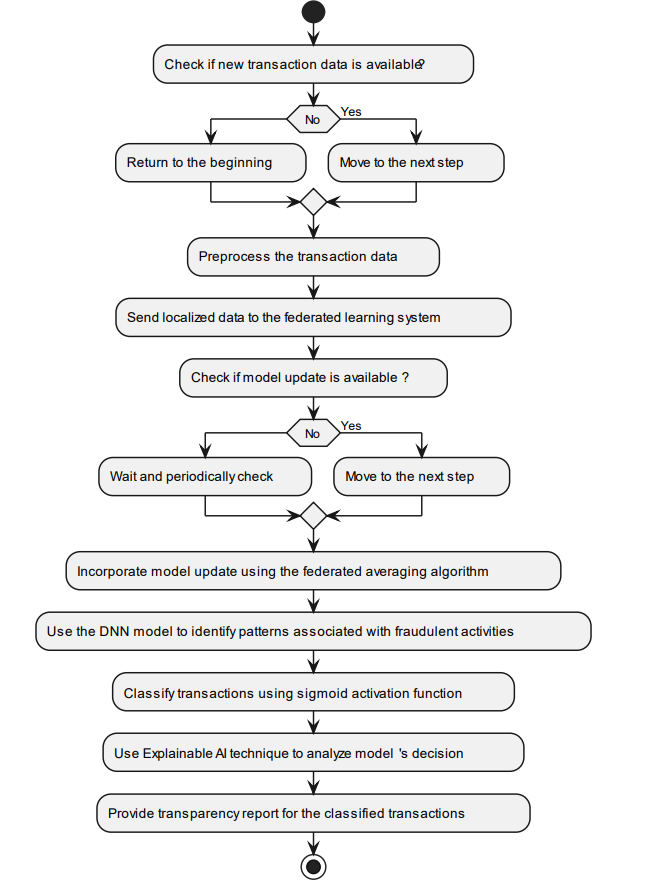
- 説明可能なAI(XAI)としてSHAP(SHapley Additive exPlanations)を統合し、特徴量がモデル予測に与える寄与度を解釈可能にする。色分けされたSHAPプロットにより、正の影響(赤)と負の影響(青)が可視化される。
- 標準的な指標を用いてモデルのパフォーマンスを評価する:正確性、適合率、再現率、F1スコアを複数の学習エポックにわたり計算する。
- サーバー・クライアント間の通信にはFlaskを、並列処理のスケーラビリティとリアルタイムのモデル集約を確保するためのマルチスレーディングを用いて実装する。
実験結果
リサーチクエスチョン
- RQ1フェデレーテッドラーニングに基づく不正検出システムは、金融機関間でデータの機微性を保ちながら高い性能を達成できるか?
- RQ2説明可能なAI(XAI)の統合により、不正検出予測の透明性と信頼性はどのように向上するか?
- RQ3FLフレームワークは、取引データセットにおけるデータの不均衡に起因するパフォーマンス低下をどの程度軽減できるか?
- RQ4複数の学習エポックにわたるFLモデルの収束行動とパフォーマンスの安定性はいかがなっているか?
- RQ5SHAP分析によって、どの取引特徴量が不正予測に最も大きな影響を与えているか?
主な発見
- FLベースの不正検出モデルは、収束後に93%の最終的正確性を達成し、不均衡な取引データに対して優れた性能を示した。
- 適合率は約40エポックまで直線的に上昇し、その後は変動を示した。これは、モデルが性能のピークに達したことを示している。
- 再現率はエポック数に応じて着実に上昇し、時間の経過とともに不正ケースを特定する能力が向上していることが示された。
- F1スコアも学習エポックに伴い向上したが、40エポック以降は収束傾向にあり、改善の余地が小さくなった。
- SHAP分析により、2.15、0.418、0.517といった特徴量が不正予測に最も強い正の寄与を示した一方、1.15 や -0.8 といった特徴量は影響が弱いことが判明した。
- SHAPプロットにより、個々の特徴量の値が予測にどのように寄与しているかが明確に可視化され、特に重要な金融応用分野における信頼性と監査可能性が向上した。
より良い研究を、今すぐ始めましょう
論文の読解から最終レビューまで、研究時間を劇的に削減しましょう。
クレジットカード登録不要
このレビューはAIが作成し、人間の編集者が確認しました。