
[論文レビュー] Type II t-J model and shared antiferromagnetic spin coupling from Hund's rule in superconducting La$_3$Ni$_2$O$_7$
論文は高圧下の La3Ni2O7 に対する Type II bilayer t-J モデルを展開し、Hundの結合が層間スピン交換を媒介し、x≈0.5 のホールドーピングまで堅牢な層間 s 波対関係を生み出すことを示す。
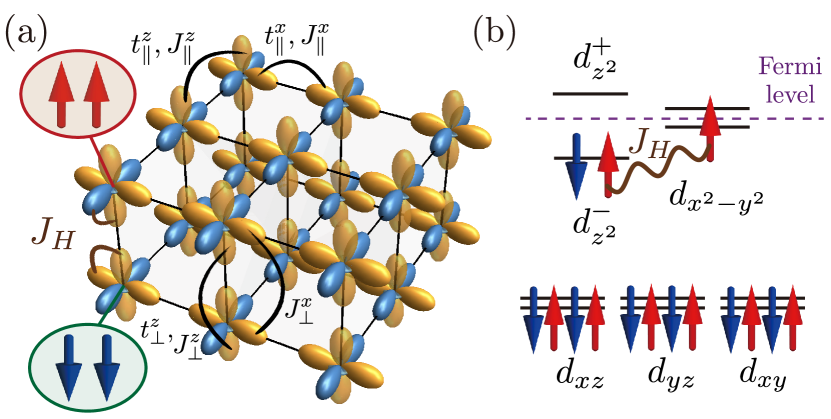
Recently, a 80 K superconductor was discovered in La$_3$Ni$_2$O$_7$ under high pressure. Density function theory (DFT) calculations identify $d_{x^2-y^2}$, $d_{z^2}$ as the active orbitals on the bilayer square lattice with a $d^{8-x}$ configuration of of Ni per site. One naive expectation is to describe this system in terms of a two-orbital t-J model. However, we emphasize the importance of Hund's coupling $J_H$ and the $x=0$ limit should be viewed as a spin-one Mott insulator. Especially, the significant Hund's coupling shares the inter-layer super-exchange $J_\perp$ of the $d_{z^2}$ orbital to the $d_{x^2-y^2}$ orbital, an effect that cannot be captured by conventional perturbation or mean-field approaches. In this study, we first explore the limit where the $d_{z^2}$ orbital is Mott localized, dealing with a one-orbital bilayer t-J model focused on the $d_{x^2-y^2}$ orbital. Notably, we find that strong inter-layer pairing survives up to $x=0.5$ hole doping driven by the transmitted $J_\perp$, which explains the existence of a high Tc superconductor in the experiment at this doping level. Next, we uncover the more realistic situation where the $d_{z^2}$ orbital is slightly hole-doped and cannot be simply integrated out. We take the $J_H ightarrow +\infty$ limit and propose a type II t-J model with four extit{spin-half} singlon ($d^7$) states and three extit{spin-one} doublon ($d^8$) states. Employing a parton mean-field approach, we recover similar results as in the one-orbital t-J model, but now with the effect of the $J_\perp$ automatically generated. We propose future experiments to electron dope the system to further enhance $T_c$.
研究の動機と目的
- 超伝導性を示す La3Ni2O7 に対して、2つの活性Ni軌道(d_x2−y2 および d_z2)を用いた最小限の低エネルギーモデリングを動機づける。
- Hund’s coupling J_H が軌道間で inter-layer exchange J_perp を共有する役割を強調する。
- 大きな J_perp とスピン状態の制約が対と超伝導に与える影響を調べる。
- 1つの軌道がモット絶縁化される場合と、両方の軌道が活性である場合の極限を探る。
- 高圧下で実験的に観測された Tc≈80 K と微視的モデルとを結びつける。
提案手法
- 正方格子上の2つのNi軌道を用いた bilayer bilinear モデルを構築する。
- スレーヴボゾン平均場理論を用いて、層間 J_perp を持つ1軌道 t-J 限界を導出・解析する。
- 大きな Hund’s coupling の下で、4つのスピン-1/2 singlon と3つのスピン-1/2 doublon 状態を持つ Type II t-J-model を導入する。
- 制限されたヒルベルト空間を扱うために3-フェルミオン parton 構成を適用する。
- 自己一致の平均場デカップリングを行い、層内および層間のペアリング秩序パラメータを得る。
- J_perp が d-wave から層間 s-wave pairing への第一種転移を誘導しうることを示す。
実験結果
リサーチクエスチョン
- RQ1Hund’s coupling は nickelate の軌道間で層間交換を共有させることができるか。
- RQ2 bilayer または Type II t-J フレームワーク は高ホールドーピング(x≈0.5)で層間 s-wave pairing を支持できるか。
- RQ3ドーピングの関数として、層間交換 J_perp が対称性と強度にどう影響するか。
- RQ4低エネルギー模型で d_z2 軌道がモット絶縁化である場合と比較的ドーピングされている場合で何が起こるか。
- RQ53-フェルミオン parton 形式は実験的に観測された対の物理を再現できるか。
主な発見
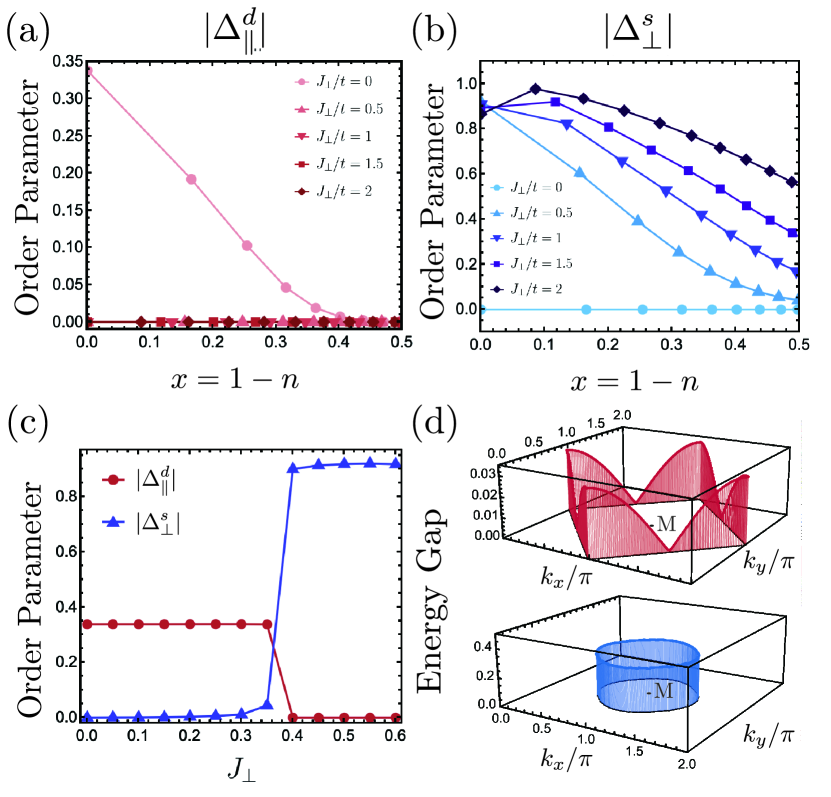
- 強い inter-layer exchange J_perp を伴う bilayer の one-orbital t-J モデルは、x ≈ 0 付近で層間 s-wave 対を支配的に生み出し、大きな J_perp で x≈0.5 まで持続する。
- J_perp の増加に伴い d-wave から s-wave pairing への第一種転移が生じる。
- 大きな J_perp 範囲では、x=0.5 で Delta_perp が有限となり、s-wave pairing の完全ギャップフェルミ面を生み出す。
- Type II t-J model では、 emergent d_x2−y2 軌道は t_perp がなくても両軌道から強化された J_perp を継承する。
- 平均場の結果は約50%のホールドーピングでの高 Tc 超伝導の実験的観測と一致し、ドーピングに対する層間 pairing の頑健性を示す。
- この枠組みは電子ドーピングによる Tc のさらなる向上を予測し、実験的方向性を示唆する。
より良い研究を、今すぐ始めましょう
論文設計から論文執筆まで、研究時間を劇的に削減しましょう。
クレジットカード登録不要
このレビューはAIが作成し、人間の編集者が確認しました。