
[論文レビュー] Ultrashort dissipative Raman solitons in Kerr resonators driven with phase-coherent optical pulses
本論文は、位相整合性パルス駆動を用いて、標準的な通信ファイバーKerr共振器内で、100 fs未塔の超短持続時間の散逸的ラーマンソリトンを決定論的に生成することを示した。融けたシリカ内の内在的ラーマン増幅を活用し、正確な分散管理を施すことで、著者たちは低反復周波数を維持しつつ記録的な短いパルスを達成した。これにより、スケーラブルでチップ互換性のある周波数コンブを実現し、ライン間隔をカスタマイズ可能にした。
External driving of passive, nonlinear optical resonators has emerged over the past decade as a novel route for the generation of ultrashort optical pulses and corresponding broadband frequency combs. Whilst the pulse formation dynamics in such systems differ dramatically from those manifesting themselves in conventional mode-locked lasers, the demarcation between the two traditionally distinct paradigms has recently begun to blur, with demonstrations of hybrid systems incorporating both external driving and active media shown to offer specific advantages. Here we explore a new pathway for ultrashort pulse generation at the interface of externally-driven passive resonators and lasers. By leveraging the nonlinear Raman gain inherent to fused silica, we achieve deterministic generation of low-noise dissipative solitons with durations well below 100 fs via phase-coherent pulsed driving of resonators made of standard, commercially-available optical fibre. We explore and explain the physics of the new dissipative Raman soliton states, identifying scaling laws that govern the pulses' characteristics and that allow output repetition rates to be scaled at will without influencing the soliton duration. The scheme explored in our work enables the shortest ever pulses generated in resonators (active or passive) made from a single commercially-available optical fibre, and it has the potential to be transferred into a chip-scale format by using existing dispersion-engineered silica microresonators.
研究の動機と目的
- 被動Kerr共振器における超短パルス持続時間と低反復周波数の間の根本的トレードオフを克服すること。
- 融けたシリカに内在するラーマンゲインを活用し、外部増幅媒体を用いずに決定論的かつ低ノイズのソリトン形成を実現すること。
- スケーリング則を通じてソリトン持続時間が反復周波数から分離可能であることを示し、柔軟なコンブ設計を可能とすること。
- 分散設計された酸化ケイ素マイクロ共振器を用いて、チップスケール統合への道筋を確立すること。
- 外部駆動型被動共振器と従来のモードロックレーザーの間のギャップを埋めるために、ハイブリッドラーマン散逸的ソリトンメカニズムを導入すること。
提案手法
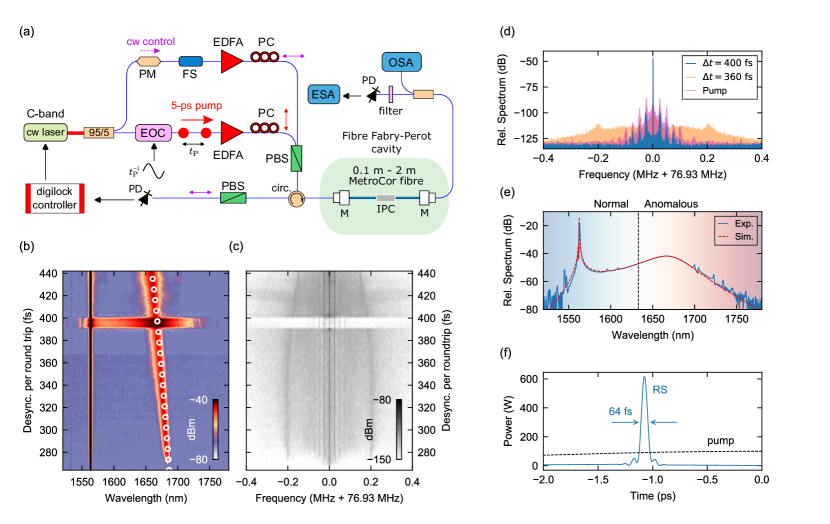
- 標準的な単モードファイバー共振器のラウンドトリップ時間に位相整合性パルス駆動を適用し、散逸的ソリトンを励起した。
- 外部増幅媒体を必要としない非線形増幅を実現するため、融けたシリカに内在する誘導ラーマン散乱(SRS)ゲインを活用した。
- グループ速度マッチングを実現し、安定した位相ロックソリトン動作を可能とするために、共振器の分散を設計した。
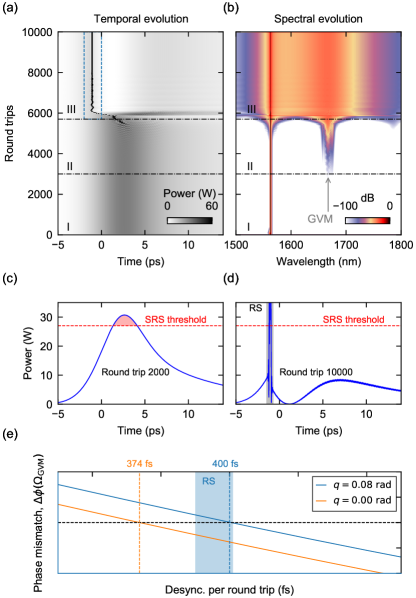
- ソリトンダイナミクスをモデル化するために、次元なし形式の一般化されたLugiato-Lefever方程式(GLE)を用い、主要パラメータとして非同期度 $d_1$、正規化時間スケール $ au_s$、三次分散 $d_3$ を含めた。
- 数値シミュレーションにより、ソリトン特性が主に $ au_s$ と $ au_R$(ラーマン応答時間スケール)に依存することを同定した。駆動周波数のずれや駆動振幅とは関係が薄いことが判明した。
- 実験結果をシミュレーションと比較することで、決定論的ソリトン形成とパルス持続時間のスケーリングが確認された。
実験結果
リサーチクエスチョン
- RQ1融けたシリカに内在するラーマンゲインが、外部増幅媒体を必要とせず、標準ファイバー共振器内で超短散逸的ソリトンを生成可能であるか。
- RQ2従来の同期駆動型ラーマンオシレータと比較して、位相整合性パルス駆動がソリトンのコherenecと持続時間にどのように影響を与えるか。
- RQ3分散および駆動タイミングの制御により、ソリトン持続時間が反復周波数からどれほど分離可能か。
- RQ4この系におけるラーマンソリトンのパルス持続時間と安定性を支配するスケーリング則は何か。
- RQ5このメカニズムが、統合応用向けのチップスケールマイクロ共振器に移植可能か。
主な発見
- 著者たちは、標準的な通信ファイバー共振器内で、全波幅半最大(FWHM)持続時間が100 fs未塔の散逸的ラーマンソリトンを達成した。これは、このようなシステムで達成された最短パルスである。
- 反復周波数に依存しないパルス持続時間が、$ au_s$ と $ au_R$ にのみ依存するスケーリング則により実証された。これにより、パルス幅を変えずに任意の反復周波数を調整可能となった。
- 位相整合性駆動とグループ速度マッチングのおかげで、決定論的かつ高忠実度のソリトン形成が実現され、従来のラーマンオシレータで一般的な低コherenecと広帯域パルスの問題を克服した。
- シミュレーションにより、ラーマン応答関数 $ ilde{ au}_R$ と正規化時間スケール $ au_s$ が、ソリトン幅と安定性を支配する主要パラメータであることが確認された。
- 物理的メカニズムとスケーリング則が分散設計された統合プラットフォームと適合するため、この手法はチップスケール酸化ケイ素マイクロ共振器へスケーラブルに拡張可能である。
- この手法により、細かいライン間隔(1 GHz未塔)の広帯域周波数コンブが生成可能であり、二重コンブ分光法などの応用に適している。同時に、超短パルス特性を維持したままである。
より良い研究を、今すぐ始めましょう
論文の読解から最終レビューまで、研究時間を劇的に削減しましょう。
クレジットカード登録不要
このレビューはAIが作成し、人間の編集者が確認しました。