
[論文レビュー] Ultraviolet Compactness of High-Redshift Galaxies as a Tracer of Early-Stage Gas Infall, Bursty Star Formation, and Offset from the Fundamental Metallicity Relation
この研究は JWST NIRSpec/NIRCam データを用いて、コンパクトさと局所的FMRからの金属量オフセットの関係を z>3 銀河で調べ、FMRの緩やかな進化とコンパクトさと金属欠乏の関連を見つけ、確率的な内部発展型の初期星形成を支持します。
The empirical anti-correlation between gas-phase metallicity and star formation rate (SFR) at a fixed stellar mass, known as the fundamental metallicity relation (FMR), is commonly interpreted as an equilibrium state in the interplay between gas infall, enrichment, and gas removal. JWST/NIRSpec spectroscopy has shown a $z>3$ deviation from the local-universe FMR calibrations, suggesting that these galaxies are potentially caught out of equilibrium. To investigate this, we inferred the stellar population, nebular, and morphological properties of 427 galaxies at $310^9M_{\odot}$ galaxies exhibit negligible redshift evolution. We also confirm the redshift evolution of the FMR: $z>3$ galaxies appear metal-deficient compared to expectations for their stellar mass and SFR according to the local-universe FMR. This offset grows with redshift. Metal deficiency is correlated with compactness: galaxies most offset from the average mass-size relation are also the most metal-poor for their stellar mass and SFR. We interpret this as a product of bursty star formation: compact galaxies exhibit elevated SFR surface densities, indicating that they are observed during burst episodes triggered by gas infall. While accretion of metal-poor gas has reduced their gas-phase metallicity by diluting the interstellar medium, they are observed prior to chemical yield release by newly formed massive stars. Simply, they are chemically out of equilibrium compared to the equilibrium state known as the FMR.
研究の動機と目的
- 赤方偏移 z≈3 以降の質量-金属量関係の進化を説明し、高赤方偏動での fundamental metallicity relation (FMR) の適用性を検証する。
- よりコンパクトな高赤方偏の銀河はより金属欠乏で、局所の FMR 校正からオフセットするかを調べる。
- z>4 銀河の rest-UV サイズと質量-サイズ関係を測定し、赤方偏移とともにその進化を評価する。
- コンパクトさが FMR オフセットと相関するかを評価し、初期段階のガス取り込みと確率的な星形成モードを示唆する。
提案手法
- NIRSpecプリズム分光とNIRCam光度計を両方持つ427個の z>3 銀河サンプルを作成(公的プログラムから334、JADESから93を含む)。
- galight を用いて WebbPSF PSF で rest-UV サイズを測定し、サンプル間の一貫性を確保。
- SED fitting (prospector/FSPS) および emission-line 分析 (pPXF with MILES library) による恒星質量、SFR、および金属量を推定。
- R23 および O32 の診断を、ISM イオン化の代理指標として EW(Hβ) に guided して、気相金属量を決定し、金属量の縮退を解消。
- Andrews & Martini (2013) の較正を Nakajima et al. 2023 を用いて Chabrier IMF に変換した予測から、stellar mass と SFR から金属量を予測して FMR の赤方偏移進化を評価。
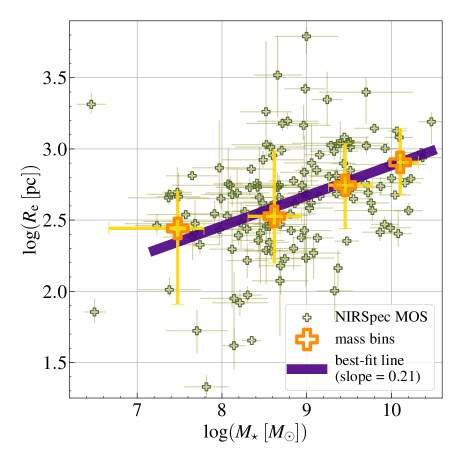
- 銀河のコンパクトさを κ log(M*) − log(Re) として定量化し、κ は 見つかった質量-サイズ勾配(0.21)に固定。
実験結果
リサーチクエスチョン
- RQ1z>4 における fundamental metallicity relation の緩やかな進化はあるか、そして高赤方偏の金属量は FMR 予測とどのように比較されるか?
- RQ2z>3 において、銀河のコンパクトさと気相金属量の間に頑健な反相関があり、初期段階のガス取り込みを示唆するか?
- RQ3z=4–10 銀河の質量-サイズ関係の赤方偏移進化はどうなっており、その進化は星形成質量に依存するか?
- RQ4コンパクトで低金属量・高SFRの系は、初期銀河の内向き・確率的な星形成シナリオを支持するか?
主な発見
- z>3 銀河に対する局所 FMR 校正を用いたとき、fundamental metallicity relation のオフセットの赤方偏移は緩やかである。
- z=4–10 の質量-サイズ関係の最適フィットべきはべきは勾配0.21 ± 0.04。
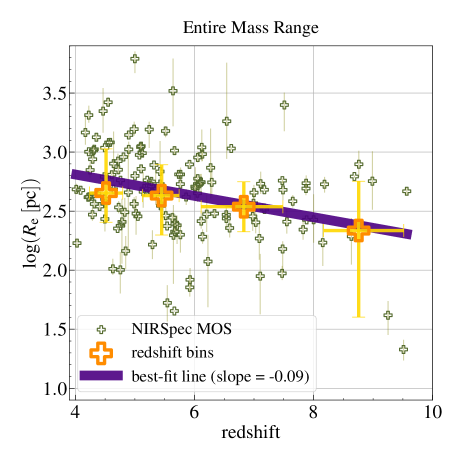
- 固定質量で高赤方偏ほど銀河はよりコンパクトになり、サイズ-赤方偏の勾配は −0.090 ± 0.02。
- 固定質量でよりコンパクトな銀河はより金属欠乏で、局所 FMR 校正からのオフセットが大きくなる傾向があり、FMR-オフセットとコンパクトさの間には線形関係があり、傾き −0.35 ± 0.11、切片 −0.56 ± 0.09。
- この解析は earliest 銀河に対して内向きで爆発的な星形成像を支持しており、急速な中心吸引がコンパクトで低金属のコアを導くことを示唆する。
より良い研究を、今すぐ始めましょう
論文設計から論文執筆まで、研究時間を劇的に削減しましょう。
クレジットカード登録不要
このレビューはAIが作成し、人間の編集者が確認しました。