
[論文レビュー] UNCOVER spectroscopy confirms a surprising ubiquity of AGN in red galaxies at $z>5$
JWST UNCOVER分光は、コンパクトな赤色の z>5 ソースの多数が塵によって赤化したAGNであることを明らかにし、広いH-αが活発なブラックホールを示し、高い推定数密度を示している。
JWST is revealing a new population of dust-reddened broad-line active galactic nuclei (AGN) at redshifts $z\gtrsim5$. Here we present deep NIRSpec/Prism spectroscopy from the Cycle 1 Treasury program UNCOVER of 15 AGN candidates selected to be compact, with red continua in the rest-frame optical but with blue slopes in the UV. From NIRCam photometry alone, they could have been dominated by dusty star formation or AGN. Here we show that the majority of the compact red sources in UNCOVER are dust-reddened AGN: $60\%$ show definitive evidence for broad-line H$α$ with FWHM$\, >2000$ km/s, for $20\%$ current data are inconclusive, and $20\%$ are brown dwarf stars. We propose an updated photometric criterion to select red $z>5$ AGN that excludes brown dwarfs and is expected to yield $>80\%$ AGN. Remarkably, among all $z_{ m phot}>5$ galaxies with F277W$-$F444W$>1$ in UNCOVER at least $33\%$ are AGN regardless of compactness, climbing to at least $80\%$ AGN for sources with F277W$-$F444W$>1.6$. The confirmed AGN have black hole masses of $10^7-10^9$ M$_{\odot}$. While their UV-luminosities ($-16>M_{ m UV}>-20$ AB mag) are low compared to UV-selected AGN at these epochs, consistent with percent-level scattered AGN light or low levels of unobscured star formation, the inferred bolometric luminosities are typical of $10^7-10^9$ M$_{\odot}$ black holes radiating at $\sim 10-40\%$ of Eddington. The number densities are surprisingly high at $\sim10^{-5}$ Mpc$^{-3}$ mag$^{-1}$, 100 times more common than the faintest UV-selected quasars, while accounting for $\sim1\%$ of the UV-selected galaxies. While their UV-faintness suggest they may not contribute strongly to reionization, their ubiquity poses challenges to models of black hole growth.
研究の動機と目的
- JWSTの赤外機能を用いてz>5でのブラックホール成長と銀河の共進化の研究を動機づける。
- 光学色分布で支配的なコンパクトな赤色z>5ソースがAGNか塵に覆われた星形成銀河かを評価する。
- 赤く・コンパクトなz>5ソースの中のAGN割合を定量化し、ブラックホール質量と成長特性を導出する。
- z>5AGNを選択する光度カラーのカットの有効性を評価し、UV選択集団と比較する。
提案手法
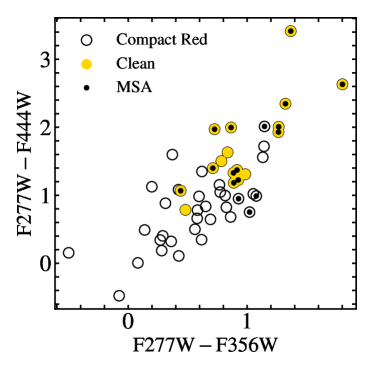
- UNCOVER JWST画像(NIRCam)を用いて、赤い光学連続体が赤く、UV斜面が青くなるような特定の色基準を満たすコンパクトな赤色ソースを選択する。
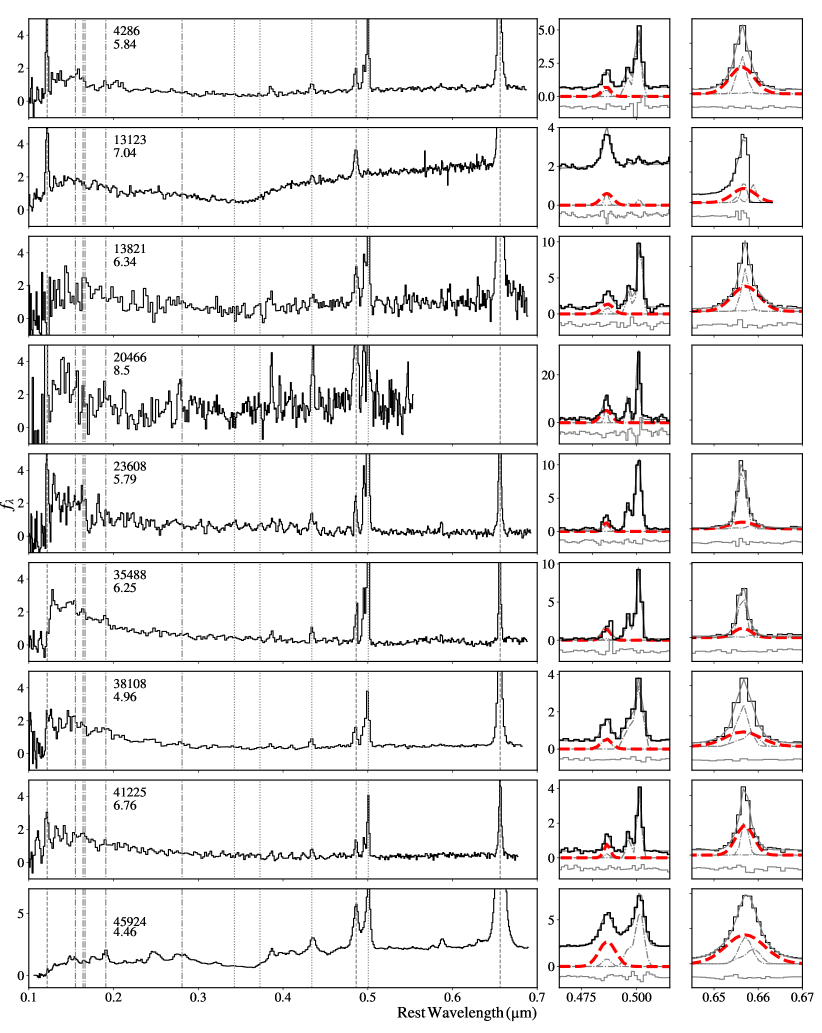
- 17のAGN候補についてNIRSpec/PRISM分光を取得し、広いBalmer線(H-α)や他のAGN指標を探す。
- Hβ, [O III], Hα, [N II]の発光線複合体を狭い成分と広い成分で適合させ、広いH-α(FWHM>2000 km/s)を識別する。
- H-αの幅と輝度からブラックホール質量を推定し、赤方偏光を除去し、レンズ効果によるデミグネーションを考慮して bolometric luminosities を算出する。
- 汚染(例えばブラウンダワーフ候補)を評価し、Balmer decrementと連続スロープを用いて減光を制約する。
- フォトメトリックなAGN選択効率を検討し、カラーカット(例:F277W−F444W)に基づくAGN割合を導出する。
実験結果
リサーチクエスチョン
- RQ1NIRSpec/PRISM分光で明確な broad-line AGN は全体の何割合か?
- RQ2これらAGNのブラックホール質量と摂動特性(ボリューム光度、Eddington比)は?
- RQ3JWSTのカラーと形態のカットがz>5のAGN選択にどの程度有効か、カラー閾値でAGN割合はどう変わるか?
- RQ4赤色z>5ソースで同定されたAGNはUV選択AGNと luminosityと数密度の点でどう比較されるか?
主な発見
- 標的としたコンパクトな赤色ソースの60%が決定的な広線H-α発光を示す(FWHM > 2000 km/s)。
- ターゲットの20%は結論が出ず、20%はブラウンダワーフである。
- F277W−F444W >1のzphot>5銀河の中で少なくとも33%がAGNで、F277W−F444W >1.6では少なくとも80%に上る。
- 確認されたAGNはブラックホール質量が10^7–10^9太陽質量の範囲。
- UV光度は相対的に低く、-16 > M_UV > -20 AB magだが、ボリューミック光度はEddingtonの約10–40%での吸収を示唆。
- AGN数密度は約10^-5 Mpc^-3 mag^-1で、UV選択のクエーサーの約100分の1で、UV選択銀河の約1%を占める。
- これらの赤色z>5AGNの遍在性は、初期のブラックホール成長と銀河との共進化モデルに挑戦をもたらす。)
- table_headers:[]
- table_rows:[]
より良い研究を、今すぐ始めましょう
論文設計から論文執筆まで、研究時間を劇的に削減しましょう。
クレジットカード登録不要
このレビューはAIが作成し、人間の編集者が確認しました。