
[論文レビュー] Unifying and benchmarking state-of-the-art quantum error mitigation techniques
この論文は、ゼロノイズ補外(ZNE)、クラウフォードデータレジーム(CDR)、バーチャルディスティルレーション(VD)を、UNITED(データ駆動型誤り軽減のための統一技術)と呼ばれる一貫したデータ駆動型フレームワークに統合する。異なるノイズレベルと状態コピー数からのノイズの強い期待値を組み合わせることで、UNITEDは特に高いショット予算下で優れた誤り軽減性能を達成し、実際の量子ノイズモデルにおけるランダムな量子回路とQAOAアプリケーションにおいて、個々の手法を上回る性能を発揮する。
Error mitigation is an essential component of achieving a practical quantum advantage in the near term, and a number of different approaches have been proposed. In this work, we recognize that many state-of-the-art error mitigation methods share a common feature: they are data-driven, employing classical data obtained from runs of different quantum circuits. For example, Zero-noise extrapolation (ZNE) uses variable noise data and Clifford-data regression (CDR) uses data from near-Clifford circuits. We show that Virtual Distillation (VD) can be viewed in a similar manner by considering classical data produced from different numbers of state preparations. Observing this fact allows us to unify these three methods under a general data-driven error mitigation framework that we call UNIfied Technique for Error mitigation with Data (UNITED). In certain situations, we find that our UNITED method can outperform the individual methods (i.e., the whole is better than the individual parts). Specifically, we employ a realistic noise model obtained from a trapped ion quantum computer to benchmark UNITED, as well as other state-of-the-art methods, in mitigating observables produced from random quantum circuits and the Quantum Alternating Operator Ansatz (QAOA) applied to Max-Cut problems with various numbers of qubits, circuit depths and total numbers of shots. We find that the performance of different techniques depends strongly on shot budgets, with more powerful methods requiring more shots for optimal performance. For our largest considered shot budget ($10^{10}$), we find that UNITED gives the most accurate mitigation. Hence, our work represents a benchmarking of current error mitigation methods and provides a guide for the regimes when certain methods are most useful.
研究の動機と目的
- 異なる最先端の量子誤り軽減技術を共通のデータ駆動型フレームワークに統合すること。
- 実際のノイズ条件下で、UNITEDの性能をZNE、CDR、VD、vnCDRと比較してベンチマークすること。
- ショット予算、回路の深さ、問題の種別に基づいて最適な誤り軽減戦略を特定すること。
- 近い将来の量子コンputィングアプリケーションにおける誤り軽減手法の選択に関する実用的ガイドを提供すること。
提案手法
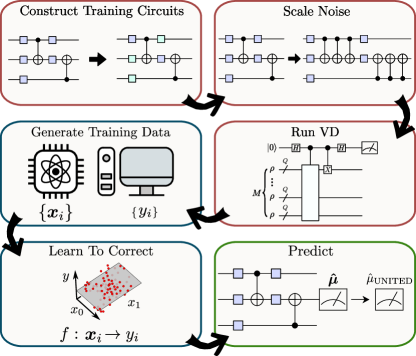
- UNITEDは、ZNEの複数のノイズレベル、CDRのニアクラウフォード回路、VDの異なる状態コピー数からのデータを、統一された回帰フレームワークに統合する。
- この手法は、ノイズの強い期待値とVDによる軽減済み期待値を正確な値にマップするためのアンサンブルを古典的フィッティングにより行い、補助回路で訓練する。
- 訓練データには、量子測定によるノイズの強い値と、ニアクラウフォード回路の古典的計算による正確な値の両方が含まれる。
- 統一されたアンサンブルを、ターゲット回路のノイズの強い値とVDによる軽減済みデータに適用し、1つの改善された推定値を生成する。
- このフレームワークは既存の手法を一般化しており、vnCDRは特別なケースとして含まれる。
- 性能評価は、ランダム回路とMax-Cut用QAOAにおける実際のトラップドアイオントノイズモデルを用いて行われる。
実験結果
リサーチクエスチョン
- RQ1ZNE、CDR、VDは、1つのデータ駆動型誤り軽減フレームワークに統合可能か?
- RQ2ショット予算と回路タイプが異なる条件下で、UNITEDの性能は個々の手法と比べてどうなるか?
- RQ3ショット数、回路の深さ、ノイズレベルの異なる組み合わせに対して、最適な誤り軽減戦略は何か?
- RQ4複数の誤り軽減手法からのデータを統合することは、個別に使用する場合よりも優れた結果をもたらすか?
- RQ5どのショット予算で、UNITEDがVDや他の手法を上回る誤り軽減精度を達成するか?
主な発見
- UNITEDは、$10^{10}$ の最大ショット予算下で、ランダムな量子回路とQAOAアプリケーションの両方において、最も正確な軽減を達成した。
- $N_{\rm tot} = 10^6$ および $10^8$ の場合、ランダムな量子回路ではvnCDRが他の手法を上回ったが、浅い回路では $10^5$ ショットでZNEが最適であった。
- QAOAでは、$10^{10}$ を除くすべてのショット予算でVDが最適であったが、$10^{10}$ ではUNITEDが解の状態におけるノイズフロアが低いため、それを上回った。
- 各手法の性能の上限はショット予算に依存し、UNITEDはより豊富なデータを用いるため、最高の上限に達した。
- ショット数を増やすことで誤り軽減の正確性が向上するが、各手法で異なる性能の上限に達する。
- ショット数を増やした際の誤り軽減された観測量の収束は、性能上限に達したかどうかを示す実用的な指標として利用できる。

より良い研究を、今すぐ始めましょう
論文の読解から最終レビューまで、研究時間を劇的に削減しましょう。
クレジットカード登録不要
このレビューはAIが作成し、人間の編集者が確認しました。