
[論文レビュー] Updating the $^{56}$Ni Problem in Core-collapse Supernova Explosion
本研究は、光球近似を用いたニュートリノ加熱を伴う1次元ラグランジュ流体力学を用いて、核心収縮超新星における56Ni問題を調査している。56Ni合成の範囲は爆発エネルギーの増加率($ olimits\dot{E}_{\text{expl}}$)にほとんど依存しないが、内側の物質が脱出できるかどうかに強く依存しており、内側物質が脱出できない場合、56Niの噴出質量は著しく減少する。そのため、$ olimits\dot{E}_{\text{expl}} \lesssim 1$ ベーテ s⁻¹ の遅い爆発では、表皮被覆のない超新星で観測される56Ni質量を再現できない。これは、表皮被覆のない超新星では初期段階の爆発がより速く($ olimits\dot{E}_{\text{expl}} \gtrsim 2$ ベーテ s⁻¹)なければならないことを示唆している。
Details of the core-collapse supernova (CCSN) explosion mechanism still need to be fully understood. There is an increasing number of successful examples of reproducing explosions in multidimensional hydrodynamic simulations, but subsequent studies pointed out that the growth rates of the explosion energy $\dot{E}_\mathrm{expl}$ of these simulations are insufficient to produce enough $^{56}$Ni to match observations. This issue is known as the `$^{56}$Ni problem' in CCSNe. Recently, however, some studies have suggested that this $^{56}$Ni problem is derived from the simplicity of the explosion model. In response, we investigate the effect of the explosion energy growth rate $\dot{E}_\mathrm{expl}$ on the behavior of nucleosynthesis in CCSNe in a more realistic model. We employ the 1D Lagrangian hydrodynamic code, in which we take neutrino heating and cooling terms into account with the light-bulb approximation. We reiterate that, consistent with previous rebuttal studies, there is the $^{56}$Ni problem: Although $^{56}$Ni is synthesized to almost the same mass coordinate independent of $\dot{E}_\mathrm{expl}$, some of the innermost material in the low-$\dot{E}_\mathrm{expl}$ model failed to escape, leading to a shift in the innermost mass coordinate of the ejecta to the outer positions. Comparing our results with observations, we find that while modern slow explosions can, in principle, reproduce observations of standard Type II SNe, this is not possible with stripped-envelope SNe. Our finding places a strong constraint on the explosion mechanism. There are significant differences in the progenitor structures and the explosion mechanism between Type II and stripped-envelope SNe.
研究の動機と目的
- 遅い爆発エネルギー増加率を用いたシミュレーションが観測された56Ni質量を再現できないという長年の56Ni問題を解決すること。
- 1次元流体力学モデルにニュートリノ加熱を組み込み、爆発エネルギー増加率($\dot{E}_{\text{expl}}$)が核合成および噴出質量に与える影響を調査すること。
- 現代の遅い爆発モデルが、II型および表皮被覆のない超新星の観測と整合するかを検証すること。
- 56Ni問題がモデルの単純化に起因するのか、それとも爆発ダイナミクスの根本的制約に起因するのかを特定すること。
- II型超新星と表皮被覆のない超新星の間で56Ni産出量に差が生じる理由が、前身星の構造的差異か爆発メカニズムの違いに起因するのかを評価すること。
提案手法
- 光球近似を用いてニュートリノ加熱および冷却項をモデル化した1次元ラグランジュ流体動力学コード。
- 初期爆発エネルギー増加率($\dot{E}_{\text{expl}}$)を0.1から5 ベーテ s⁻¹ まで変化させた、自己一貫した爆発モデル。
- 640種類の核種を含む反応ネットワークを用いた後処理核合成計算により56Ni産出量を算出。
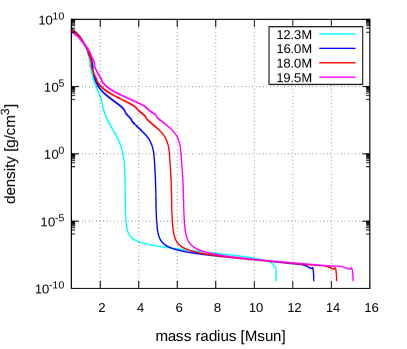
- 初期質量が12.3、16.0、18.0、19.5 M$_\odot$ の前身星をゼロ・メインシーケンス(ZAMS)で設定し、密度構造とニュートリノ放射率を変化させた。
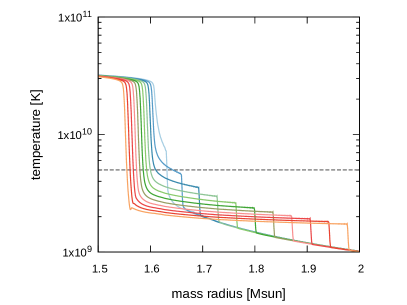
- 衝撃波、PNS、56Ni豊富な領域の質量座標を追跡し、噴出物質の組成と脱出条件を評価。
- II型および表皮被覆のない超新星の光曲線から得られた観測値と比較して、シミュレートされた56Ni質量を評価。
実験結果
リサーチクエスチョン
- RQ1自己一貫した流体力学モデルにニュートリノ加熱を組み込み、爆発エネルギー増加率($\dot{E}_{\text{expl}}$)が核合成および56Ni産出量に与える影響は何か?
- RQ2なぜ現代の遅い爆発シミュレーション($\dot{E}_{\text{expl}} \lesssim 1$ ベーテ s⁻¹)は、表皮被覆のない超新星で観測された56Ni質量を再現できないのか?
- RQ356Ni産出量と$\dot{E}_{\text{expl}}$の逆相関関係は、過去のモデルで初期収縮を考慮していなかったための数値的アーチファクトであるのか?
- RQ4遅い爆発は標準的なII型超新星の観測56Ni質量($M_{\text{Ni}} \approx 0.03 M_\odot$)を再現できるか、それともより速い爆発段階が必要か?
- RQ5II型超新星と表皮被覆のない超新星の間で56Ni産出量に差が生じる物理的要因(前身星構造の違いや爆発メカニズムの違い)は何か?
主な発見
- 56Ni合成の範囲(質量座標まで)は$\dot{E}_{\text{expl}}$にほとんど依存せず、核合成が爆発速度にほとんど影響されないことを示している。
- 低$\dot{E}_{\text{expl}}$モデルでは、内側物質が脱出できず、噴出物質の内側境界が外側にずれるため、56Niの総噴出質量が減少する。
- 同じ程度の56Ni合成が行われても、56Niの噴出質量は、内側PNS表面領域が脱出速度に達するかどうかに強く依存する。
- 現代の遅い爆発($\dot{E}_{\text{expl}} \lesssim 1$ ベーテ s⁻¹)は、標準的なII型超新星($M_{\text{Ni}} \approx 0.03 M_\odot$)の観測56Ni質量を再現できる。
- しかし、これらのモデルは表皮被覆のない超新星($M_{\text{Ni}} \approx 0.07 M_\odot$)のより高い56Ni質量を再現できない。これには$\dot{E}_{\text{expl}} \gtrsim 2$ ベーテ s⁻¹ が必要である。
- 結果から、II型超新星と表皮被覆のない超新星の間には、前身星構造や爆発メカニズムに顕著な違いがあり、後者は初期段階の爆発がより速くなければならないことが示唆される。
より良い研究を、今すぐ始めましょう
論文の読解から最終レビューまで、研究時間を劇的に削減しましょう。
クレジットカード登録不要
このレビューはAIが作成し、人間の編集者が確認しました。