
[論文レビュー] US Microelectronics Packaging Ecosystem: Challenges and Opportunities
USベースの高度パッケージング供給網を分析し、ボトルネック、オフショア依存、セキュリティの考慮点を特定するとともに、HI主導の半導体パッケージングにおける安全で強靭なオンショア能力への道筋を概説する。
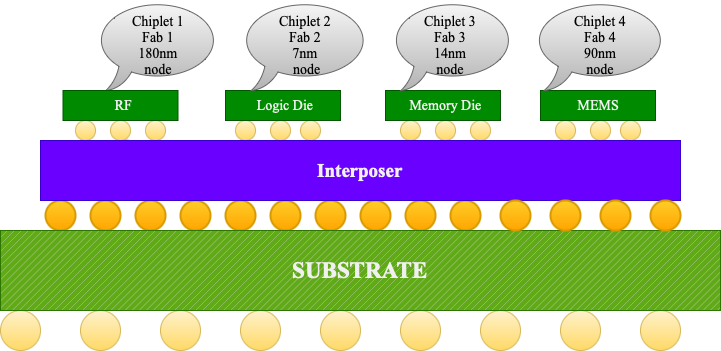
The semiconductor industry is experiencing a significant shift from traditional methods of shrinking devices and reducing costs. Chip designers actively seek new technological solutions to enhance cost-effectiveness while incorporating more features into the silicon footprint. One promising approach is Heterogeneous Integration (HI), which involves advanced packaging techniques to integrate independently designed and manufactured components using the most suitable process technology. However, adopting HI introduces design and security challenges. To enable HI, research and development of advanced packaging is crucial. The existing research raises the possible security threats in the advanced packaging supply chain, as most of the Outsourced Semiconductor Assembly and Test (OSAT) facilities/vendors are offshore. To deal with the increasing demand for semiconductors and to ensure a secure semiconductor supply chain, there are sizable efforts from the United States (US) government to bring semiconductor fabrication facilities onshore. However, the US-based advanced packaging capabilities must also be ramped up to fully realize the vision of establishing a secure, efficient, resilient semiconductor supply chain. Our effort was motivated to identify the possible bottlenecks and weak links in the advanced packaging supply chain based in the US.
研究の動機と目的
- Motivate HI as a path to sustain Moore’s Law through diverse chiplet integration and higher functional density.
- Characterize the US advanced packaging supply chain and its offshore dependencies.
- Identify bottlenecks and security risks in the US HI-ready packaging ecosystem.
- Survey industry players and initiatives to build onshore capabilities in packaging and materials.
- Propose a roadmap for securing a US-based advanced packaging supply chain.
提案手法
- Review of HI fundamentals and packaging technologies (2.5D/3D, SiP) and their role in extending Moore’s Law.
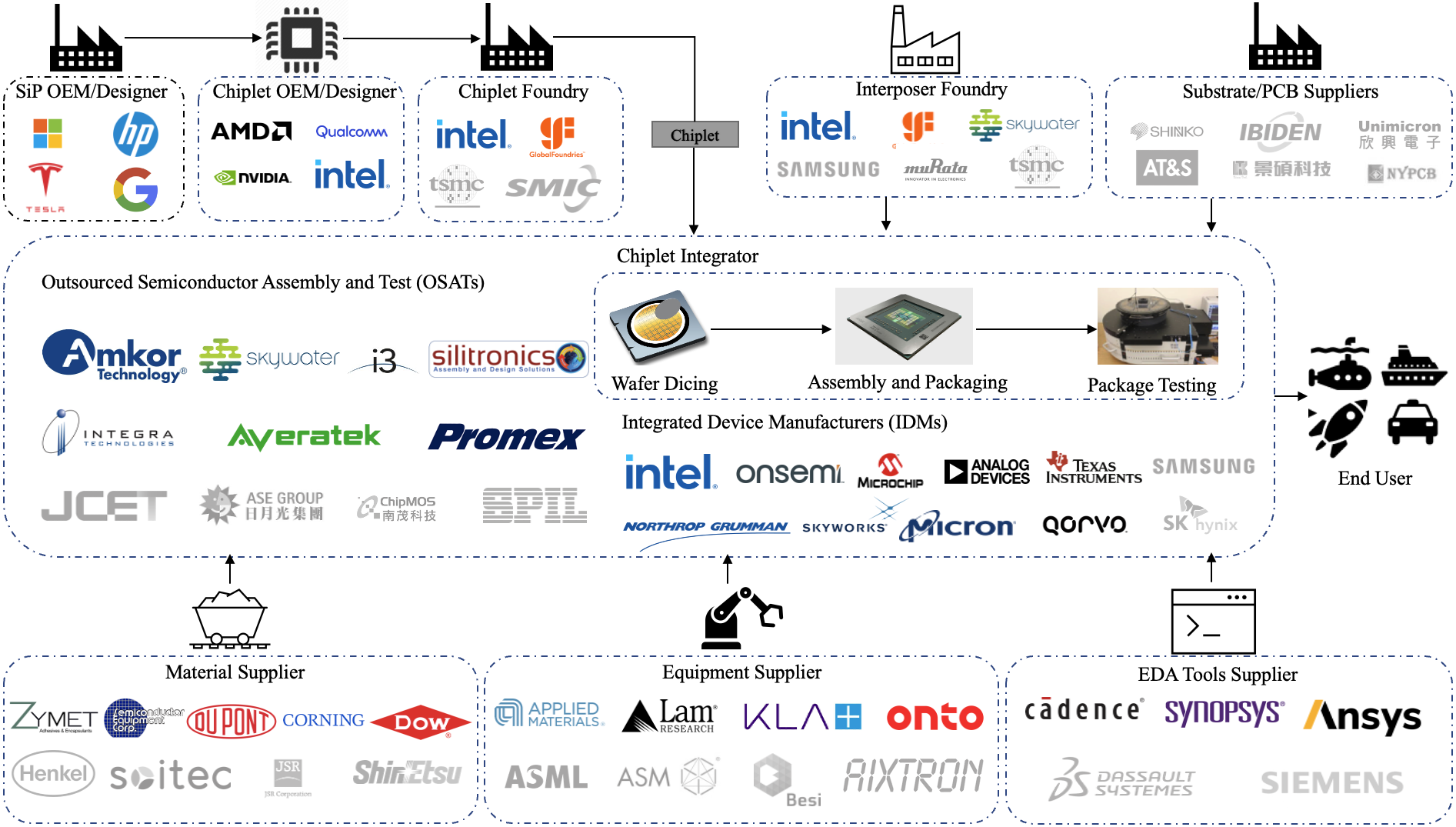
- Mapping of the US advanced packaging ecosystem, including OEMs, chiplet designers, OSATs, substrates, materials, equipment, and EDA/tooling.
- Assessment of economic, policy, and security factors shaping domestic capabilities and offshore dependencies.
- Analysis of application-domain requirements (defense, 5G, HPC, automotive, IoT, mobile, medical) to identify onshore needs.
- Synthesis into a roadmap for onshore capability development and secure supply chains.
実験結果
リサーチクエスチョン
- RQ1What is the current state of US onshore advanced packaging manufacturing and where are the gaps?
- RQ2How dependent is the US HI/advanced packaging ecosystem on offshore resources across key application sectors?
- RQ3What are the security and reliability considerations in the US-based advanced packaging supply chain?
- RQ4What actions and investments are needed to secure a robust onshore HI-capable packaging ecosystem?
主な発見
- US advanced packaging capacity is limited, with only about 3% market share for advanced packaging and heavy offshore reliance in interposers and materials.
- Onshore capability expansion is needed across OEMs, chiplet integrators, OSATs, substrates, materials, equipment, and EDA tools to secure the supply chain.
- Defense/aerospace shows stronger onshore capability readiness (trusted suppliers and onshore integration) compared with consumer-focused segments like 5G and HPC.
- US interposer fabrication remains largely offshore (e.g., TSMC as a primary supplier) despite some onshore investments.
- Material and substrate supply chains are vulnerable, with the US holding about 10% market share in semiconductor materials and no onshore substrate supplier for high-end packaging.
- Roadmap elements emphasize standardization, secure design practices, onshore manufacturing, and resilient, trusted supply chains.]
- table_headers:[]
- table_rows:[]
より良い研究を、今すぐ始めましょう
論文設計から論文執筆まで、研究時間を劇的に削減しましょう。
クレジットカード登録不要
このレビューはAIが作成し、人間の編集者が確認しました。