
[論文レビュー] Wave function network description and Kolmogorov complexity of quantum many-body systems
本論文は波動関数ネットワークを導入し、量子多体のスナップショットを記述するためにそれらを用い、Kolmogorov 複雑性を推定し、スケールフリーなネットワークと Rydberg 量子シミュレータにおけるプラットフォーム間の認証を実証します。
Programmable quantum devices are now able to probe wave functions at unprecedented levels. This is based on the ability to project the many-body state of atom and qubit arrays onto a measurement basis which produces snapshots of the system wave function. Extracting and processing information from such observations remains, however, an open quest. One often resorts to analyzing low-order correlation functions - i.e., discarding most of the available information content. Here, we introduce wave function networks - a mathematical framework to describe wave function snapshots based on network theory. For many-body systems, these networks can become scale free - a mathematical structure that has found tremendous success in a broad set of fields, ranging from biology to epidemics to internet science. We demonstrate the potential of applying these techniques to quantum science by introducing protocols to extract the Kolmogorov complexity corresponding to the output of a quantum simulator, and implementing tools for fully scalable cross-platform certification based on similarity tests between networks. We demonstrate the emergence of scale-free networks analyzing data from Rydberg quantum simulators manipulating up to 100 atoms. We illustrate how, upon crossing a phase transition, the system complexity decreases while correlation length increases - a direct signature of build up of universal behavior in data space. Comparing experiments with numerical simulations, we achieve cross-certification at the wave-function level up to timescales of 4 $μ$ s with a confidence level of 90%, and determine experimental calibration intervals with unprecedented accuracy. Our framework is generically applicable to the output of quantum computers and simulators with in situ access to the system wave function, and requires probing accuracy and repetition rates accessible to most currently available platforms.
研究の動機と目的
- 多体波動関数スナップショットを低次相関を超えて構造化され情報量に富んだ記述へ動機づける。
- スピン系・ボソン系・フェルミ系の全情報内容を保持するネットワーク表現(波動関数ネットワーク)を開発する。
- 得られたネットワークがスケールフリーになり得ることを示し、この構造を用いて Kolmogorov 複雑性を抽出する。
- ネットワークベースの類似性テストを用いた量子シミュレータのプラットフォーム横断認証を実証する。
提案手法
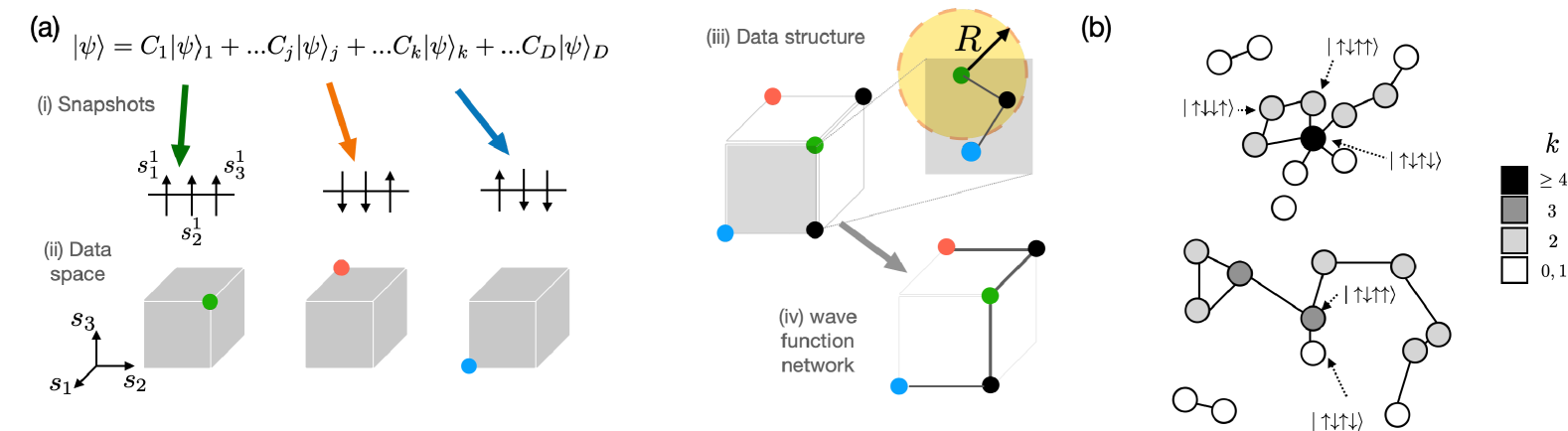
- 波動関数スナップショットの集合をネットワークに写像し、各スナップショットをノードとし、構成間のハミング距離がカットオフ R 未満である場合にリンクを引く。
- カットオフ R を最近傍距離の平均として定義し、ネットワークのスパース性を安定させる。
- ハミング距離を用いて構成間の短距離・長距離の相関の両方を捉える。
- 2-NN(2-nn intrinsic-dimension)法によって波動関数スナップショットのKolmogorov 複雑性を推定する。
- Epps-Singleton テストを適用してプラットフォーム間のネットワークを比較し、クロス検証が成立する時間スケールを特定する。
実験結果
リサーチクエスチョン
- RQ1波動関数スナップショットは underlying の相関や臨界挙動を明らかにするネットワークで忠実に表現できるか。
- RQ2波動関数ネットワークは量子相転移近傍でスケールフリー性を示し、これらの性質は実空間の相関とどのように関連するか。
- RQ3ネットワークベースの Kolmogorov 複雑性は情報内容とその量子シミュレータにおける進展を定量化できるか。
- RQ4ネットワークベースのプラットフォーム横断認証は実験データと数値データの体系的な差異をどれだけうまく識別できるか。
主な発見
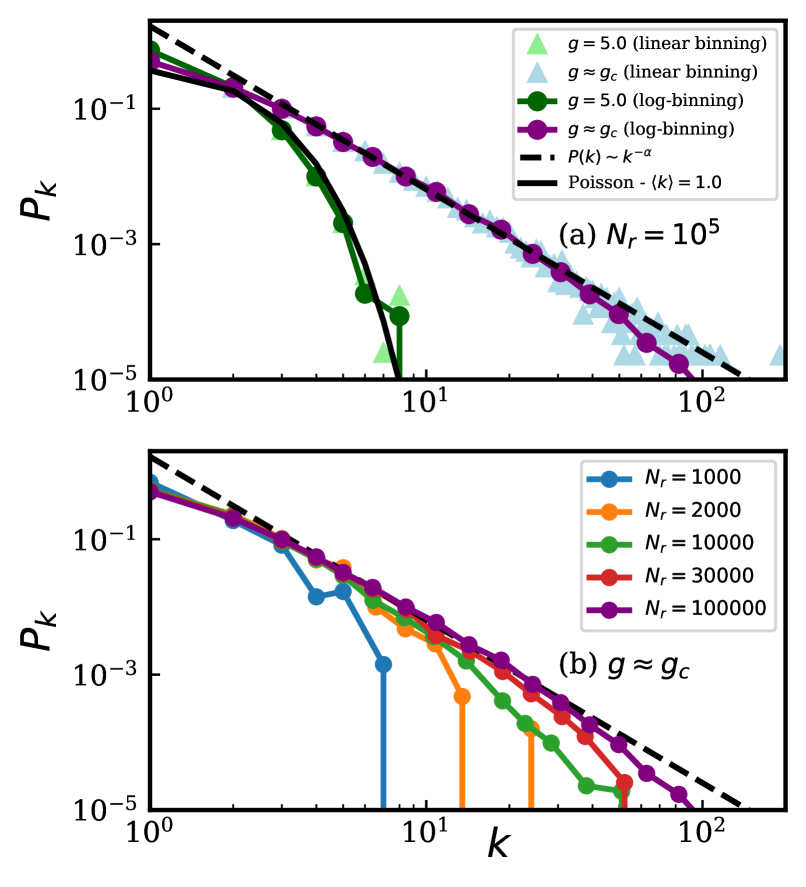
- 波動関数ネットワークは相関が強い領域でスケールフリーになり得る一方、パラメトリック(ER様)領域は Erdos-Renyi ネットワークに似る。
- 2D 量子 Ising モデルでは、学位分布 Pk はパラメトリック相でポアソン分布であり、臨界点近傍ではべき乗則 α ≈ 2.4。
- ルビジウム系の量子シミュレータを用いた実験では、Pk が短時間では指数関数的減衰から後半には安定したべき乗尾部(α < 2)へと進化する。
- 配列中の約3% の欠陥を含めてもスケールフリー構造を崩さず、ネットワーク署名の頑健性を示す。
- ネットワークベースのテストによるクロスプラットフォーム検証はおよそ 4 μs まで波動関数レベルの挙動を約 90% の信頼度で認証できる。
- 波動関数スナップショットの Kolmogorov 複雑性は 2-NN の intrinsic-dimension アプローチで推定でき、普遍的挙動が蓄積するにつれて現れる単純さを示す。
より良い研究を、今すぐ始めましょう
論文設計から論文執筆まで、研究時間を劇的に削減しましょう。
クレジットカード登録不要
このレビューはAIが作成し、人間の編集者が確認しました。