
[論文レビュー] Wavefield Networked Sensing: Principles, Algorithms and Applications
本稿は、回折トモグラフィ理論(DTT)を用いた物理駆動型フレームワークを提示し、ネットワーク化された無線センシングにおける像分解能の最適化とグレーティング lobes の抑制を実現する。波数トランセレーショントランスフォーメーション原理を活用して複数端末を統合制御することで、制限された帯域幅下でも高品質な像を得ることが可能となり、任意のトポロジーにおいて多ステーション低分解能データのコherent結合を活用する。
Networked sensing refers to the capability of properly orchestrating multiple sensing terminals to enhance specific figures of merit, e.g., positioning accuracy or imaging resolution. Regarding radio-based sensing, it is essential to understand extit{when} and extit{how} sensing terminals should be orchestrated, namely the best cooperation that trades between performance and cost (e.g., energy consumption, communication overhead, and complexity). This paper addresses networked sensing from a physics-driven perspective, aiming to provide a general theoretical benchmark to evaluate its extit{imaging} performance bounds and to guide the sensing orchestration accordingly. Diffraction tomography theory (DTT) is the method to quantify the imaging resolution of any radio sensing experiment from inspection of its spectral (or wavenumber) content. In networked sensing, the image formation is based on the back-projection integral, valid for any network topology and physical configuration of the terminals. The extit{wavefield networked sensing} is a framework in which multiple sensing terminals are orchestrated during the acquisition process to maximize the imaging quality (resolution and grating lobes suppression) by pursuing the deceptively simple extit{wavenumber tessellation principle}. We discuss all the cooperation possibilities between sensing terminals and possible killer applications. Remarkably, we show that the proposed method allows obtaining high-quality images of the environment in limited bandwidth conditions, leveraging the coherent combination of multiple multi-static low-resolution images.
研究の動機と目的
- ネットワーク化センシングの像形成性能を評価するための物理的理論的ベンチマークを確立すること。
- 性能とコスト(エネルギー、複雑性、通信オーバーヘッド)のバランスを考慮したセンシング端末の統合制御を導くこと。
- 制限された帯域幅下でも、多ステーション低分解能データのコherent結合により高分解能像形成を実現すること。
- スペクトルカバレッジと波数トランセレーショントランスフォーメーションに基づき、coherent と incoherent、monostatic と bistatic の最適協調戦略を特定すること。
- 任意のネットワークトポロジー、端末能力、センシング設定に適用可能な一般化されたフレームワークを提供すること。
提案手法
- 本稿は、センシング取得のスペクトル(波数)コンテンツに基づいて像分解能を定量化するため、回折トモグラフィ理論(DTT)を採用する。
- 任意のネットワークトポロジーや端末の物理的配置に有効な一般化されたバックプロジェクション積分を導出する。
- 波数トランセレーショントランスフォーメーション原理を、スペクトルカバレッジと像質の最大化のためのコアな統合制御戦略として提案する。
- 空間スペクトルのネットワーク化システムに基づいて、分解能、PSLR、ISLR などの指標を用いて性能を評価する。
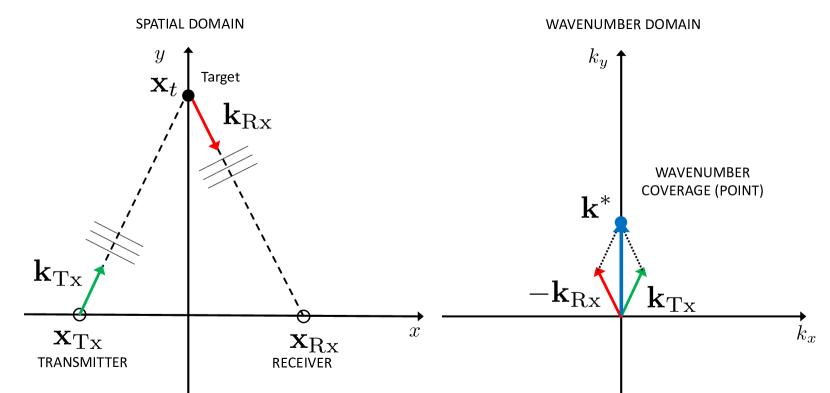
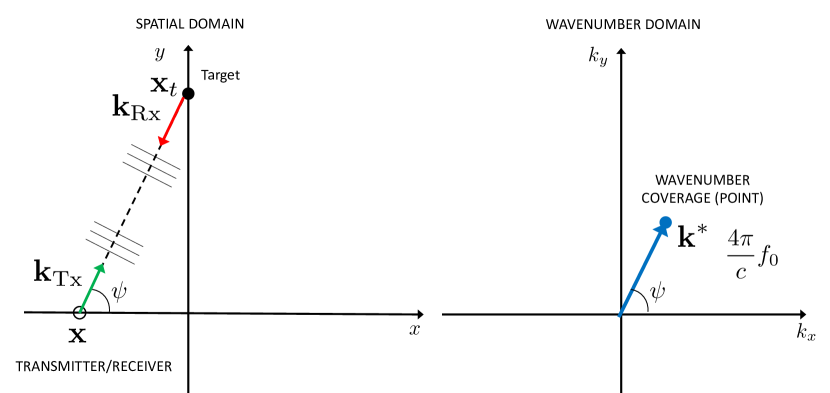
- モノステートおよびバイステート設定を分析し、スペクトルカバレッジが不十分(例:送信・受信方向が反対)な場合、分解能の低下とグレーティング lobes が生じることを示す。
- 信号や雑音モデルに依存しない、ネットワークとターゲットの幾何的情報のみを用いて、像形成性能を予測可能である。
実験結果
リサーチクエスチョン
- RQ1ネットワーク化センシング端末をどのように統合制御すれば、コストを最小限に抑えながら像分解能を最大化できるか?
- RQ2ネットワーク化センシングシステムの根本的な像形成性能限界は何か? そして、物理的原理からどのように予測できるか?
- RQ3波数ドメインのスペクトルカバレッジが、特にマルチステーション設定において像質にどのように影響するか?
- RQ4分解能とグレーティング lobes の抑制という観点から、モノステートとバイステートセンシングの間にはどのような性能的トレードオフがあるか?
- RQ5任意のネットワークトポロジーや端末能力に適用可能な、統一された理論的フレームワークを構築できるか?
主な発見
- 波数トランセレーショントランスフォーメーション原理により、最適なスペクトルカバレッジが実現され、制限された帯域幅下でも高分解能像形成が可能となる。
- y軸に沿って送信・受信端末が反対方向を向いたバイステート設定では、その方向にスペクトルカバレッジがゼロとなり、分解能が完全に消失する。
- バイステートシステムにおける空間分解能は、バイステート角の半分のコサインに比例し、120°を超える角度では顕著な性能劣化が生じる。
- 空間スペクトルが疎である場合、マルチステーション像のcoherent融合は効果を発揮せず、高レベルのグレーティング lobes とターゲット検出性の低下を引き起こす。
- モノステート設定は最高の分解能を達成するが、大きな角度を持つバイステートペアは、性能対コストの観点から劣る。
- DTTに基づくフレームワークは、ノイズのない、信号に依存しないベンチマークを提供し、CRLBとは異なる新たなKPIのクラスをセンシングシステムに可能にする。
より良い研究を、今すぐ始めましょう
論文の読解から最終レビューまで、研究時間を劇的に削減しましょう。
クレジットカード登録不要
このレビューはAIが作成し、人間の編集者が確認しました。