
[論文レビュー] Wavelength-accurate and wafer-scale process for nonlinear frequency mixers in thin-film lithium niobate
本論文は、薄膜 tantalate (TFLN) 非線形周波数混合器のエッチング前ポーリングプロセスを提示し、波導幾何形状の事前および事後エッチングメトロロジーを可能にすることで、波長の正確性を向上させる。この手法により、73%の二次高調波生成デバイスが±5 nm以内のターゲット波長に達し、熱光的チューニングにより約96%が仕様範囲内に収束し、高精度なTFLN光回路のスケーラブル統合を可能にする。
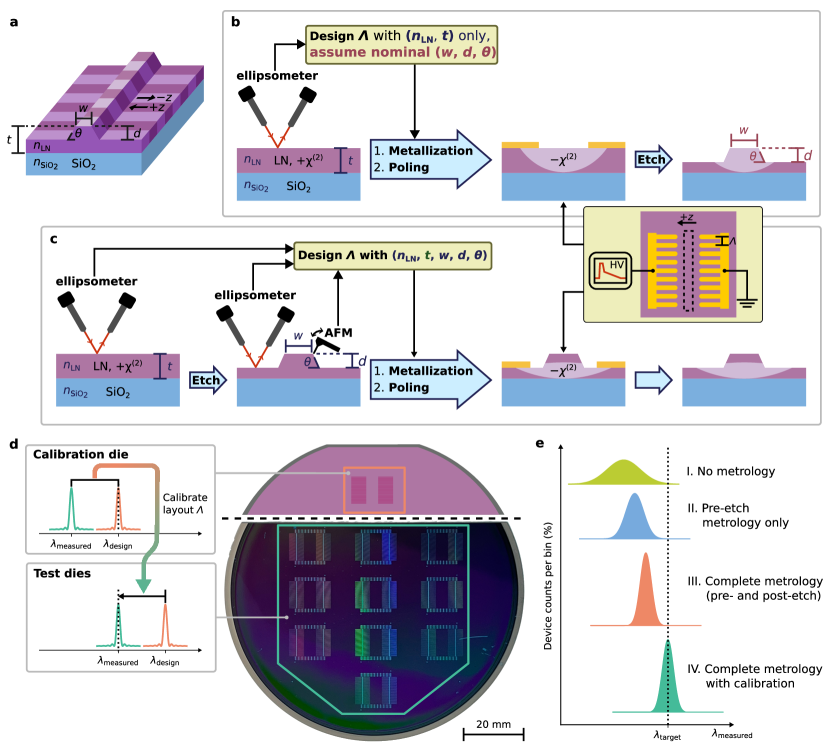
Recent advancements in thin-film lithium niobate (TFLN) photonics have led to a new generation of high-performance electro-optic devices, including modulators, frequency combs, and microwave-to-optical transducers. However, the broader adoption of TFLN-based devices that rely on all-optical nonlinearities have been limited by the sensitivity of quasi-phase matching (QPM), realized via ferroelectric poling, to fabrication tolerances. Here, we propose a scalable fabrication process aimed at improving the wavelength-accuracy of optical frequency mixers in TFLN. In contrast to the conventional pole-before-etch approach, we first define the waveguide in TFLN and then perform ferroelectric poling. This sequence allows for precise metrology before and after waveguide definition to fully capture the geometry imperfections. Systematic errors can also be calibrated by measuring a subset of devices to fine-tune the QPM design for remaining devices on the wafer. Using this method, we fabricated a large number of second harmonic generation devices aimed at generating 737 nm light, with 73% operating within 5 nm of the target wavelength. Furthermore, we also demonstrate thermo-optic tuning and trimming of the devices via cladding deposition, with the former bringing ~96% of tested devices to the target wavelength. Our technique enables the rapid growth of integrated quantum frequency converters, photon pair sources, and optical parametric amplifiers, thus facilitating the integration of TFLN-based nonlinear frequency mixers into more complex and functional photonic systems.
研究の動機と目的
- 製造による幾何形状のばらつきが原因で生じるTFLNベースの非線形周波数混合器における波長不正確性の課題に対処すること。
- ポーリングとエッチングを分離することで、準位相一致(QPM)デバイスのウェーハスケール、高精度なプロセスを可能にすること。
- 波導幾何形状のメトロロジーを用いた体系的な誤差補正を導入することで、試行錯誤に依存する設計を低減すること。
- 複雑な光子回路への統合を可能にする、スケーラブルな波長チューニングおよびトリミングを実証すること。
- 量子周波数変換や光子対源などの応用に適した、高収率かつ波長正確なデバイスを実現すること。
提案手法
- 従来のポーリング→エッチングの順序を逆転させ、最初に乾式エッチングにより波導を定義する。
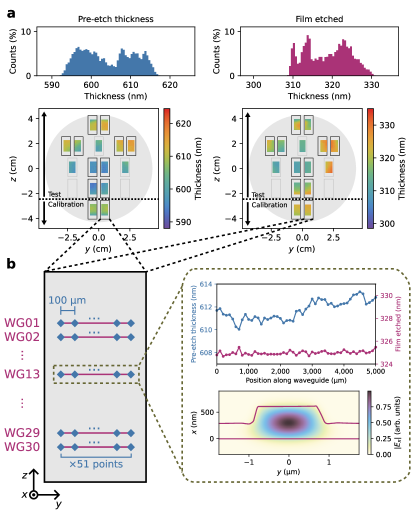
- ウェーハ全体の複数の位置で、原子間力顕微鏡(AFM)を用いてエッチング前およびエッチング後の膜厚および波導幾何形状を測定する。
- 測定された波導断面に基づき、幾何形状の不備を補償するため、局所的に変化するQPMグレーティング周期を計算する。
- 一部のデバイスを測定することで体系的な誤差を補正し、ウェーハ上に残るデバイスのQPM設計パrameterを調整する。
- オフチップのセラミックヒーターを用いて熱光的チューニングを実施し、120 °Cの範囲で動作波長をシフトさせる。
- クラッド膜のSiO₂堆積を用いて波長トリミングを実施し、膜厚が増加するにつれてブルー・シフト率が低下する。
実験結果
リサーチクエスチョン
- RQ1ウェーハスケールのプロセスにより、ポーリングとエッチングを分離することで、TFLN非線形周波数混合器における波長正確性が向上するか。
- RQ2エッチング前後におけるメトロロジーが、QPMデバイスにおける波長偏差をどの程度低減できるか。
- RQ3測定されたデバイス幾何形状に基づく体系的誤差補正が、ウェーハ全体における収率および正確性を向上させられるか。
- RQ4高精度なTFLNデバイスにおける残存波長誤差の補正に、熱光的チューニングはどの程度効果的か。
- RQ5クラッド膜の堆積が、スケーラブルで低損失な方法として、非線形混合器の動作波長を微調整可能か。
主な発見
- 体系的補正後、73%の二次高調波生成デバイスがターゲット波長737 nmの±5 nm以内に達した。
- 熱光的チューニングにより、動作波長が最大12.1 nmシフトし、試験されたデバイスの約96%がターゲット波長範囲内に収束した。
- SiO₂のクラッド膜堆積により、動作波長が100 nm以上ブルー・シフトしたが、膜厚が増加するにつれてチューニング率は低下した。
- エッチング前ポーリングプロセスにより、局所的な波導幾何形状測定を用いたQPMグレーティング周期の正確なキャリブレーションが可能となり、従来手法と比較して波長分散が低減した。
- 2回のウェーハランで、波長正確なデバイスの高収率を達成した。それぞれ600および300個のキャリブレーション不要デバイスが製造された。
- 高クラッド膜厚でのスペクトル幅の拡大は、群速度不一致の増加を示唆したが、通常のトリミング範囲(<50 nm)では影響は最小限であった。
より良い研究を、今すぐ始めましょう
論文の読解から最終レビューまで、研究時間を劇的に削減しましょう。
クレジットカード登録不要
このレビューはAIが作成し、人間の編集者が確認しました。