
[論文レビュー] What does it take to catch a Chinchilla? Verifying Rules on Large-Scale Neural Network Training via Compute Monitoring
本論文は、大規模な機械学習の訓練規則を検証するために、MLチップ上のウェイトスナップショットの記録、トランスクリプトの起源追跡、サプライチェーン監視を組み合わせたハードウェア・ソフトウェア監視フレームワークを提案し、機密データを開示することなく規則違反の訓練実行を高確率で検出できるようにする。
As advanced machine learning systems' capabilities begin to play a significant role in geopolitics and societal order, it may become imperative that (1) governments be able to enforce rules on the development of advanced ML systems within their borders, and (2) countries be able to verify each other's compliance with potential future international agreements on advanced ML development. This work analyzes one mechanism to achieve this, by monitoring the computing hardware used for large-scale NN training. The framework's primary goal is to provide governments high confidence that no actor uses large quantities of specialized ML chips to execute a training run in violation of agreed rules. At the same time, the system does not curtail the use of consumer computing devices, and maintains the privacy and confidentiality of ML practitioners' models, data, and hyperparameters. The system consists of interventions at three stages: (1) using on-chip firmware to occasionally save snapshots of the the neural network weights stored in device memory, in a form that an inspector could later retrieve; (2) saving sufficient information about each training run to prove to inspectors the details of the training run that had resulted in the snapshotted weights; and (3) monitoring the chip supply chain to ensure that no actor can avoid discovery by amassing a large quantity of un-tracked chips. The proposed design decomposes the ML training rule verification problem into a series of narrow technical challenges, including a new variant of the Proof-of-Learning problem [Jia et al. '21].
研究の動機と目的
- 高度な機械学習のガバナンスを促進するため、訓練規則の政府による検証を可能にする。
- チップ、データセンター、サプライチェーンにまたがる三層監視フレームワークを提案する。
- 訓練データとモデルの機密性を確保しつつ、高確率の規則検出を可能にする。
- このような検証システムの実用性、限界、課題を評価する。
提案手法
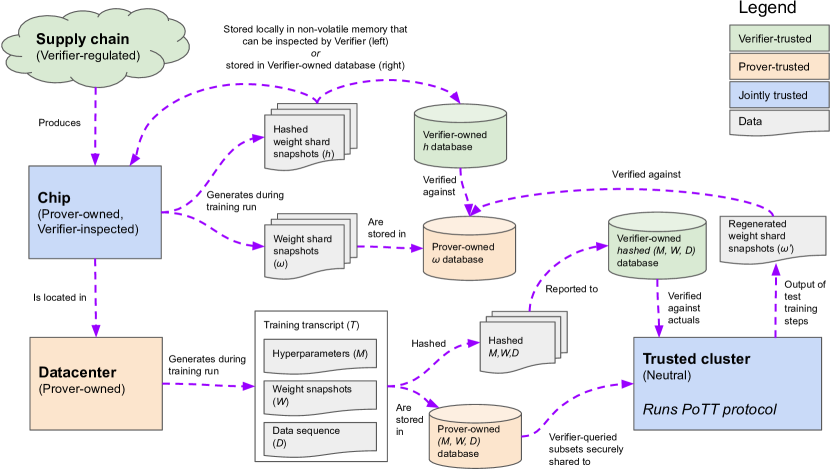
- ハードウェアに裏打ちされたファームウェア attestations に基づく、オンチップのウェイト・シャードスナップショット記録を導入する。
- 出自を証明するために、ウェイトスナップショットのハッシュと対応する訓練トランスクリプトの伝送を要求する(Proof-of-Learning に触発されたプロトコルを介して)。
- 追跡されていないチップの隠蔽を防ぐため、サプライチェーンの所有権検証を実装する。
- サンプルサイズと計算パラメータに基づく、規則違反の訓練実行を捉える確率保証を導出する。
- さまざまな規模で過去および将来のモデルに必要な検査を見積もる定量的な表を提供する。
実験結果
リサーチクエスチョン
- RQ1検証者は、ML訓練規則違反を高い確率で検出するために、最小限どの検証可能なアクションを要求できるか?
- RQ2チップレベルの記録、訓練トランスクリプト、サプライチェーン監視をどのように統合して、堅牢な遵守証明を提供できるか?
- RQ3大規模な規則違反実行を検出するために必要な実践的なサンプルサイズと検査頻度はどれくらいか?
- RQ4この監視手法で強制できる規則(計算量、データ特性、ハイパーパラメータ、性能閾値)は何か?
- RQ5提案されたフレームワークのスケーラビリティとセキュリティの制約は何か?
主な発見
| モデル | トレーニングFLOPs | H100-days | 1年で訓練する H100 の数 | サンプル/年 (C=1e3) | サンプル/年 (C=1e5) | サンプル/年 (C=1e7) |
|---|---|---|---|---|---|---|
| GPT-3 | 3.14e+23 | 3.64e+3 | 10 | 243 | 2.43e+4 | 2.43e+6 |
| Chinchilla | 5.76e+23 | 6.67e+3 | 19 | 132 | 1.33e+4 | 1.33e+6 |
| PaLM | 2.56e+24 | 2.96e+4 | 82 | 29 | 2.98e+3 | 2.99e+5 |
| Chinchilla-280B | 9.9e+24 | 1.15e+5 | 314 | 7 | 771 | 7.72e+4 |
| Chinchilla-1T | 1.27e+26 | 1.47e+6 | 4.03e+3 | — | 60 | 6.02e+3 |
| Chinchilla-10T | 1.3e+28 | 1.5e+8 | 4.12e+5 | — | — | 58 |
- サンプリングベースの枠組みは、チップの一部を検査し、ウェイトスナップショットのハッシュを訓練トランスクリプトと照合することで、高い確率で規則違反の訓練実行を検出できる。
- 本論文は、モデルの規模とチップ数に応じた年間に必要なサンプル数の定量的推定を示し、モデルサイズとスケール性を示している。
- ウェイトシャードのスナップショットとハッシュ化された出自情報により、機密データやウェイトを公開せずに遡及的検証が可能になる。
- 追跡されていないチップが大規模な訓練実行を隠すのを防ぐため、サプライチェーン監視は不可欠である。
- このアプローチは主に特化型ア クセラレータでの大規模訓練に対して実現可能性が高く、古いチップやセンター外の計算には制約がある。
より良い研究を、今すぐ始めましょう
論文設計から論文執筆まで、研究時間を劇的に削減しましょう。
クレジットカード登録不要
このレビューはAIが作成し、人間の編集者が確認しました。