
[論文レビュー] Where are NANOGrav's big black holes?
この論文は、パルサー・ティミング・アレイ(PTA)が測定した重力波背景(GWb)の振幅と、局所の超大質量ブラックホール(SMBH)質量関数に基づく理論的予測との乖離を調査する。フィネイ(2001)の形式を用いて、観測されたGWbの振幅は、合体レートの増加や質量依存的進化では説明できないことが示され、代わりにGWbは質量が約3×10¹⁰ M☉のSMBHに支配されていることを示唆する。これは、100 Mpc圏内にこれまで検出されていなかったような、極めて質量の大きなブラックホールの集団を必要とする。
Multiple pulsar timing array (PTA) collaborations have recently reported the first detection of gravitational waves (GWs) of nanohertz frequencies. The signal is expected to be primarily sourced by inspiralling supermassive black hole binaries (SMBHBs) and these first results are broadly consistent with the expected GW spectrum from such a population. Curiously, the measured amplitude of the GW background in all announced results is a bit larger than theoretical predictions. In this work, we show that the amplitude of the stochastic gravitational wave background (SGWB) predicted from the present-day abundance of SMBHs derived from local scaling relations is significantly smaller than that measured by the PTAs. We demonstrate that this difference cannot be accounted for through changes in the merger history of SMBHs and that there is an upper limit to the boost to the characteristic strain from multiple merger events, due to the fact that they involve black holes of decreasing masses. If we require the current estimate of the black hole mass density -- equal to the integrated quasar luminosity function through the classic Soltan argument -- to be preserved, then the currently measured PTA result would imply that the typical total mass of SMBHs contributing to the background should be at least $\sim 3 imes 10^{10} M_\odot$, a factor of $\sim 10$ larger than previously predicted. The required space density of such massive black holes corresponds to order $10$ $3 imes 10^{10} M_\odot$ SMBHs within the volume accessible by stellar and gas dynamical SMBH measurements. By virtue of the GW signal being dominated by the massive end of the SMBH distribution, PTA measurements offer a unique window into such rare objects and complement existing electromagnetic observations.
研究の動機と目的
- PTAが測定したナノヘルツスケールの重力波背景(GWb)の振幅と、局所のSMBH質量関数に基づく理論的予測との間の矛盾を解消すること。
- SMBHの合体レートの増加や質量の進化が、過剰なGWb振幅を説明できるかどうかを検証すること。
- Sołtanの議論により全ブラックホール質量密度を保存しつつ、PTAの測定値に一致させるために必要な影響を評価すること。
- GW観測と電波観測を調和させるために必要なSMBH質量関数のピークを特定すること。
- M–σ関係や速度分散関数(VDF)の修正が、欠落している高質量集団を説明できるかどうかを評価すること。
提案手法
- Phinney(2001)の形式を応用し、二重星の合体歴史を介して現在のSMBH集団と確率的重力波背景(SGWB)を結びつける。
- Sołtanの議論を用いて全ブラックホール質量密度を保存し、SMBH質量関数の高質量尾部に必要な制約を与える。
- Hénon–Hertzsprung関係を用いて、SGWBの特徴的歪みをSMBH質量関数の関数としてモデル化する。
- 複数回の合体によるGW歪みへの最大ブーストを定量化し、ブラックホール質量の減少に伴い、その値が約1.64に制限されることを示す。
- M–σ関係および速度分散関数(VDF)における内挿散乱(ε₀)と転換スケール(σ*)の変動が与える影響を評価する。
- 高速度分散領域におけるM–σ関係の傾きを鋭くすることで、必要な高質量集団を説明できるかどうかをテストする。
実験結果
リサーチクエスチョン
- RQ1PTAが測定した重力波背景の過剰な振幅は、SMBHの合体レートの増加によって説明可能か?
- RQ2段階的に軽くなるブラックホールを含む複数回の合体イベントによる特徴的歪みへの最大ブーストはどの程度か?
- RQ3Sołtanの議論により全ブラックホール質量密度を保存しつつ、PTAのGWb振幅に一致させるために必要なSMBH質量関数のピークはどの程度か?
- RQ4M–σ関係やVDFに必要な修正は、SMBH質量および速度分散に関する現在の観測制約と整合的か?
- RQ5観測されたGWbを説明するために、超巨大SMBH(M ∼ 3×10¹⁰ M☉)の局所空間密度はどの程度必要か?
主な発見
- 観測されたPTAのGWb振幅は、合体歴史を考慮しても、局所のSMBH質量関数に基づく理論的予測を大幅に上回っている。
- 複数回の合体による特徴的歪みへの最大理論的ブーストは約1.64に制限され、これは観測された過剰な振幅を説明するには不十分である。
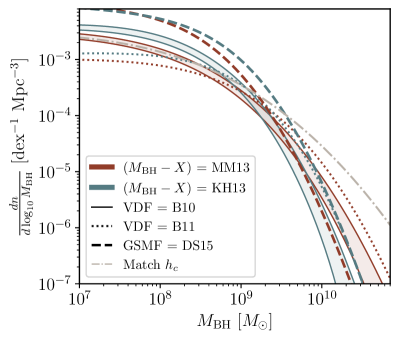
- Sołtanの議論により全ブラックホール質量密度を保存しつつPTA測定値に一致させるためには、GWbに寄与するピーク質量が約3×10¹⁰ M☉でなければならない。これは、局所観測から予測される値のおよそ10倍に相当する。
- 必要な局所空間密度は、100 Mpc圏内に質量が約3×10¹⁰ M☉のSMBHが約10個、または質量が約10¹¹ M☉のSMBHが1個存在することに対応するが、これはまだ星間またはガス力学的測定で検出されていない集団である。
- M–σ関係の内挿散乱や転換スケールの修正は、必要な高質量集団を説明するには不十分であり、観測の残差フィットに反する可能性がある。
- 高速度分散領域でM–σ関係の傾きを鋭くすることで、欠落している高質量尾部を説明できる可能性があるが、それでも不一致を完全に解消することはできず、より大きな質量のSMBH集団が存在する必要があることを示唆する。
より良い研究を、今すぐ始めましょう
論文の読解から最終レビューまで、研究時間を劇的に削減しましょう。
クレジットカード登録不要
このレビューはAIが作成し、人間の編集者が確認しました。