
[論文レビュー] Why is AI not a Panacea for Data Workers? An Interview Study on Human-AI Collaboration in Data Storytelling
この研究は18名のデータ作業者へのインタビューを通じて、データのストーリーテリングのワークフロー全体でAIとどこで、どう、なぜ協力したいのかを把握し、4つのAI役割と混合のエージェンシー-オートメーションパターンを提案します。
Data storytelling plays an important role in data workers' daily jobs since it boosts team collaboration and public communication. However, to make an appealing data story, data workers spend tremendous efforts on various tasks, including outlining and styling the story. Recently, a growing research trend has been exploring how to assist data storytelling with advanced artificial intelligence (AI). However, existing studies may focus on individual tasks in the workflow of data storytelling and do not reveal a complete picture of humans' preference for collaborating with AI. To better understand real-world needs, we interviewed eighteen data workers from both industry and academia to learn where and how they would like to collaborate with AI. Surprisingly, though the participants showed excitement about collaborating with AI, many of them also expressed reluctance and pointed out nuanced reasons. Based on their responses, we first characterize stages and tasks in the practical data storytelling workflows and the desired roles of AI. Then the preferred collaboration patterns in different tasks are identified. Next, we summarize the interviewees' reasons why and why not they would like to collaborate with AI. Finally, we provide suggestions for human-AI collaborative data storytelling to hopefully shed light on future related research.
研究の動機と目的
- 実世界のデータストーリーテリングのワークフローにおける段階とタスクを特徴づける。
- 計画、実行、伝達の各段階でデータ作業者がAIとどこで、どう協力したいかを特定する。
- エージェンシー-オートメーションの枠組みを用いてAI役割の好みを分析する。
- データストーリーテリングにおけるAIの採用理由と反対理由を要約し、設計指針を提供する。
提案手法
- academiaと産業界から18名のデータ作業者を対象に半構造化インタビューを実施した。
- マインドマップを用いて各参加者のデータストーリーテリングのワークフローを引き出した。
- 反復的なコーディングを適用して、インタビューの転写から協力パターンとAI役割を導出した。
実験結果
リサーチクエスチョン
- RQ1データストーリーテリングのワークフローで人間はどこでAIと協力したいか。
- RQ2さまざまなストーリーテリングタスクを横断して、AIと人間はどのように協力したいか。
- RQ3データ作業者はデータストーリーテリングにおけるAIとの協力をなぜ好むのか、あるいは避けるのか。
- RQ4データストーリーテリングのワークフローに最も適したAIの役割と協力パターンは何か。
主な発見
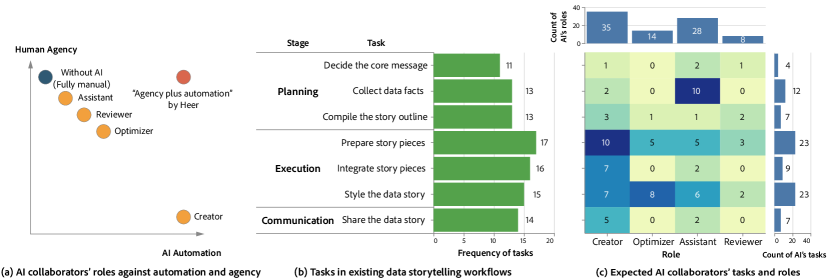
- データストーリーテリングのワークフローは計画、実行、伝達の3つの段階と8つのタスクから成る。
- 参加者はAIの4つの役割—クリエイター、オプティマイザー、レビュアー、アシスタント—を、エージェンシー-オートメーションのスペクトラムに沿ってマッピングして好む。
- 協力パターンは計画と実行に集中しており、AIはデータ事実の収集ではアシスタントとして、ストーリーの一部とスタイリングではクリエイターまたはオプティマイザーとして機能することが多い。
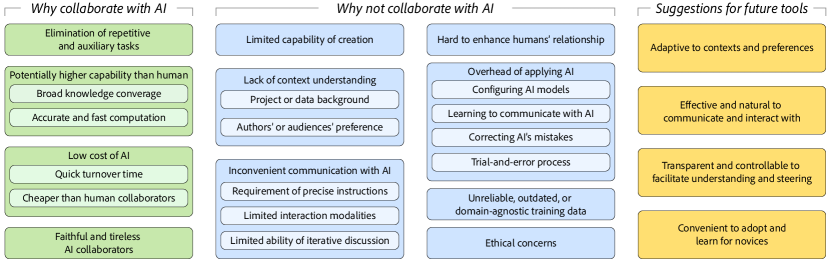
- AIへのアクセスは反復タスクの作業負荷を減らすために評価されているが、文脈を理解し人間の制御を維持することへの懸念が生じる。
- 人々は段階を横断して混合パターンを好み、高い人間のエージェンシーとAIの自動化を組み合わせたい(エージェンシー+オートメーション)。
- ほとんどの参加者は人間のストーリーテリングを完全に置き換えることには消極的で、聴衆の理解と文脈的ニュアンスを維持するAIサポートを好む。
より良い研究を、今すぐ始めましょう
論文設計から論文執筆まで、研究時間を劇的に削減しましょう。
クレジットカード登録不要
このレビューはAIが作成し、人間の編集者が確認しました。