
[論文レビュー] Wireless Multi-Agent Generative AI: From Connected Intelligence to Collective Intelligence
tldr: 本論文は、無線ネットワークにおける on-device, multi-agent generative AI の基盤を構築し、edgeでの集合知を実現するための planning、game-theoretic interactions、semantic communication を分析して、on-device LLMs を用いたケーススタディを通じてネットワークのエネルギー節約をデモンストレーションします。
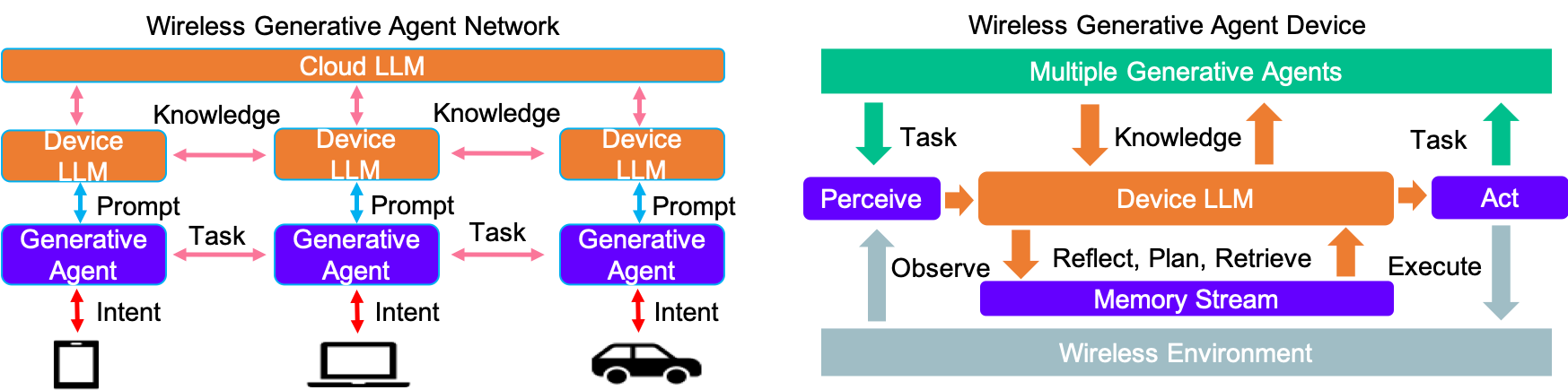
The convergence of generative large language models (LLMs), edge networks, and multi-agent systems represents a groundbreaking synergy that holds immense promise for future wireless generations, harnessing the power of collective intelligence and paving the way for self-governed networks where intelligent decision-making happens right at the edge. This article puts the stepping-stone for incorporating multi-agent generative artificial intelligence (AI) in wireless networks, and sets the scene for realizing on-device LLMs, where multi-agent LLMs are collaboratively planning and solving tasks to achieve a number of network goals. We further investigate the profound limitations of cloud-based LLMs, and explore multi-agent LLMs from a game theoretic perspective, where agents collaboratively solve tasks in competitive environments. Moreover, we establish the underpinnings for the architecture design of wireless multi-agent generative AI systems at the network level and the agent level, and we identify the wireless technologies that are envisioned to play a key role in enabling on-device LLM. To demonstrate the promising potentials of wireless multi-agent generative AI networks, we highlight the benefits that can be achieved when implementing wireless generative agents in intent-based networking, and we provide a case study to showcase how on-device LLMs can contribute to solving network intents in a collaborative fashion. We finally shed lights on potential challenges and sketch a research roadmap towards realizing the vision of wireless collective intelligence.
研究の動機と目的
- 無線ネットワークに生成型エージェントを統合してエッジベースの集合知を実現する動機付け。
- 6G無線システムにおける on-device LLMs の実現技術とアーキテクチャを特定する。
- 複数のLLMエージェント間の計画、推論、ゲーム理論的相互作用を探る。
- エージェント間で知識とタスクを効率的に共有する手段として意味通信を強調する。
- 多エージェント LLMs によって導かれるエネルギー節約の意図を示すケーススタディを示し、課題とロードマップを議論する。
提案手法
- 複数の on-device LLMs が相互作用してエッジ実行のための意図をタスクの連続として分解するアーキテクチャを記述する。
- システム-2 レベルの認識(チェーン・オブ・思考、自己一貫性、思考の木)を可能にする計画と推論技術を検討する。
- 協調行動を導出し、エージェント間の通信コストを削減するための多エージェント LLM ゲームと強化学習を導入する。
- 生データではなくタスクに関連する知識を転送するよう、意味情報と意味通信を提唱する。
- GPT-4 を用いたケーススタディを通じて、ネットワーク全体の最適化のための無線エネルギー節約ゲームを解く。

実験結果
リサーチクエスチョン
- RQ1クラウドベースの LLM に依存せず、on-device LLMs が協調して計画・推論・行動を行い、ネットワークレベルの目標を達成できるのか?
- RQ2ネットワークエッジでの効率的な集合知を実現するために、無線生成エージェント間のどのようなアーキテクチャと相互作用が必要か?
- RQ3計画、推論、MARL は、無線環境における協調的でありながら競争的な多エージェント行動の実現にどのような役割を果たすか?
- RQ4意味通信は、マルチエージェントの無線ネットワークにおいて LLM にとってタスクに関連する知識を保持しつつ情報交換を削減するのにどう寄与できるか?
- RQ5エッジネットワークにおける Telecom ドメインの LLMs に関する主な課題(例:幻覚、自己複製概念、リソース管理)と今後の方向性は何か?
主な発見
- オンデバイスの多エージェント LLMs は、閉ループ(計画、実行、最適化)としてネットワーク目標を達成するために協調して telecom タスクを計画・解決できる。
- ゲーム理論と MARL は、エージェント間の相互作用をモデル化し、個々の KPI を考慮しつつ協調的なポリシーを学ぶ枠組みを提供する。
- 意味通信は、データ交換を削減し、エージェント間の協力を改善するために、タスク特異的知識を転送することができる。
- 四名のユーザーを対象としたエネルギー節約のケーススタディは、エージェンスデバイスの LLMs が電力節約目標を達成しつつレート制約を維持できることを示すが、エージェント数が増えると多エージェント協調が難しくなる。
- 論文は Telecom ドメイン特有の LLMs に必要な要素を特定し、on-device LLMs の幻覚、自己複製概念、リソース管理といった課題を指摘している。
より良い研究を、今すぐ始めましょう
論文設計から論文執筆まで、研究時間を劇的に削減しましょう。
クレジットカード登録不要
このレビューはAIが作成し、人間の編集者が確認しました。