
[논문 리뷰] A hybrid discrete-continuum modelling approach for the interactions of the immune system with oncolytic viral infections
이 연구는 면역세포, 감염된 암세포 및 미감염 암세포의 확률적 에이전트 기반 역학과 밀도 기반 연속체 PDE를 결합한 하이브리드 이산-연속 모델을 제시한다. 이 모델은 과도하게 빠른 면역 반응이 종양세포를 파괴하는 바이러스 치료의 효과를 떨어뜨릴 수 있음을 드러내며, 종양 및 환자 특화 요소에 맞춘 면역 반응 조절의 필요성을 강조한다.
Oncolytic virotherapy, utilizing genetically modified viruses to combat cancer and trigger anti-cancer immune responses, has garnered significant attention in recent years. In our previous work arXiv:2305.12386, we developed a stochastic agent-based model elucidating the spatial dynamics of infected and uninfected cells within solid tumours. Building upon this foundation, we present a novel stochastic agent-based model to describe the intricate interplay between the virus and the immune system; the agents' dynamics are coupled with a balance equation for the concentration of the chemoattractant that guides the movement of immune cells. We formally derive the continuum limit of the model and carry out a systematic quantitative comparison between this system of PDEs and the individual-based model in two spatial dimensions. Furthermore, we describe the traveling waves of the three populations, with the uninfected proliferative cells trying to escape from the infected cells while immune cells infiltrate the tumour. Simulations show a good agreement between agent-based approaches and numerical results for the continuum model. Some parameter ranges give rise to oscillations of cell number in both models, in line with the behaviour of the corresponding nonspatial model, which presents Hopf bifurcations. Nevertheless, in some situations the behaviours of the two models may differ significantly, suggesting that stochasticity plays a key role in the dynamics. Our results highlight that a too rapid immune response, before the infection is well-established, appears to decrease the efficacy of the therapy and thus some care is needed when oncolytic virotherapy is combined with immunotherapy. This further suggests the importance of clinically improving the modulation of the immune response according to the tumour's characteristics and to the immune capabilities of the patients.
연구 동기 및 목표
- 온콜리틱 바이러스, 종양세포 및 면역세포 간의 공간적 상호작용과 확률적 상호작용을 포괄하는 하이브리드 모델링 프레임워크를 개발하기 위해.
- 연속체 PDE를 통해 유도된 화학유인물질에 의한 면역세포 유입이 실체 종양에서 온콜리틱 바이러스 치료 결과에 미치는 영향을 조사하기 위해.
- 에이전트 기반 시뮬레이션과 그 연속체 PDE 근사치를 비교하여 모델 행동의 타당성을 검증하고, 확률적 성격으로 인한 이질성을 규명하기 위해.
- 특히 병용 바이로치료 및 면역치료의 맥락에서 면역 반응의 시기와 강도가 치료 효과에 미치는 영향을 탐색하기 위해.
- 면역 반응 유도가 바이러스 온콜리시스를 촉진하는지 또는 저해하는지의 조건을 규명하여 최적의 치료 일정 수립에 기여하기 위해.
제안 방법
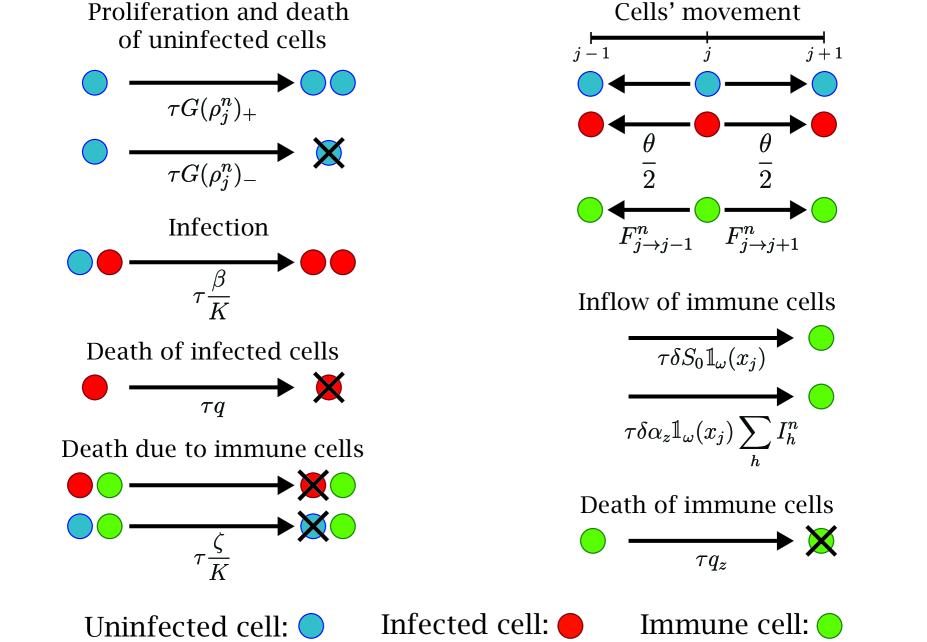
- 확률적 에이전트 기반 모델은 이동, 증식, 사멸, 감염 및 화학유인물질 생산을 포함한 개별 면역세포, 감염된 암세포 및 미감염 암세포의 행동을 시뮬레이션한다.
- 면역세포의 화학유도성은 PDE 기반 화학유인물질 필드에 의해 구동되며, 노이만 경계 조건과 안정성을 확보하기 위한 업윈드 유한차분 방법을 사용한다.
- 에이전트 기반 모델의 연속체 근사는 수식적으로 유도되며, 세포 밀도와 화학유인물질 농도를 위한 연립 PDE 시스템을 도출한다.
- 수치적 시뮬레이션은 작은 시간 간격(Δt = 10⁻⁴ h)과 공간 해상도(Δx = 0.01 mm)를 사용한 명시적 유한차분법를 적용하여 급격한 면역세포 파동을 해석한다.
- 모델의 매개변수 값은 실험 데이터를 기반으로 캘리브레이션되며, 면역세포 이동 속도(χ = 0.165 mm²/h), 유입률(S₀ = 5.00×10⁻² cells/(mm²·h)), 면역세포 살해율(ζ = 0.50 또는 5.00 h⁻¹) 등이 포함된다.
- 모델 검증은 다수의 시뮬레이션 런과 공간 구성에서 에이전트 기반 모델과 연속체 모델 출력을 직접 비교함으로써 수행된다.
실험 결과
연구 질문
- RQ1화학유인물질에 의해 유도되는 면역세포 침투의 공간적 역학은 실체 종양에서 온콜리틱 바이로치료 결과에 어떻게 영향을 미치는가?
- RQ2에이전트 기반 모델과 연속체 모델이 서로 다름을 보이는 매개변수 영역은 어디이며, 이는 면역 반응 역학에서 확률적 성격의 역할을 어떻게 시사하는가?
- RQ3면역 반응의 시기와 강도는 온콜리틱 바이러스의 확산과 종양 조절에 성공에 어떻게 영향을 미치는가?
- RQ4종양 미세환경에서 미감염 세포, 감염 세포 및 면역세포의 이동파동이 나타나는 조건은 무엇인가?
- RQ5높은 공간 이질성 조건에서 개별 면역세포 및 감염 세포의 확률적 행동을 연속체 근사가 정확하게 표현할 수 있는가?
주요 결과
- 대부분의 매개변수 영역에서 에이전트 기반 모델과 연속체 모델 간에 강한 정량적 일치를 보이며, 대규모 동역학에 대한 PDE 근사의 타당성을 검증한다.
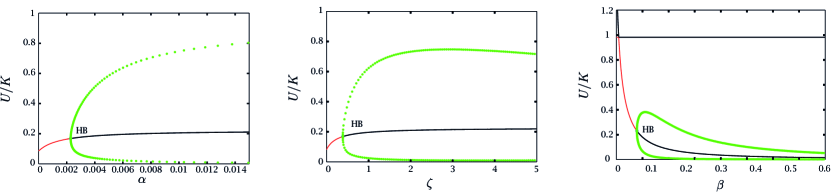
- 특히 높은 면역세포 살해율(ζ = 5.00 h⁻¹) 조건에서는 양 모델 모두 비공간 모델에서 관찰된 호프 분기와 일치하는 진동 동역학을 나타낸다.
- 바이러스 감염이 잘 정착되기 이르기 전에 너무 빠른 면역 반응은 치료 효과를著격히 감소시키며, 이는 해로운 시기 효과를 시사한다.
- 실제 조건에서 면역세포 이동 속도는 약 ~0.06 mm/h로 추정되며(χ = 0.165 mm²/h), 종양 미세환경 내 물리적 장벽과 일치한다.
- 모델은 감염에 의해 면역세포 유입이 증가함을 예측한다(α_z = 3.75×10⁻⁵ (mm²·h)⁻¹), 이는 종양 부위에 면역세포를 유인하는 데 기여한다.
- 파면 분석 결과, 미감염 세포는 감염 영역을 피하려는 경향이 있으며, 면역세포는 외곽에서 침투하여 명확한 이동파 패턴을 형성한다.
더 나은 연구,지금 바로 시작하세요
논문 읽기부터 검토까지, 연구 시간을 획기적으로 줄여보세요.
카드 등록 없음 · 무료 플랜 제공
이 리뷰는 AI가 만들고, 인간 에디터가 검토했습니다.