
[논문 리뷰] A Survey of Generative AI for de novo Drug Design: New Frontiers in Molecule and Protein Generation
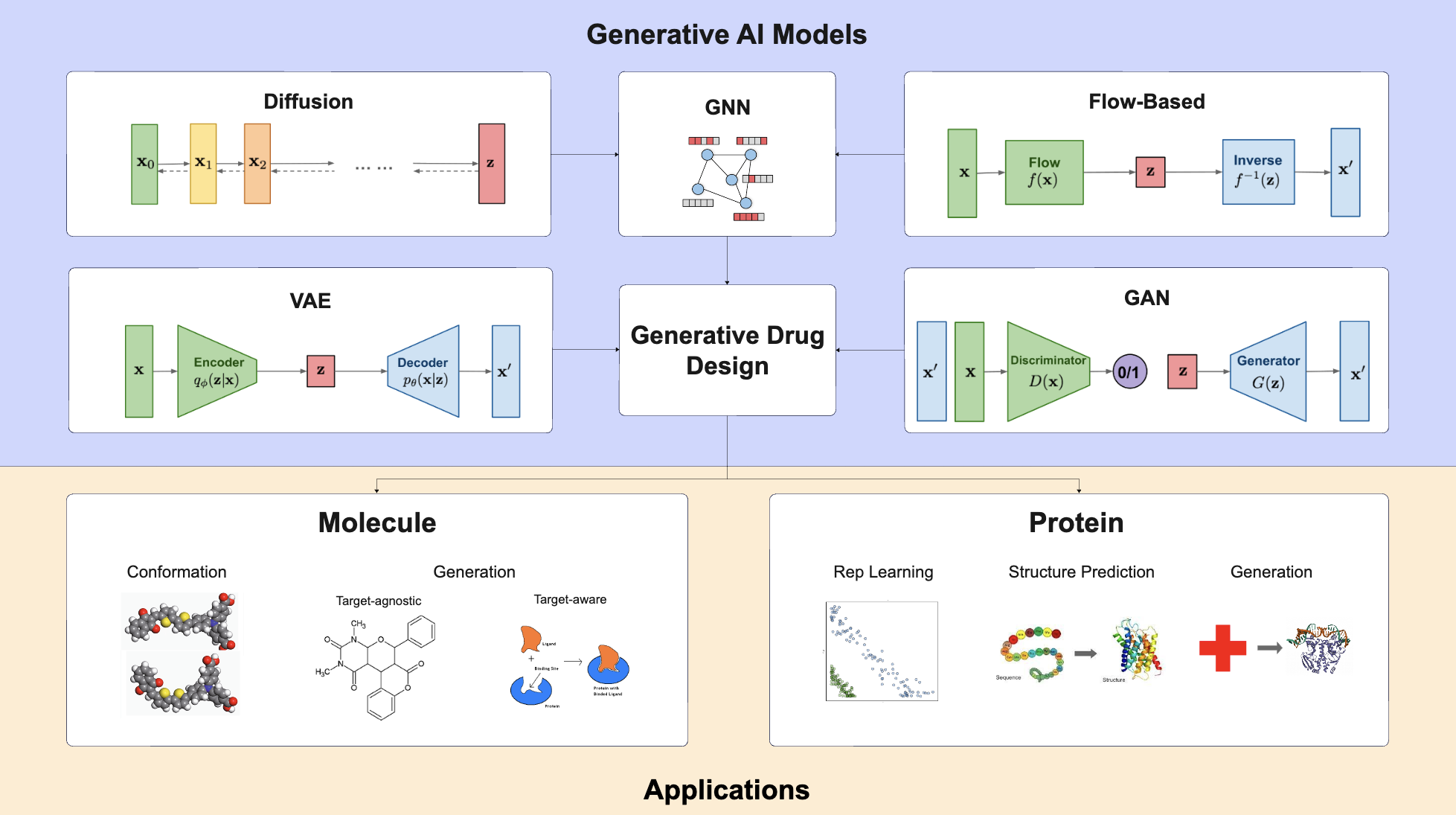
이 종합적 리뷰는 신약 설계를 위한 생성형 AI에 대해 소분자 및 단백질 생성에 초점을 맞춰 포괄적인 개요를 제공한다. 모델 아키텍처, 벤치마크, 데이터셋 및 다양한 작업에서의 성능을 평가하며, 확산 모델과 그래프 신경망이 주요 접근법임을 강조한다. 특히 단백질 생성에서는 RFDiffusion, 소분자 생성에서는 GeoLDM이 최고 성능을 기록하였다.
Artificial intelligence (AI)-driven methods can vastly improve the historically costly drug design process, with various generative models already in widespread use. Generative models for de novo drug design, in particular, focus on the creation of novel biological compounds entirely from scratch, representing a promising future direction. Rapid development in the field, combined with the inherent complexity of the drug design process, creates a difficult landscape for new researchers to enter. In this survey, we organize de novo drug design into two overarching themes: small molecule and protein generation. Within each theme, we identify a variety of subtasks and applications, highlighting important datasets, benchmarks, and model architectures and comparing the performance of top models. We take a broad approach to AI-driven drug design, allowing for both micro-level comparisons of various methods within each subtask and macro-level observations across different fields. We discuss parallel challenges and approaches between the two applications and highlight future directions for AI-driven de novo drug design as a whole. An organized repository of all covered sources is available at https://github.com/gersteinlab/GenAI4Drug.
연구 동기 및 목표
- 생성형 AI를 활용한 신약 설계 분야의 급속한 발전을 소분자 및 단백질 생성이라는 두 핵심 분야로 체계화하고 정리하기.
- 두 분야에서 핵심 하위 작업, 데이터셋, 벤치마크 프로토콜 및 모델 아키텍처를 식별하기.
- 목표 무관 및 목표 인식 생성 작업 전반에서 확산, GNN 기반, 유동 기반 아키텍처를 포함한 주요 모델의 성능를 비교하기.
- 해석 가능성, 벤치마크 표준화, 실제 생물학적 제약 조건과의 일치성과 같은 공통 과제를 부각하기.
- 향후 연구 방향을 제안하며, 개선된 작업 정의, 향상된 평가 지표, 결합 친화도 및 약물 유사성 예측 모델과의 통합을 포함한다.
제안 방법
- 이 리뷰는 생성형 AI 모델에 대한 체계적인 문헌 조사로, 입력 모odal리티(1D 서열 대비 2D/3D 구조)와 작업 유형(목표 무관 대비 목표 인식 생성)에 따라 방법을 분류한다.
- 변동형 자동차오더( variational autoencoders, VAEs), 생성적 적대 기반 네트워크(generative adversarial networks, GANs), 정규화 유동(normalizing flows), 확산 모델 등을 포함한 모델 아키텍처를 평가하며, 그래프 신경망(GNNs)과 E(3)-등변성 아키텍처에 특별한 주목을 기울인다.
- QM9, GEOM-Drugs와 같은 표준화된 벤치마크와 항체 CDR-H3 생성 및 접힘 분류에 사용된 단백질 전용 데이터셋을 분석하여 성능를 평가한다.
- 유효성, 안정성, 신규성, 성질 최적화(예: 결합 친화도, 약물 유사성) 등의 지표를 사용하여 성능를 비교하며, 목표 인식 생성 작업에 특별한 중점을 둔다.
- 조건부 생성에 사용되는 친화도 분류기와 같은 예측 모델의 통찰을 통합하여, 생물학적으로 관련성이 있는 결과를 유도하는 데서 그 역할을 강조한다.
- 재현성과 향후 참고를 위해 https://github.com/gersteinlab/GenAI4Drug 에서 모델 및 자료의 포괄적이고 체계화된 레포지터리를 구축한다.
실험 결과
연구 질문
- RQ1신약 설계에서의 생성형 AI 모델 아키텍처 중 주로 사용되는 것은 무엇이며, 소분자 및 단백질 생성 작업에서의 성능는 어떠한가?
- RQ2구조 기반 및 서열 기반 접근법은 새로운 안정성 있고 약물 유사성을 갖춘 소분자 및 단백질을 생성할 때 어떻게 비교되는가?
- RQ3해석 가능성, 벤치마크 표준화, 실제 적용 가능성 등의 과제는 생성형 AI가 신약 개발에 통합되는 데 있어 어떤 장애를 초래하는가?
- RQ4특히 E(3) 등변성을 갖춘 확산 모델은 어떤 방식으로 다른 아키텍처보다 분자 및 단백질 생성에서 뛰어난 성능를 발휘하는가?
- RQ5임상적으로 실현 가능한 신약 후보를 위한 생성형 AI의 발전을 위해 가장 중요한 향후 연구 방향은 무엇인가?
주요 결과
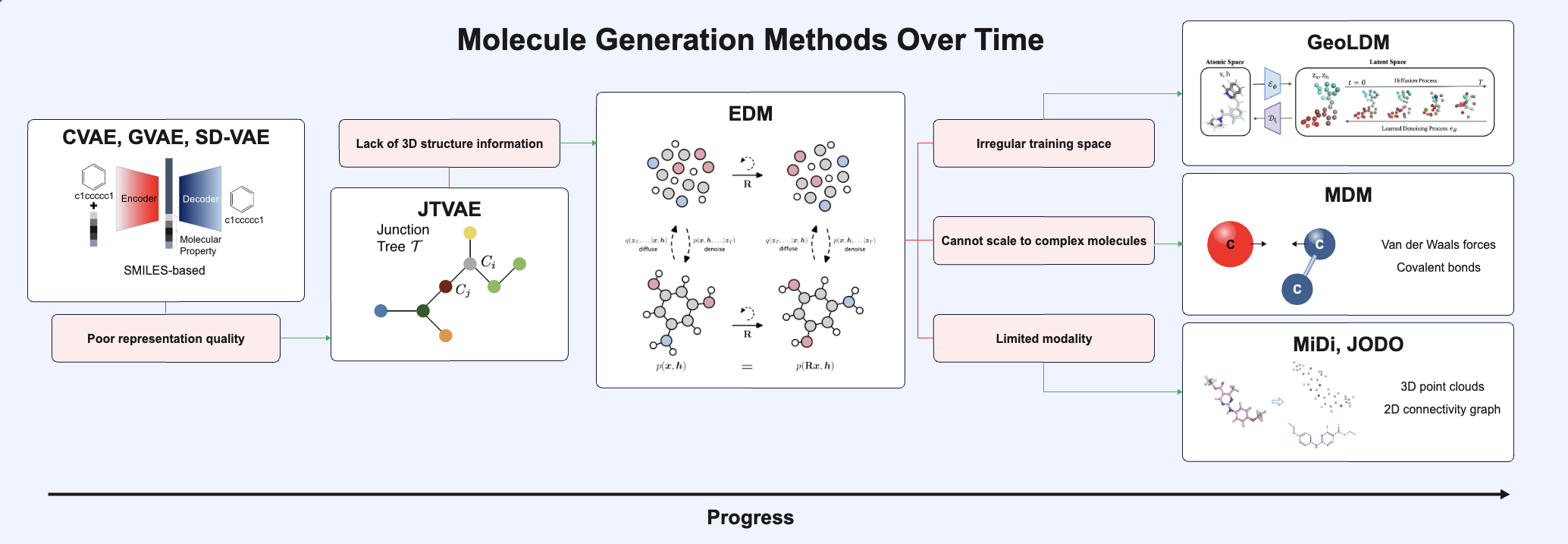
- GeoLDM 및 MiDi와 같은 그래프 기반 확산 모델은 목표 무관 소분자 생성에서 최고 성능를 기록하며, 특히 유효하고 안정된 분자를 생성하는 데 뛰어나다.
- 목표 인식 소분자 생성에서는 TargetDiff, Pocket2Mol, DiffSBDD와 같은 모델이 3D 구조 정보와 단백질-리간드 상호작용 데이터를 활용하여 서열 기반 기준 모델을 능가한다.
- Torsional Diffusion는 분자 구형 생성에서 최고 성능를 기록하여 2D SMILES 입력에서 정확한 3D 구조 예측이 가능하다.
- 단백질 생성 분야에서 RFDiffusion는 프레임워크 생성 작업에서 최고의 성능를 보이며, 이전 방법들보다 뛰어난 새로운 안정성 있는 단백질 접힘 형태를 생성한다.
- ESM-1B 및 UniRep 표현과 3D 기하학을 통합한 구조 기반 모델인 GearNET은 순수 서열 기반 방법보다 뛰어난 성능를 보였다.
- 다시 말해, 현재 모델들은 여전히 해석 가능성, 벤치마크 표준화, 고친화도 결합체 생성에 어려움을 겪고 있어 실제 적용 가능성에 중요한 격차가 존재한다.
더 나은 연구,지금 바로 시작하세요
논문 읽기부터 검토까지, 연구 시간을 획기적으로 줄여보세요.
카드 등록 없음 · 무료 플랜 제공
이 리뷰는 AI가 만들고, 인간 에디터가 검토했습니다.