
[논문 리뷰] Bayesian analysis of a Unified Dark Matter model with transition: can it alleviate the $H_{0}$ tension?
이 논문은 허블 장애를 완화하기 위해 빠른 전이를 갖는 통합 어두운 물질(UQM) 모형을 베이지안 추론을 통해 분석한다. SNIa(Pantheon), CMB 우선사(Planck), SH0ES 기반의 $M$-우선사가 사용되었다. 모형은 약 1.5σ 정도의 $H_0$ 장애를 약간 감소시키지만, AIC/BIC 기준으로 $Λ$CDM가 강하게 선호되어 표준 모형보다는 유의미한 개선이 없음을 시사한다. 이는 이론적 요구 조건을 충족하더라도 여전히 그러한 개선이 없다는 것을 의미한다.
We consider cosmological models in which Dark Matter (DM) and Dark Energy (DE) are described by a single component, dubbed Unified Dark Matter (UDM) models, in which the DE-like part can have an equation state $<-1$ at late times without violating the null energy condition. In this paper, we investigate whether this feature can relieve the Hubble tension. We perform a Bayesian analysis of the model using SNIa data from Pantheon, the CMB distance prior from Planck, and the prior on the absolute magnitude $M$ of SNIa from SH0ES. Using the prior, the data suggests a smooth transition taking place at redshifts $z_{ m t} \simeq 2.85$, which provides a value $H_0=69.64\pm 0.88$ for the Hubble constant, slightly alleviating the tension by $\sim 1.5 σ$. Without it, we obtain $H_0 = 67.6^{+1.3}_{-0.82}$ and a transition happening at $z_t=1.36$. We also discuss the importance of using the prior on $M$ for constraining this model.
연구 동기 및 목표
- 빠른 전이를 갖는 통합 어두운 물질(UQM) 모형이 $H_0$ 장애를 완화할 수 있는지 평가하는 것.
- SNIa(Pantheon), CMB 거리 우선사(Planck), 및 타입 Ia 초신성의 절대 등급 $M$에 대한 SH0ES 우선사가 포함된 천체물리적 자료를 이용해 UQM 모형의 베이지안 분석을 수행하는 것.
- $M$-우선사가 UQM 모형의 매개변수 제약과 최종 $H_0$ 값에 미치는 영향을 평가하는 것.
- 정보 기준(AIC/BIC)을 사용하여 UQM 모형의 데이터 적합도를 표준 $Λ$CDM 모형과 비교하는 것.
- UQM 모형이 $w < -1$를 횡단하면서도 영에너지 조건을 유지할 수 있다는 점이 $H_0$ 장애 완화에 실현 가능한 해법을 제공하는지 판단하는 것.
제안 방법
- CLASS 볼츠만 해석기와 MontePython을 사용해 $\beta$ 및 $a_t$로 매개변수화된 전이를 갖는 UQM 모형의 베이지안 매개변수 추정을 수행한다.
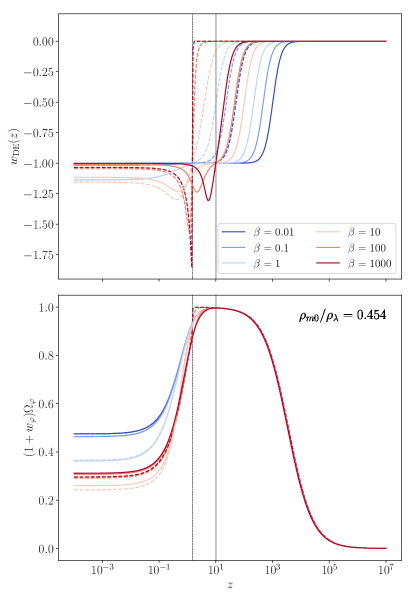
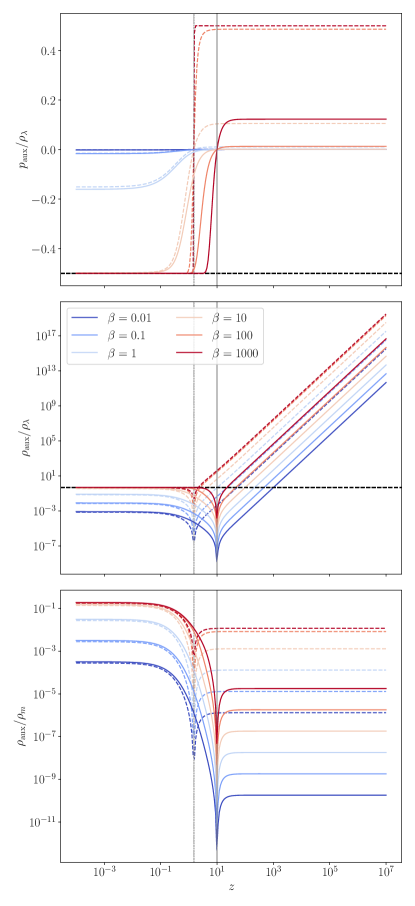
- Bertacca 등(2011)의 압력 프로파일을 사용하여 $\beta$ 및 $a_t$에 따라 물질 유사에서 어두운 에너지 유사 행동으로의 부드럽거나 빠른 전이가 가능하도록 한다.
- SH0ES 협력단으로부터 제공된 SNIa의 절대 등급 $M$에 대한 우선사를 적용하여 $H_0$ 및 UQM 매개변수의 제약을 향상시키고, 딜레마를 해소한다.
- CMB 연관 거리 우선사(예: $R$, $l_A$)를 Planck로부터 고정하여 UQM 모형이 $H_0$ 및 $M$에 미치는 영향을 분리한다.
- 모형 성능을 비교하기 위해 아카이케(AIC) 및 베이지안(BIC) 정보 기준을 계산한다.
- 이론적 magnitude 차이와 관측값을 비교하여 UQM 모형이 Pantheon SNIa 자료와 일치하는지 평가한다.
실험 결과
연구 질문
- RQ1빠른 전이를 갖는 통합 어두운 물질 모형이 $Λ$CDM에 비해 $H_0$ 장애를 감소시킬 수 있는가?
- RQ2SH0ES의 $M$ 우선사가 UQM 모형 매개변수의 제약과 유추된 $H_0$에 어떤 영향을 미치는가?
- RQ3UQM 모형이 영에너지 조건을 유지하면서도 $w < -1$를 횡단할 수 있다는 점이 $H_0$ 장애 완화에 실현 가능한 메커니즘을 제공하는가?
- RQ4정보 기준으로 측정했을 때, UQM 모형은 $Λ$CDM에 비해 얼마나 우수한 데이터 적합도를 보이는가?
- RQ5관측된 $H_0$ 장애 감소는 진정으로 $H_0$가 증가한 탓인지, 아니면 $H_0$와의 상관관계로 인한 매개변수 불확실성 증가 때문인가?
주요 결과
- 자료는 UQM 모형에서 부드러운 전이를 선호하며, $\beta(a^3 - a_t^3) < 1$로 나타나 전이는 빠르기보다는 점진적임을 시사한다.
- $M$-우선사를 포함할 경우 전이 적색편이의 사후분포는 $z_t \simeq 2.85$로 나타나 상대적으로 고적색편이에서 전이가 일어남을 시사한다.
- 모형은 $H_0 = 69.64 \pm 0.88 \, \text{km} \, \text{s}^{-1} \, \text{Mpc}^{-1}$를 도출하며, 이는 $Λ$CDM 값에 비해 약 1.5\sigma 정도의 $H_0$ 장애 감소를 의미한다.
- 장애 감소의 주요 원인은 $H_0$와의 매개변수 상관관계로 인한 불확실성 증가이며, 중심값의 유의미한 이동은 아니다.
- AIC 및 BIC 기준으로 $Λ$CDM 모형이 UQM 모형보다 강하게 선호되며, $M$-우선사를 사용할 경우 $\Delta$AIC = 0.8, $\Delta$BIC = 10.8로 나타나 경험적으로 표준 모형이 유리함을 시사한다.
- 가장 장애 감소가 유망한 경우인 $\beta = 10$일 때 UQM 모형은 Pantheon SNIa 자료와 일치하지 않으며, 이는 이론적 매력에도 불구하고 관측과의 괴리가 있음을 나타낸다.
이 논문 읽기
누빈트 뷰어에서 원문을 열고, 읽으면서 궁금한 곳을 바로 물어보세요.
누빈트에서 이 논문 읽기이 리뷰는 AI가 논문 원문을 바탕으로 만들었습니다. 인용하기 전에 원문을 확인해 주세요.