
[논문 리뷰] Causal Inference in Recommender Systems: A Survey of Strategies for Bias Mitigation, Explanation, and Generalization
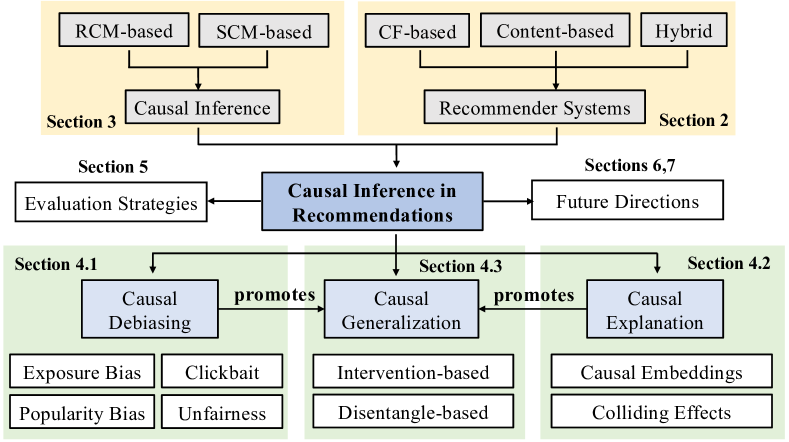
본 고찰은 Rubin’s potential outcomes와 Pearl’s structural causal models를 통해 인과 추론이 추천 시스템에 어떻게 도입되어 예측 편향을 제거하고 설명 가능성을 개선하며 일반화를 향상시키는지 검토합니다.
In the era of information overload, recommender systems (RSs) have become an indispensable part of online service platforms. Traditional RSs estimate user interests and predict their future behaviors by utilizing correlations in the observational historical activities, their profiles, and the content of interacted items. However, since the inherent causal reasons that lead to the observed users' behaviors are not considered, multiple types of biases could exist in the generated recommendations. In addition, the causal motives that drive user activities are usually entangled in these RSs, where the explainability and generalization abilities of recommendations cannot be guaranteed. To address these drawbacks, recent years have witnessed an upsurge of interest in enhancing traditional RSs with causal inference techniques. In this survey, we provide a systematic overview of causal RSs and help readers gain a comprehensive understanding of this promising area. We start with the basic concepts of traditional RSs and their limitations due to the lack of causal reasoning ability. We then discuss how different causal inference techniques can be introduced to address these challenges, with an emphasis on debiasing, explainability promotion, and generalization improvement. Furthermore, we thoroughly analyze various evaluation strategies for causal RSs, focusing especially on how to reliably estimate their performance with biased data if the causal effects of interests are unavailable. Finally, we provide insights into potential directions for future causal RS research.
연구 동기 및 목표
- 전통적인 상관 기반 추천 시스템이 인과 추론의 격차로 인해 가지는 한계를 설명한다.
- 두 가지 주요 인과 추론 프레임워크(Rubin’s potential outcome 및 Pearl’s structural causal model)와 RSs와의 연결을 요약한다.
- 인과 기법이 RSs의 디바이싱, 설명 가능성 및 일반화에 어떻게 기여하는지 논의한다.
- 편향된 데이터와 가용한 인과 효과가 없는 상황에서의 인과 RSs 평가 전략을 분석한다.
- 향후 인과 RS 연구의 방향을 제시한다.
제안 방법
- 전통적인 RSs의 기본과 상관 기반의 한계를 제시한다.
- RS 맥락에서 Rubin’s potential outcome 프레임워크와 Pearl’s structural causal model을 소개한다.
- 인과 추론 기법이 RS의 디바이싱(예: 노출 편향 해결), 설명 가능성 촉진, 일반화 개선에 어떻게 기여하는지 설명한다.
- RSs에서의 인과 그래프 구조와 개입 개념(do-operator)을 논의한다.
- RS 데이터에서 인과 효과를 식별하기 위한 역문/공변량 기반 전략(IPW) 및 백도어 보정의 원리를 설명한다.
실험 결과
연구 질문
- RQ1전통적 RS에서 노출 편향은 어떻게 발생하며 인과 방법이 이를 완화할 수 있는가?
- RQ2Rubin’s 및 Pearl’s 인과 프레임워크가 추천 시스템에 주는 이점과 트레이드오프는 무엇인가?
- RQ3인과 추론 기법이 RS의 설명 가능성과 일반화를 어떻게 향상시킬 수 있는가?
- RQ4인과 효과를 직접 관측할 수 없는 경우 신뢰할 수 있는 RS 성능 평가 전략은 무엇인가?
- RQ5인과 RS 연구를 발전시키기 위한 향후 유망한 방향은 무엇인가?
주요 결과
- 인과 RS는 관찰된 평점의 편향과 혼동으로부터 발생하는 편향을 해결하는 원칙적 방법을 제공한다.
- Rubin’s와 Pearl’s 프레임워크는 상호 보완적 관점을 제공한다: RCM은 잠재적 결과에 초점을 두고; SCM은 인과 그래프와 개입을 강조한다.
- 하이브리드 접근 방식(예: 보조 정보 통합)은 인과 관계 형성 및 잘못된 상관관계 완화에 도움이 된다.
- SCM은 개입과 반사실(f counterfactuals)에 대한 추론을 가능하게 하여 설명 가능성과 다양한 설정 간의 목표 지향적 일반화를 돕는다.
- 본 고찰은 특히 인과 효과를 직접 관찰하기 어려운 상황에서 인과 RS의 평가 전략을 제시한다.
- 인과 RS 연구를 위한 미해결 질문과 향후 방향을 식별한다.

이 논문 읽기
누빈트 뷰어에서 원문을 열고, 읽으면서 궁금한 곳을 바로 물어보세요.
누빈트에서 이 논문 읽기이 리뷰는 AI가 논문 원문을 바탕으로 만들었습니다. 인용하기 전에 원문을 확인해 주세요.