
[논문 리뷰] Constraining the major merger history of $z \sim 3-9$ galaxies using JADES: dominant in-situ star formation
연구는 JADES 데이터를 사용하여 $z\sim 3-9$ 은하의 근접-쌍 분수와 주요 병합 속도를 분석하고, 병합이 질량 증가의 약 5-14%에 기여하며 현장 내 별 형성이 지배적임을 발견했다.
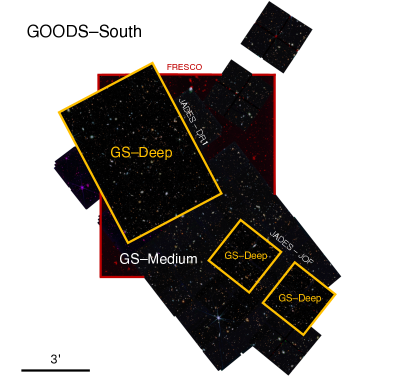
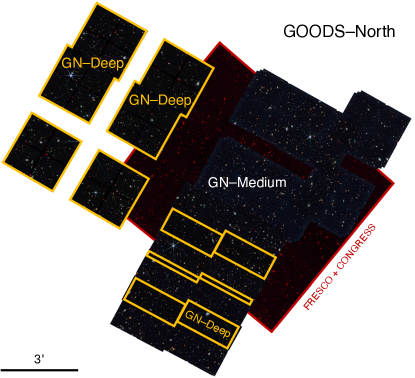
We present a comprehensive analysis of galaxy close-pair fractions and major merger rates to evaluate the importance of mergers in the hierarchical growth of galaxies over cosmic time. This study focuses on the previously poorly understood redshift range of $z \approx 3-9$ using JADES observations. Our mass-complete sample includes primary galaxies with stellar masses of ${ m log}(M_\star/{ m M_\odot}) = [8, 10]$, having major companions (mass ratio $\geq 1/4$) selected by $5-30$ pkpc projected separation and redshift proximity criteria. Pair fractions are measured using a statistically robust method incorporating photometric redshift posteriors and available spectroscopic data. The pair fraction evolves with redshift and shows dependence on the stellar mass: at ${ m log}(M_\star/{ m M_\odot}) = [8.0, 8.5]$ there is an increase up to $z\sim5-6$, followed by a turnover; while at higher stellar masses there is a flattening and weak decline with increasing redshift. Similarly, the derived galaxy major merger rate increases and flattens beyond $z \sim 6$ to $2-8~{ m Gyr^{-1}}$ per galaxy, showing a weak scaling with stellar mass, driven by the evolution of the galaxy stellar mass function. A comparison between the cumulative mass accretion from major mergers and the mass assembled through star formation indicates that major mergers contribute approximately $3-13\%$ to the total mass growth over the studied redshift range, which is in agreement with the ex-situ mass fraction estimated from our simple numerical model. These results highlight that major mergers contribute little to the direct stellar mass growth compared to in-situ star formation but could still play an indirect role by driving star formation itself.
연구 동기 및 목표
- 깊은 JWST/JADES 데이터로 $z\sim 3$에서 $z\sim 9$까지 은하의 질량 증가에서 주요 병합의 역할을 평가한다.
- 적은-쌍 분수와 주요 병합 속도가 적색편이에 따라 어떻게 진화하는지 그리고 질량에 따라 어떻게 달라지는지 정량화한다.
- 병합에 의한 질량 축적을 우주 시간에 따라 현장 내 별 형성과 비교한다.
- 주요 병합에 의해 암시된 외부 질량 비율을 간단한 수치 모델로 평가한다.
제안 방법
- ${\log}(M_{\star}/M_{\odot})=[8,10]$와 주요 동반자(질량 비율 ≥ 1/4)를 갖는 질량 완전 샘플의 기본 은하를 사용한다.
- 전체 광학 적색도 사후분포(및 분광 데이터)를 전파하는 확률적 근접-쌍 분석을 적용하여 쌍 분수를 계산한다.
- 관측된 쌍 분수를 통해 병합 관측 가능 시간척도(merger observability timescale)를 채택하여 은하의 주요 병합 속도를 도출/추정한다.
- 별질량을 두 가지 독립적인 SED 적합 방법으로 계산한다: Prospector (베이지안, 비모수형 SFH) 및 eazy-py (빠른 템플릿 적합).
- F444W의 5σ 포인트 소스 깊이와 Pozzetti(2010) 스타일의 완전성 분석을 통해 성분별 질량 완전성을 평가한다.
- 주요 병합으로부터의 누적 질량 증가를 별 형성으로부터의 증가와 간단한 질량 증가 프레임워크를 사용해 비교한다.
실험 결과
연구 질문
- RQ1$z\sim 3-9$ 은하의 근접-쌍(주요 병합) 분수의 적색편향 진화는 어떻게 나타나는가?
- RQ2연구 범위 내에서 주요 병합 속도는 적색편향과 기본 은하 질량에 따라 어떻게 달라지는가?
- RQ3주요 병합이 전체 질량 증가에서 차지하는 비율은 현장 내 별 형성에 비해 어느 정도인가?
- RQ4주요 병합에 의해 암시되는 외부 질량 비율은 간단한 수치 모델의 기대치와 어떻게 비교되는가?
주요 결과
- 근접-쌍 분수는 $z\approx 5-6$에서 상승하고 피크를 보인 뒤 더 높은 redshift에서 전환되며 기본 질량에 따라 위치가 달라진다.
- 주요 병합 속도는 $z\approx 6$를 넘어서 증가하다가 평탄해지며 은하당 $2-10\ \mathrm{Gyr^{-1}}$에 도달하고 질량 의존성은 약하다.
- 주요 병합은 $z\sim 3-9$ 기간 동안 총 질량 증가의 약 5-14%에 기여하며 간단한 모델에서의 외부 질량 분율과 일치한다.
- 병합은 직접 질량 증가의 주된 채널은 아니며, 현장 내 별 형성이 지배적이지만 병합이 별 형성에 간접적으로 영향을 미칠 수 있다.
이 논문 읽기
누빈트 뷰어에서 원문을 열고, 읽으면서 궁금한 곳을 바로 물어보세요.
누빈트에서 이 논문 읽기이 리뷰는 AI가 논문 원문을 바탕으로 만들었습니다. 인용하기 전에 원문을 확인해 주세요.