
[논문 리뷰] Cosmic shear with small scales: DES-Y3, KiDS-1000 and HSC-DR1
이 연구는 DES-Y3, KiDS-1000, HSC-DR1의 천체군 분포 데이터를 통합하여 조화 공간 분석을 통해 𝓁_max = 4500까지의 각도 스케일을 탐색하며, 비선형 및 복사 효과를 Baccoemu로 모델링한다. S₈ = 0.795⁺⁰.⁰¹⁵₋₀.⁰¹⁷의 결과를 도출하였으며, 이는 Planck CMB 제약과 약 1.8σ의 갈등을 보인다. 그러나 Ωₘ = 0.212⁺⁰.⁰¹⁷₋₀.⁰³²로 나타나 Planck와 약 3σ 갈등을 보이며, 이는 H₀에 대한 의존성이 없는 변수로 S₈와 Ωₘ를 재정의할 경우 H₀ 갈등으로 재해석될 수 있다.
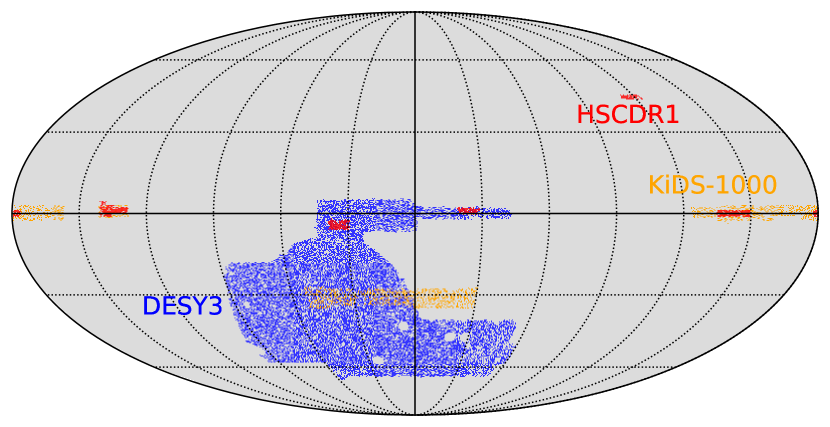
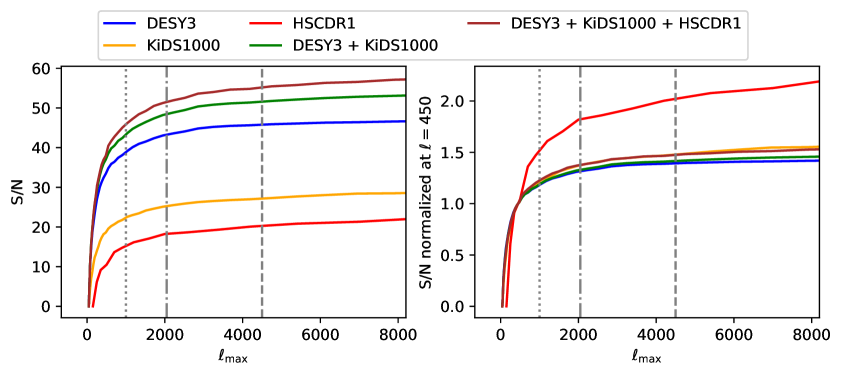
We present a cosmological analysis of the combination of the DES-Y3, KiDS-1000 and HSC-DR1 weak lensing samples under a joint harmonic-space pipeline making use of angular scales down to $\ell_{ m max}=4500$, corresponding to significantly smaller scales ($δθ\sim2.4'$) than those commonly used in cosmological weak lensing studies. We are able to do so by accurately modelling non-linearities and the impact of baryonic effects using Baccoemu. We find $S_8\equivσ_8\sqrt{Ω_{ m m}/0.3}=0.795^{+0.015}_{-0.017}$, in relatively good agreement with CMB constraints from Planck (less than $\sim1.8σ$ tension), although we obtain a low value of $Ω_{ m m}=0.212^{+0.017}_{-0.032}$, in tension with Planck at the $\sim3σ$ level. We show that this can be recast as an $H_0$ tension if one parametrises the amplitude of fluctuations and matter abundance in terms of variables without hidden dependence on $H_0$. Furthermore, we find that this tension reduces significantly after including a prior on the distance-redshift relationship from BAO data, without worsening the fit. In terms of baryonic effects, we show that failing to model and marginalise over them on scales $\ell\lesssim2000$ does not significantly affect the posterior constraints for DES-Y3 and KiDS-1000, but has a mild effect on deeper samples, such as HSC-DR1. This is in agreement with our ability to only mildly constrain the parameters of the Baryon Correction Model with these data
연구 동기 및 목표
- DES-Y3, KiDS-1000, HSC-DR1의 천체군 측정치를 일관된 조화 공간 파ipelined를 사용하여 통합적 우주론 분석에 통합한다.
- 일般적으로 약한 렌즈 연구에서 제외되는 작은 각도 스케일(ℓ_max = 4500)을 탐색한다.
- 특히 HSC-DR1과 같은 깊은 설문에서 복사 물리학의 영향을 평가한다.
- S₈ 및 H₀ 갈등의 근본 원인을 다수의 약한 렌즈 탐측치를 통합하고 사전 조건을 테스트하여 조사한다.
- 외부 데이터(예: BAO 또는 SH0ES 사전 조건)를 포함함으로써 관측된 Ωₘ 및 S₈ 갈등이 해결될 수 있는지 평가한다.
제안 방법
- DES-Y3, KiDS-1000, HSC-DR1의 천체군 스펙트럼을 분석하기 위해 통합된 조화 공간 우도 파ipelined를 사용하며, ℓ_max = 4500까지 확장한다.
- 비선형 중력 효과와 소규모에서의 복사 피드백을 정확하게 모델링하기 위해 Baccoemu 에뮬레이터를 적용한다.
- 다중성 렌즈 편향, 적색편이 분포 이동, 내재적 정렬 매개변수(IA) 등의 체계적 불확실성을 후행 분포에서 평균화함으로써 다루었다.
- 복사 효과는 복사 보정 모델(BCM)을 사용하여 모델링하였으며, 전체 사후 분포에서 BCM 매개변수를 평균화하였다.
- 갈등 해결에 미치는 영향을 평가하기 위해 BAO, SH0ES, Planck 2018, 클러스터 수명 데이터 등의 외부 사전 조건을 테스트하였다.
- 복사 효과를 모델링한 결과와 모델링하지 않은 결과를 비교하여 복사 효과가 우주론적 제약에 미치는 영향을 정량화하였다.
실험 결과
연구 질문
- RQ1DES-Y3, KiDS-1000, HSC-DR1의 천체군 데이터를 ℓ_max = 4500까지의 작은 각도 스케일에서 통합할 경우 S₈에 대한 우주론적 제약는 무엇인가?
- RQ2복사 효과는 특히 HSC-DR1과 같은 깊은 설문에서 우주론적 매개변수 제약에 어떤 영향을 미치는가?
- RQ3외부 사전 조건을 포함함으로써 저 redshift 약한 렌즈 결과와 Planck CMB 제약 간의 갈등을 어느 정도 해결할 수 있는가?
- RQ4H₀에 대한 의존성이 없는 변수로 S₈와 Ωₘ를 재정의할 경우, 관측된 낮은 Ωₘ 값이 H₀ 갈등으로 재해석될 수 있는가?
- RQ5다른 체계적 모델링 선택(예: IA, 광학적 적색편이 오차, 복사 효과)이 최종 우주론적 제약에 어떤 영향을 미치는가?
주요 결과
- 통합 분석 결과 S₈ = 0.795⁺⁰.⁰¹⁵₋₀.⁰¹⁷를 도출하였으며, 이는 Planck CMB 제약(S₈ = 0.832 ± 0.013)과 약 1.8σ 갈등을 보인다.
- 물질 밀도 Ωₘ는 0.212⁺⁰.⁰¹⁷₋₀.⁰³²로 측정되었으며, Planck의 Ωₘ = 0.311 ± 0.005와 약 3σ 갈등을 보인다.
- 이 낮은 Ωₘ 값은 H₀에 대한 의존성이 없는 변수로 S₈와 Ωₘ를 재정의할 경우 H₀ 갈등으로 재해석될 수 있다.
- BAO 사전 조건을 포함하면 적합도가 악화되지 않으면서도 갈등이 감소하여 Planck와의 일관성이 향상된다.
- 복사 효과를 모델링하지 않은 경우 HSC-DR1에는 약간의 영향을 미치지만, DES-Y3와 KiDS-1000에는 거의 영향이 없어 깊은 설문일수록 복사 효과 모델링에 더 민감함을 시사한다.
- 현재 데이터로는 복사 효과가 우주론적 제약에 대해 약하게만 제약을 받으며, BCM 매개변수의 제약력은 제한적이다.
이 논문 읽기
누빈트 뷰어에서 원문을 열고, 읽으면서 궁금한 곳을 바로 물어보세요.
누빈트에서 이 논문 읽기이 리뷰는 AI가 논문 원문을 바탕으로 만들었습니다. 인용하기 전에 원문을 확인해 주세요.