
[논문 리뷰] Dark siren cosmology with binary black holes in the era of third-generation gravitational wave detectors
이 논문은 제3세대 중력파 탐지기(Einstein Telescope 및 Cosmic Explorer)로 탐지된 이진 블랙홀 합병을 어둠의 시그널로 활용하여 우주론적 파라미터를 제약하는 방법을 제안한다. $z=1$ 이하의 시뮬레이션된 은하 목록과 고신호대비잡음비 GW 이벤트를 교차 매칭함으로써, ET와 두 대의 CE로 구성된 네트워크가 1년간의 관측에서 $H_0$를 0.8% 정밀도로, $\Omega_m$를 10.0% 정밀도로 90% 신뢰구간 내에서 측정할 수 있음을 보여준다.
Third-generation (3G) gravitational wave detectors, in particular Einstein Telescope (ET) and Cosmic Explorer (CE), will explore unprecedented cosmic volumes in search for compact binary mergers, providing us with tens of thousands of detections per year. In this study, we simulate and employ binary black holes detected by 3G interferometers as dark sirens, to extract and infer cosmological parameters by cross-matching gravitational wave data with electromagnetic information retrieved from a simulated galaxy catalog. Considering a standard $Λ$CDM model, we apply a suitable Bayesian framework to obtain joint posterior distributions for the Hubble constant $H_0$ and the matter energy density parameter $Ω_m$ in different scenarios. Assuming a galaxy catalog complete up to $z=1$ and dark sirens detected with a network signal-to-noise ratio greater than 300, we show that a network made of ET and two CEs can constrain $H_0$ ($Ω_m$) to a promising $0.8\%$ ($10.0\%$) at $90\%$ confidence interval within one year of continuous observations. Additionally, we find that most of the information on $H_0$ is contained in local, single-host dark sirens, and that dark sirens at $z>1$ do not substantially improve these estimates. Our results imply that a sub-percent measure of $H_0$ can confidently be attained by a network of 3G detectors, highlighting the need for characterising all systematic effects to a higher accuracy.
연구 동기 및 목표
- 제3세대 중력파 탐지기 시대의 이진 블랙홀에서 유래하는 어둠의 시그널의 우주론적 잠재력을 평가하기 위해.
- Einstein Telescope 및 Cosmic Explorer와 같은 향후 탐지기가 통계적 적색편이 매칭을 통해 $H_0$와 $\Omega_m$를 얼마나 잘 제약할 수 있는지 정량화하기 위해.
- 지역적 어둠의 시그널과 고적색편이 어둠의 시그널이 $H_0$ 정밀도에 기여하는 비율을 평가하고, 은하 조사 깊이의 영향을 분석하기 위해.
- 어둠의 시그널 측정의 하프퍼센트 수준을 달성하기 위한 탐지기 네트워크 구성의 역할을 조사하기 위해.
- 하프퍼센트 수준의 $H_0$ 정밀도를 달성하기 위해 고정밀 캘리브레이션의 체계적 영향이 얼마나 필요한지 판단하기 위해.
제안 방법
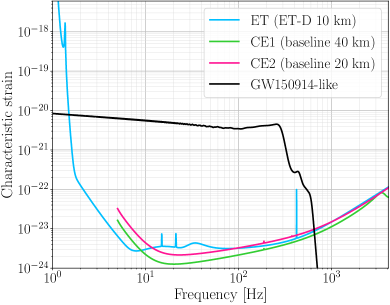
- 제3세대 중력파 탐지기에서 탐지 가능한 이진 블랙홀(BBH) 신호의 집단을 Fisher 정보 행렬(FIM) 체계를 사용해 시뮬레이션한다.
- 중력파 천구 위치 오차 부피와 시뮬레이션된 은하 목록 간의 교차 매칭을 통해 $H_0$와 $\Omega_m$의 공동 사후 분포를 추론하기 위해 베이지안 프레임워크를 활용한다.
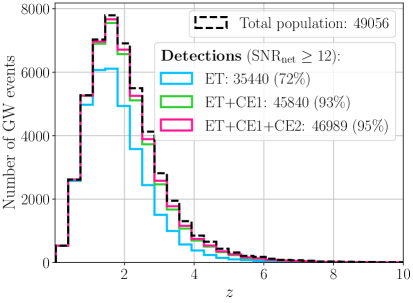
- 네트워크 구성의 영향을 평가하기 위해: ET 단독, ET+CE1, ET+CE1+CE2를 고려하고, 연속 1년 관측을 가정한다.
- 어둠의 시그널 후보를 네트워크 신호대비잡음비 >300인 이벤트로 정의하고, 이들의 천구 위치를 목록 내 주변 은하와 매칭한다.
- $z=1$ 까지 완전한 은하 목록과 $z=3$ 까지 확장된 낙관적 시나리오를 테스트한다.
- 단일 은하를 가진 어둠의 시그널(지역 이벤트)의 기여를 별도로 분석하여 $H_0$ 제약력의 격리 분석을 수행한다.
실험 결과
연구 질문
- RQ1Einstein Telescope 및 Cosmic Explorer와 같은 제3세대 중력파 탐지기가 어둠의 시그널을 통해 $H_0$를 하프퍼센트 수준의 정밀도로 측정할 수 있는가?
- RQ23세대 탐지기 네트워크 구성이 $H_0$와 $\Omega_m$의 우주론적 제약에 어떻게 영향을 미치는가?
- RQ3지역(저적색편이) 어둠의 시그널과 고적색편이 어둠의 시그널이 $H_0$ 측정 정밀도에 기여하는 비율은 각각 어느 정도인가?
- RQ4은하 조사 깊이를 $z=3$ 까지 확장하면 어둠의 시그널에서 유도된 우주론적 제약이 얼마나 향상되는가?
- RQ5체계적 오차와 선택 편향이 어둠의 시그널 프레임워크에서 $H_0$ 측정의 최종 정확도에 미치는 영향은 어느 정도인가?
주요 결과
- Einstein Telescope와 두 대의 Cosmic Explorer 탐지기(ET+CE1+CE2)로 구성된 네트워크는 연속 1년 관측 내에 $H_0$를 0.8%, $\Omega_m$를 10.0%의 정밀도로 90% 신뢰구간 내에서 제약할 수 있다.
- ET 단독으로서는 $H_0$에 대한 정보성 제약을 도출하기에 부족하며, 다중 탐지기 네트워크의 필요성을 강조한다.
- $\Omega_m$가 사전에 알려져 있을 경우, ET+CE 네트워크는 $H_0$ 정밀도를 0.4%로 달성할 수 있다.
- $H_0$에 대한 대부분의 정보는 지역의 단일 은행 어둠의 시그널에 포함되어 있으며, 단일 은행 이벤트만으로도 $H_0$ 제약는 ET+CE1+CE2 기준 2.7%, ET+CE1 기준 5.6%를 기록한다.
- $z>1$의 어둠의 시그널은 고적색편이 우주론 탐사 잠재력이 있음에도 불구하고 $H_0$ 제약에 유의미한 기여를 하지 못한다.
- 은하 조사 깊이를 $z=3$ 까지 확장해도 $H_0$ 정밀도에 큰 향상이 없지만, 모든 네트워크 구성에서 $\Omega_m$ 제약에 약간의 향상이 있다.
이 논문 읽기
누빈트 뷰어에서 원문을 열고, 읽으면서 궁금한 곳을 바로 물어보세요.
누빈트에서 이 논문 읽기이 리뷰는 AI가 논문 원문을 바탕으로 만들었습니다. 인용하기 전에 원문을 확인해 주세요.