
[논문 리뷰] Evidence for multiple nucleosynthetic processes from carbon enhanced metal-poor stars in the Carina dwarf spheroidal galaxy
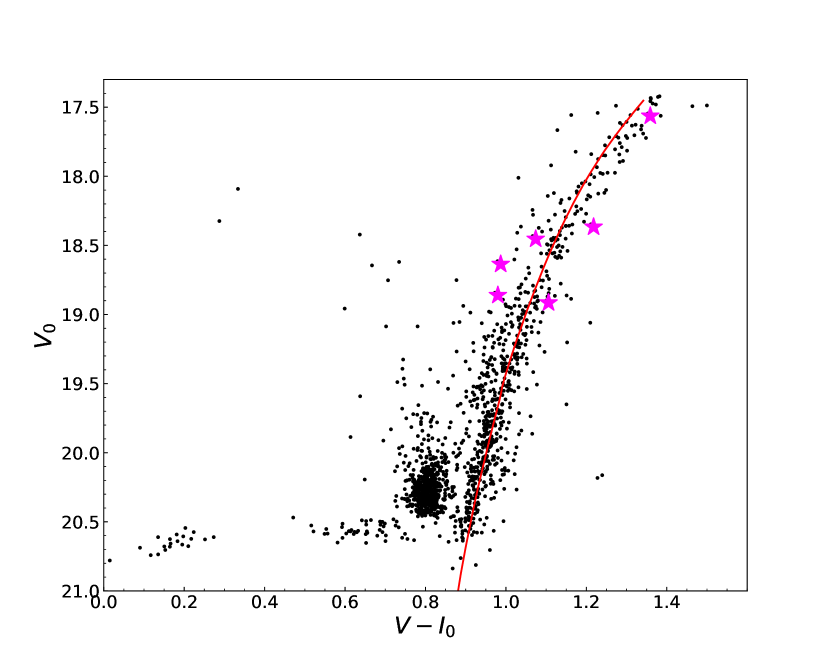
이 연구는 타원형 소은하에서 탄소가 풍부한 금속성 낮은(CMP) 별의 가장 큰 고해상도 원소 농도 분석을 제시하며, 카이나 dSph에서 여섯 개인 CEMP 별을 규명하였다. 여러 핵합성 과정이 드러났으며, 한 명의 CEMP-no 별은 낮은 중성자 포획 원소 농도를 보이고, 다섯 명의 CEMP-s/r/s 별은 s- 및 r-과정 원소 농도가 높다. 중성자 포획 패턴은 금속성 낮은 저질량 AGB 모델에서 유도된 i-과정 수확량과 가장 잘 일치하며, 이는 i-과정이 CEMP-r/s 별의 원소 농도 패턴의 주요 기원임을 뒷받침한다.
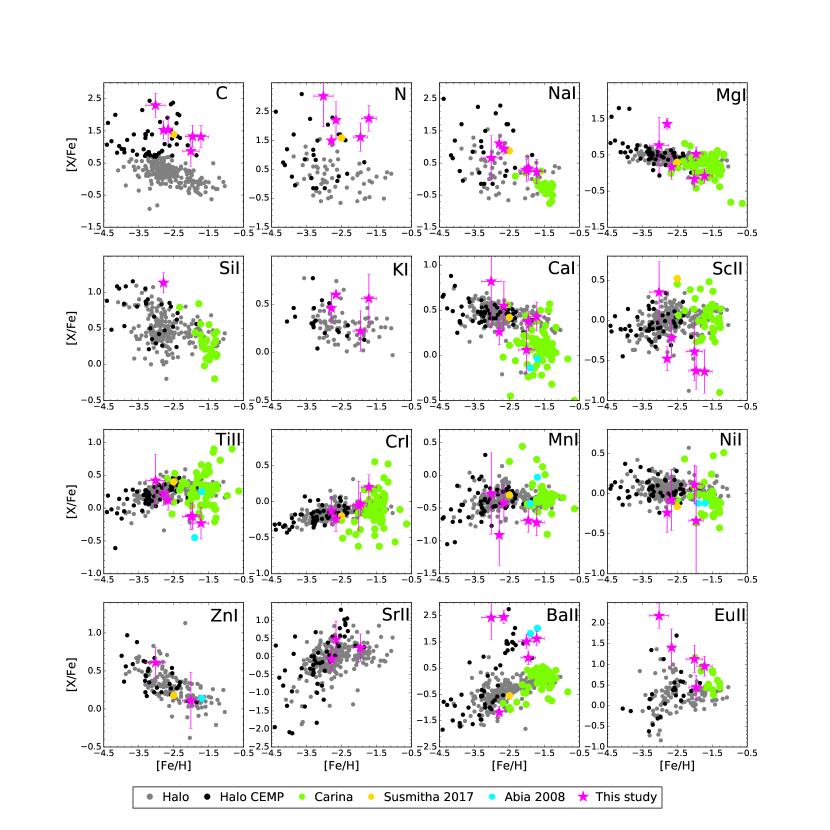
Context: Carbon Enhanced Metal-Poor (CEMP) stars ($\mathrm{[C/Fe]} > 0.7$) are known to exist in large numbers at low metallicity in the Milky Way halo and are important tracers of early Galactic chemical evolution. However, very few such stars have been identified in the classical dwarf spheroidal (dSph) galaxies, and detailed abundances, including neutron-capture element abundances, have only been reported for 12 stars. Aims: We aim to derive detailed abundances of six CEMP stars identified in the Carina dSph and compare the abundances to CEMP stars in other dSph galaxies and the Milky Way halo. This is the largest sample of CEMP stars in a dSph galaxy analysed to date. Methods: 1D LTE elemental abundances are derived via equivalent width and spectral synthesis using high-resolution spectra of the six stars obtained with the MIKE spectrograph at Las Campanas Observatory. Results: Abundances or upper limits are derived for up to 27 elements from C to Os in the six stars. The analysis reveals one of the stars to be a CEMP-no star with very low neutron-capture element abundances. In contrast, the other five stars all show enhancements in neutron-capture elements in addition to their carbon enhancement, classifying them as CEMP-$s$ and -$r/s$ stars. The six stars have similar $α$ and iron-peak element abundances as other stars in Carina, except for the CEMP-no star, which shows enhancement in Na, Mg, and Si. We explore the absolute carbon abundances ($A( m C)$) of CEMP stars in dSph galaxies and find similar behaviour as is seen for Milky Way halo CEMP stars, but highlight that CEMP-$r/s$ stars primarily have very high $A( m C)$ values. We also compare the neutron-capture element abundances of the CEMP-$r/s$ stars in our sample to recent $i$-process yields, which provide a good match to the derived abundances.
연구 동기 및 목표
- 카이나 dSph에서 CEMP 별의 상세한 원소 농도를 규명하기 위해, 이는 이전에 CEMP 연구가 제한된 은하이기 때문이다.
- 카이나 dSph의 CEMP 별 농도 패턴을 은하수 헬로 및 다른 dSph 은하의 농도 패턴과 비교하기 위해.
- CEMP 별에서 중성자 포획 원소 농도 증가의 기원을 조사하고, 특히 i-과정의 역할을 규명하기 위해.
- dSph에서의 CEMP-r/s 별이 은하수 헬로에서의 CEMP-r/s 별과 동일한 핵합성 경로를 공유하는지 평가하기 위해.
- dSph CEMP 별의 절대 탄소 농도 추세를 탐구하고 초기 은하 진화에 대한 함의를 제시하기 위해.
제안 방법
- 라스 캄파냐스 관측소의 6.5m 매그날란드 망원경에 장착된 MIKE 스펙트로그래프를 이용한 고해상도 스펙트로스코피.
- 탄소에서 오스뮴까지 최대 27개 원소에 대해 등가폭과 스펙트럼 합성 기반의 1D LTE 농도 분석.
- 최근에 발표된 금속성 낮은 저질량 AGB 모델에서 유도된 금속성 낮은 AGB 모델의 i-과정 수확량과 관측된 중성자 포획 원소 패턴을 비교.
- 은하별 바륨(Ba) 및 europium(Eu) 농도에 맞추어 i-과정 수확량을 스케일링하고, Ba에서 Dy로의 평균 편차를 보정.
- 절대 탄소 농도(A(C)) 유도 및 CEMP 하위 유형 간 및 금속성에 따른 비교.
- [Ba/Fe], [Eu/Fe], [Ba/Eu] 비율을 기반으로 별들을 CEMP-no, CEMP-s, CEMP-r/s로 분류.
실험 결과
연구 질문
- RQ1카이나 dSph의 CEMP 별은 은하수 헬로의 CEMP 별과 유사한 농도 패턴을 보이는가?
- RQ2카이나의 CEMP 별에서 관측된 중성자 포획 원소 농도 증가의 원인인 핵합성 과정은 무엇인가?
- RQ3i-과정이 카이나의 CEMP-r/s 별에서 관측된 농도 패턴을 재현할 수 있는가?
- RQ4dSph의 CEMP 별에서의 절대 탄소 농도(A(C))는 은하수 헬로의 CEMP 별과 어떻게 비교되는가?
- RQ5dSph의 CEMP-r/s 별은 CEMP-s 별과 구별되는 뚜렷한 농도 서식을 보이는가?
주요 결과
- 여섯 명의 CEMP 별 중 한 명은 [Ba/Fe] < 0.0 이며 낮은 중성자 포획 원소 농도를 보이는 CEMP-no 별로 분류된다.
- 다른 다섯 명의 별은 탄소와 중성자 포획 원소 농도가 모두 증가한 CEMP-s 또는 CEMP-r/s 별이다.
- CEMP-r/s 별은 절대 탄소 농도(A(C)) > 7.5를 보이며, CEMP 별 중에서 가장 높은 A(C) 범주에 속한다.
- CEMP-r/s 별의 중성자 포획 원소 농도 패턴은 금속성 낮은 AGB 모델에서 유도된 i-과정 수확량과 양호한 일치를 보이며, 특히 바륨(Ba)에서 Dysprosium(Dy)까지의 원소에서 뚜렷하다.
- i-과정 모델은 관측값보다 탄소를 약간 낮게 예측하며, 예측된 logε(C) 값은 9.26–9.29이지만 관측 보정값은 7.24–7.80이다.
- CEMP-no 별은 나트륨(Na), 마그네슘(Mg), 실리콘(Si) 농도가 뚜렷하게 증가해 있으며, 이는 일부 헬로 CEMP-no 별에서도 관찰되는 특징으로, 공통된 핵합성 기원을 시사한다.
이 논문 읽기
누빈트 뷰어에서 원문을 열고, 읽으면서 궁금한 곳을 바로 물어보세요.
누빈트에서 이 논문 읽기이 리뷰는 AI가 논문 원문을 바탕으로 만들었습니다. 인용하기 전에 원문을 확인해 주세요.