
[논문 리뷰] Exploring the $H_0$ tension and the evidence of dark sector interaction from 2D BAO measurements
이 논문은 상호작용하는 어두운 에너지(IDE) 모델을 2차원(BAO) 음향장파 측정치와 Planck-CMB 자료를 결합하여 조사하며, 2D BAO 자료는 전통적인 3D BAO 분석에 비해 더 높은 허블 상수 값($H_0 = 73.4 \pm 0.88$ km/s/Mpc)을 선호함을 발견한다. 공동 분석은 IDE 모델이 국소적 거리 래더 측정치와의 $H_0$ 갈등을 해결한다는 강력한 통계적 증거(>3σ)를 제공한다.
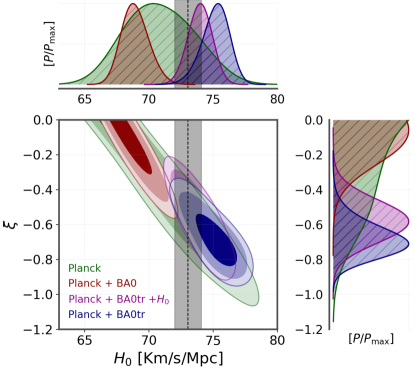
We explore observational constraints on a cosmological model with an interaction between dark energy (DE) and dark matter (DM), using a compilation of 15 measurements of the 2D BAO (i.e., transversal) scale in combination with Planck-CMB data, to explore the parametric space of a class of interacting DE models. We find that 2D BAO measurements can generate different observational constraints compared to the traditional approach of studying the matter clustering in the 3D BAO measurements. Contrary to the observations for the $Λ$CDM and IDE models when analyzed with Planck-CMB + 3D BAO data, we note that Planck-CMB + 2D BAO data favor high values of the Hubble constant $H_0$. From the joint analysis with Planck-CMB + 2D BAO + Gaussian prior on $H_0$, we find $H_0 = 73.4 \pm 0.88$ km/s/Mpc. We conclude that the $H_0$ tension is solved in the IDE model with strong statistical evidence (more than 3$σ$) for the IDE cosmologies.
연구 동기 및 목표
- 2D BAO 측정치가 $\Lambda$CDM를 초월한 모델, 특히 상호작용 어두운 에너지(IDE) 모델에서 우주론적 제약에 미치는 영향을 평가하기 위해.
- 3D BAO 분석에 비해 기준 우주론 모델 의존도가 낮은 2D BAO 자료가 전통적인 3D BAO 분석과 다른 제약을 제공하는지 조사하기 위해.
- 2D BAO 자료를 Planck-CMB 및 국소적 $H_0$ 사전정보와 함께 사용할 때 IDE 모델에서 $H_0$ 갈등이 해결될 수 있는지 테스트하기 위해.
- IDE 프레임워크에서 어두운 에너지와 어두운 물질 간의 결합 계수를 제약하는 데 있어 2D BAO 자료의 탄력성 평가하기 위해.
제안 방법
- 연구는 어둠의 에너지와 어두운 물질 간의 상수 결합을 가진 상호작용 어두운 에너지(IDE) 모델을 제약하기 위해 15개의 횡방향(2D) BAO 측정치를 포함한 자료를 사용한다. 이는 3D 기하학적 가정에 의존하지 않는, 바리온 드래그 시점의 음향장파 반경의 각도 스케일 투영이다.
- 2D BAO 자료를 Planck-CMB 관측치와 조합하여 어두운 에너지와 어두운 물질 간에 상수 결합이 존재하는 IDE 모델의 제약을 수행한다.
- Planck-CMB, 2D BAO, 그리고 SH0ES 거리 래더에서 유도된 $H_0$에 대한 가우시안 사전정보를 사용한 공동 우도 프레임워크를 활용하여 모델 일관성 테스트를 수행한다.
- 결합 계수를 변화시켜 $H_0$와 $S_8$에 미치는 영향을 탐색하고, 마르코프 체인 몬테카를로 샘플링을 통해 제약 조건을 도출한다.
- 거리 재구성에서의 모델 편향을 줄이기 위해 기준 우주론 모델 의존도를 피하기 위해 적색편이 셸에서의 각도 군집에 초점을 맞춘다.
- 결과는 Menote & Marra (2022)의 다른 2D BAO 샘플과 비교하여 확인되었으며, 주요 결과의 탄력성을 확인한다.
실험 결과
연구 질문
- RQ13D BAO 대신 2D BAO 자료를 사용할 경우, $\Lambda$CDM에 비해 상호작용 어두운 에너지 모델에서 제약 조건이 유의미하게 다를까?
- RQ22D BAO 자료를 Planck-CMB 및 국소적 $H_0$ 사전정보와 함께 사용할 때 IDE 모델에서 $H_0$ 갈등을 해결할 수 있을까?
- RQ32D BAO 접근법은 IDE 모델에서 추정된 $H_0$ 값에 어떤 영향을 미치며, SH0ES와 일치하는 더 높은 값을 선호하는가?
- RQ42D BAO 자료는 IDE 우주론에서 $S_8$ 갈등에 어떤 영향을 미치며, 약한 렌즈 및 은하 군집 데이터와의 일치도 향상시키는가?
- RQ5다른 2D BAO 샘플을 사용할 경우 결과는 얼마나 탄력적인가? 이는 2D BAO가 비-$\Lambda$CDM 모델에서 탐사 수단으로서 신뢰성 있는가에 대한 함의는 무엇인가?
주요 결과
- Planck-CMB와 2D BAO 자료의 공동 분석은 $H_0$에 대한 가우시안 사전정보를 포함할 경우 $H_0 = 73.4 \pm 0.88$ km/s/Mpc로 더 높은 허블 상수를 선호한다.
- $\Lambda$CDM 및 IDE 모델 모두에서 3D BAO 분석은 낮은 $H_0$ 값을 선호하는 반면, 2D BAO 자료는 IDE 프레임워크 내에서 일관되게 높은 $H_0$ 값을 선호한다.
- Planck-CMB + 2D BAO + $H_0$ 사전정보를 사용할 경우, IDE 모델에서 $H_0$ 갈등은 강력한 통계적 증거(3$\sigma$ 초과)로 해결된다.
- 2D BAO 자료 세트는 자체적으로는 전체 매개변수 공간을 제약하기에 충분한 능력을 가지지 못하지만, IDE 모델에서 $H_0$ 값이 더 높은 방향으로 제약 조건이 크게 이동함을 보여준다.
- 3D BAO와 2D BAO 간의 제약 조건 차이는 $\Lambda$CDM보다 IDE 모델에서 더 뚜렷하게 드러나며, 이는 2D BAO가 비표준 역학에 민감함을 강조한다.
- IDE 모델에서의 $S_8$ 값은 $\Lambda$CDM보다 높으며, 오차 범위 내에서 약한 렌즈 및 은하 군집 데이터와 일치하지만, $S_8$의 모델 의존성으로 인해 $S_8$ 갈등에 대한 확실한 결론은 내릴 수 없다.

이 논문 읽기
누빈트 뷰어에서 원문을 열고, 읽으면서 궁금한 곳을 바로 물어보세요.
누빈트에서 이 논문 읽기이 리뷰는 AI가 논문 원문을 바탕으로 만들었습니다. 인용하기 전에 원문을 확인해 주세요.