
[논문 리뷰] Federated Learning and Blockchain-enabled Fog-IoT Platform for Wearables in Predictive Healthcare
The paper proposes a fog-IoT platform that combines federated learning and private blockchain to secure data privacy, integrity, and adaptability for wearable IoT in predictive healthcare, validated on a HAR dataset using 1D CNN across a Raspberry Pi testbed.
Over the years, the popularity and usage of wearable Internet of Things (IoT) devices in several healthcare services are increased. Among the services that benefit from the usage of such devices is predictive analysis, which can improve early diagnosis in e-health. However, due to the limitations of wearable IoT devices, challenges in data privacy, service integrity, and network structure adaptability arose. To address these concerns, we propose a platform using federated learning and private blockchain technology within a fog-IoT network. These technologies have privacy-preserving features securing data within the network. We utilized the fog-IoT network's distributive structure to create an adaptive network for wearable IoT devices. We designed a testbed to examine the proposed platform's ability to preserve the integrity of a classifier. According to experimental results, the introduced implementation can effectively preserve a patient's privacy and a predictive service's integrity. We further investigated the contributions of other technologies to the security and adaptability of the IoT network. Overall, we proved the feasibility of our platform in addressing significant security and privacy challenges of wearable IoT devices in predictive healthcare through analysis, simulation, and experimentation.
연구 동기 및 목표
- 착용형 IoT의 예측 의료에서 데이터 프라이버시 및 서비스 무결성 도전과제 해결.
- 연합 학습과 프라이빗 블록체인을 활용한 확장 가능하고 적응적인 fog-IoT 아키텍처 개발.
- 분산 헬스케어 분석에서 모델 정확도 및 보안 함의 평가를 위한 저비용 테스트베드 평가.
제안 방법
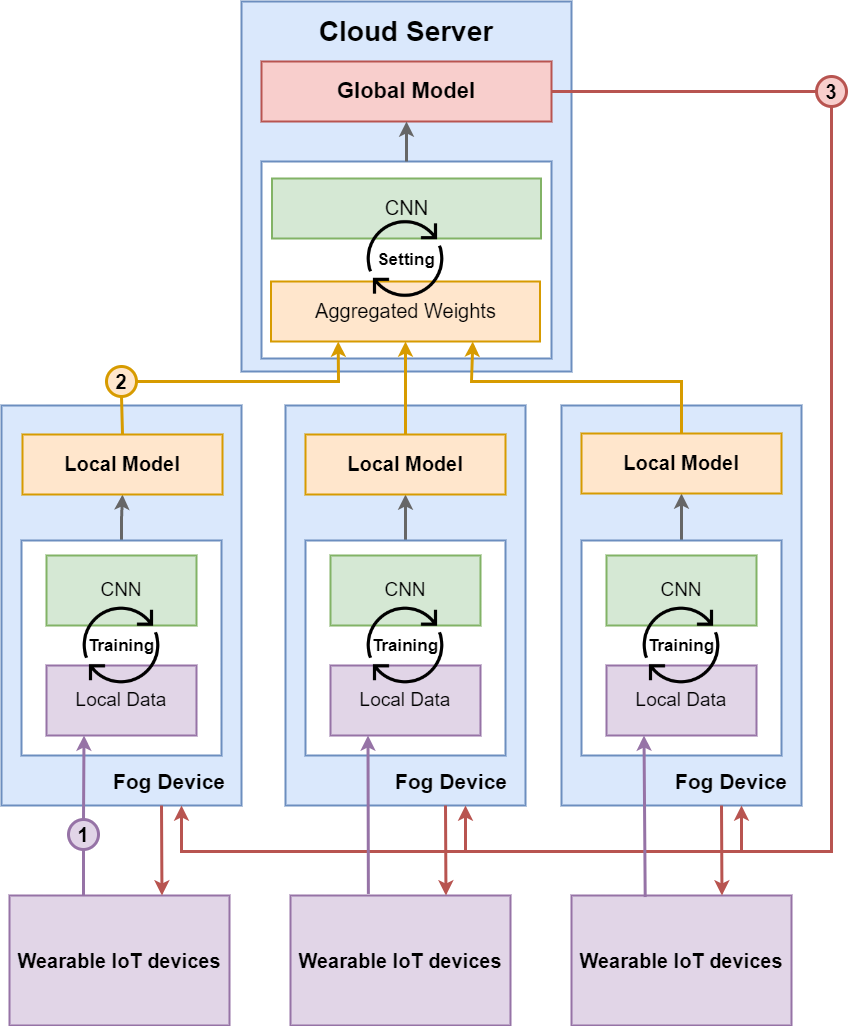
- 학습을 fog 장치로 이동시키고 웨어러블 장치는 클라이언트로 작동하는 fog-IoT 아키텍처를 활용한다.
- 로컬에서 학습된 CNN 모델을 글로벌 HAR 모델로 집계하기 위해 연합 학습을 구현한다.
- 변조 방지 하이퍼레저에서 학습 데이터 및 모델 버전 관리를 위해 프라이빗 블록체인을 도입한다.
- HAR 데이터로 학습된 1D CNN을 사용해 예측 헬스케어 모니터링을 시뮬레이션한다.
- 분산 학습 및 평가를 모의하기 위해 10개의 fog 노드를 갖춘 Raspberry Pi 기반 테스트베드를 배치한다.
- FL 효과를 평가하기 위해 글로벌 모델 정확도를 평균 로컬 모델 정확도와 비교한다.

실험 결과
연구 질문
- RQ1가장자리에서 fog로의 학습이 포함된 연합 학습이 웨어러블 IoT 환경에서 환자 데이터 프라이버시를 보존하고 예측 모델의 무결성을 유지할 수 있는가?
- RQ2프라이빗 블록체인 통합이 fog-IoT 헬스케어 플랫폼에서 로컬 학습 모델과 글로벌 집계의 보안 및 추적 가능성을 향상시키는가?
- RQ3제안된 확장 스킴이 로컬 모델의 평균과 비교하여 글로벌 모델 성능에 미치는 영향은 무엇인가?
주요 결과
- 로컬 모델은 HAR 데이터에서 90.43%의 테스트 정확도를 달성했다.
- 글로벌 모델 정확도는 91.75%에서 최대치를 기록하며 클라이언트 수가 증가함에 따라 평균 로컬 모델 정확도를 넘어선다.
- 확장 스킴은 최상의 로컬 모델에 가장 높은 가중치를 부여해 글로벌 모델 성능을 향상시킨다.
- 연합 학습 구성은 분류기의 무결성을 유지하면서 중앙 서버에 대한 원시 데이터 노출을 줄인다.
- 프라이빗 블록체인은 학습 모델 및 연합 업데이트에 대한 변조 방지 로그와 접근 제어를 제공한다.
이 논문 읽기
누빈트 뷰어에서 원문을 열고, 읽으면서 궁금한 곳을 바로 물어보세요.
누빈트에서 이 논문 읽기이 리뷰는 AI가 논문 원문을 바탕으로 만들었습니다. 인용하기 전에 원문을 확인해 주세요.