
[논문 리뷰] Fourier PINNs: From Strong Boundary Conditions to Adaptive Fourier Bases
이 논문은 고주파 및 다중스케일 해 학습을 향상시키기 위해 네트워크 아키텍처에 적응형 푸리에 기저 함수를 통합한 새로운 물리 기반 신경망 프레임워크인 Fourier PINNs를 소개한다. 신경망 최적화와 동적 기저 선택 및 계수 잘라내기 기법을 결합함으로써 Fourier PINNs는 상대적 $L_2$ 오차를 $10^{-3}$–$10^{-4}$ 수준으로 낮춰 표준 PINNs, W-PINNs, A-PINNs, RFF-PINNs보다 뛰어난 정확도를 달성한다. 이는 고주파 문제에서 하이퍼파rameter 민감도로 인해 성능이 떨어지는 경향이 있는 기존 방법들과는 대조된다.
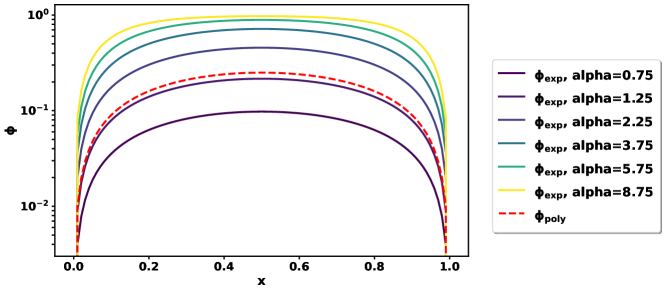
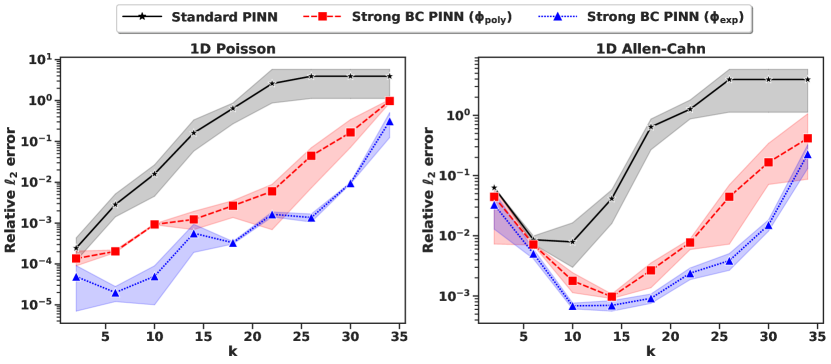
Interest is rising in Physics-Informed Neural Networks (PINNs) as a mesh-free alternative to traditional numerical solvers for partial differential equations (PDEs). However, PINNs often struggle to learn high-frequency and multi-scale target solutions. To tackle this problem, we first study a strong Boundary Condition (BC) version of PINNs for Dirichlet BCs and observe a consistent decline in relative error compared to the standard PINNs. We then perform a theoretical analysis based on the Fourier transform and convolution theorem. We find that strong BC PINNs can better learn the amplitudes of high-frequency components of the target solutions. However, constructing the architecture for strong BC PINNs is difficult for many BCs and domain geometries. Enlightened by our theoretical analysis, we propose Fourier PINNs -- a simple, general, yet powerful method that augments PINNs with pre-specified, dense Fourier bases. Our proposed architecture likewise learns high-frequency components better but places no restrictions on the particular BCs or problem domains. We develop an adaptive learning and basis selection algorithm via alternating neural net basis optimization, Fourier and neural net basis coefficient estimation, and coefficient truncation. This scheme can flexibly identify the significant frequencies while weakening the nominal frequencies to better capture the target solution's power spectrum. We show the advantage of our approach through a set of systematic experiments.
연구 동기 및 목표
- 고주파 또는 다중스케일 해를 갖는 PDE를 해결할 때 표준 PINNs에서 관찰되는 떨어진 성능 문제를 해결하기 위해.
- 주파수 척도 조정이 철저히 필요하고 민감도로 인해 실패하는 경우가 많은 기존 방법들인 RFF-PINNs의 한계를 극복하기 위해.
- 경계 조건이나 도메인 기하학에 대한 아키텍처 제약 없이 고주파 성분 학습을 향상시키는 일반적이고 유연하며 강건한 프레임워크를 개발하기 위해.
- 수동으로 기저 수나 척도를 조정할 필요 없이 중요한 주파수를 자동으로 식별하고 불필요한 주파수를 억제하는 적응형 기저 선택 알고리즘을 설계하기 위해.
- 다양한 1D 및 2D PDE 문제에서 기존 PINN 변종 대비 정확도와 강건성 면에서 Fourier PINNs의 우수성을 입증하기 위해.
제안 방법
- 고주파 해 성분의 표현을 향상시키기 위해 고정된 밀도의 사전 지정된 푸리에 기저 함수를 PINN 아키텍처에 통합한다.
- 신경망 가중치, 푸리에 기저 계수를 동시에 업데이트하고 계수 잘라내기를 수행하는 교대 최적화 기법을 도입하여 유의미한 주파수만 유지한다.
- 푸리에 변환과 콘볼루션 정리에 기반한 이론적 분석을 통해 경계 조건을 강하게 구현할 경우 고주파 진폭 학습이 향상되는 이유를 설명한다.
- 충분히 큰 후보 주파수 범위 $K$를 갖는 굵은-부터-미세한 주파수 탐색 전략을 적용하여 목표 주파수가 기저 집합에 포함되도록 보장한다.
- 낮은 크기의 푸리에 계수를 제거하는 잘라내기 메커니즘을 구현하여 노이즈를 감소시키고 모델 일반화 능력을 향상시킨다.
- 손실 함수를 수정하거나 경계 조건에 특화된 아키텍처가 필요 없이, 기존 PINN 학습과 호환되도록 푸리에 기저를 인덕티브 바이어스로 통합한다.
실험 결과
연구 질문
- RQ1PINNs에서 강력한 경계 조건을 적용하면 고주파 성분 학습이 향상되는가?
- RQ2PINNs에 사전 지정된 푸리에 기저를 사용할 경우, 표준 PINNs에 비해 고주파 및 다중스케일 문제에서 더 강건하고 정확한 해를 도출할 수 있는가?
- RQ3수동으로 기저 수나 척도를 조정할 필요 없이 적응형 기저 선택 알고리즘이 중요한 주파수를 자동으로 식별할 수 있는가?
- RQ4RFF-PINNs와 비교할 때 Fourier PINNs의 성능은 하이퍼파ram터 선택 민감도와 해 정확도 측면에서 어떻게 다른가?
- RQ5아키텍처 수정 없이 Fourier PINNs는 다양한 PDE와 경계 조건에 얼마나 잘 일반화되는가?
주요 결과
- 모든 테스트된 1D 및 2D 문제에서 Fourier PINNs는 상대적 $L_2$ 오차를 $10^{-3}$에서 $10^{-4}$ 사이로 유지하며, 표준 PINNs, W-PINNs, A-PINNs, RFF-PINNs를 크게 앞서는 성능을 보였다.
- 표준 PINN 변종은 고주파 문제에서 일관되게 실패하며, 상대적 $L_2$ 오차가 약 1.0 수준을 유지하여 고주파 성분을 포착하지 못하는 것으로 나타났다.
- RFF-PINNs는 주파수 척도와 기저 수 설정에 매우 민감하여, 테스트된 구성의 60–70%에서 실패했으며, 소수의 경우에만 낮은 오차를 기록했다.
- 스펙트럼 방법은 효과적이나, 상대적 $L_2$ 오차가 Fourier PINNs보다 두 개의 주기 정도 높고, 경계 근처에서 눈에 띄는 점별 오차 편향을 보였다.
- Fourier PINNs는 주파수 범위 $K$의 선택에 대해 강건성을 보였으며, $K$가 목표 주파수를 충분히 포함할 경우 일관된 정확도를 유지했다.
- 제안된 적응형 기저 선택 알고리즘이 주요 주파수를 성공적으로 식별하고 불필요한 주파수를 억제하여, 기저 파rameter 조정 없이도 정확한 해 복원이 가능했다.
이 논문 읽기
누빈트 뷰어에서 원문을 열고, 읽으면서 궁금한 곳을 바로 물어보세요.
누빈트에서 이 논문 읽기이 리뷰는 AI가 논문 원문을 바탕으로 만들었습니다. 인용하기 전에 원문을 확인해 주세요.