
[논문 리뷰] Gravitational Waves from SMBH Binaries in Light of the NANOGrav 15-Year Data
본 논문은 SMBH 이진이 중력파뿐만 아니라 환경 효과(가스, 별, 다크 물질)에 의해 에너지를 잃는 모델로 NANOGrav 15년 데이터를 더 잘 적합시키며, GW 전용 진화보다 더 나은 적합도를 보이고 높은 SMBH 합병 효율을 시사한다.
The NANOGrav Collaboration has recently announced evidence for nHz gravitational waves (GWs), in the form of a Hellings-Downs angular correlation in the common-spectrum process that had been observed previously by them and other Pulsar Timing Arrays (PTAs). We analyze the possibility that these GWs originate from binary supermassive black holes (SMBHs) with total masses $\gtrsim 10^9\, M_{\odot}$. The spectral index of the GW signal differs at 95 % CL from that predicted for binary evolution by GW emission alone, and we find $> 3 σ$ evidence that environmental effects such as dynamical friction with gas, stars, and dark matter may be affecting the binary evolution. We estimate the required magnitude and spectrum of such environmental effects and comment on their possible implications for measurements of GWs at higher frequencies.
연구 동기 및 목표
- NG15 나노헤르츠 GW 신호가 은하 환경 내의 SMBH 이진에서 기인한다는 해석을 동기화한다.
- 환경 에너지 손실과 SMBH–헤일로 질량 관계에서의 산포를 포함하여 이전의 SMBH 이진 인구 모델링을 확장한다.
- 환경 효과가 GW 스펙트럼에 미치는 영향을 정량화하고 PTA 관측 및 고주파 GW 전망에 미치는 영향을 평가한다.
제안 방법
- Extended Press-Schechter 형식을 사용하여 SMBH 이진 형성 및 합병률을 추정한다.
- 로그-정규 점유 분포 p_occ(m|M,z)와 일정한 합병 효율 p_BH로 SMBH 질량 분포 함수 모델링.
- f_GW( M, η, z ) = f_ref (M/10^9 M_sun)^{-β}의 거듭제곱 의존성으로 환경 에너지 손실을 도입하고, β=0.4로 고정하며 α와 f_ref를 통해 t_env/t_GW를 매개화한다.
- 합병 모집단으로부터의 GW 에너지 밀도 스펙트럼 Omega_GW(f)와 환경 효과를 포함한 진화를 계산하고, 빈도 구간 분포 P_data(Omega|f_i)를 사용하여 전체 우도(likelihood)를 생성한다.
- 강력한 소스의 몬테카를로 스타일 구현을 수행하고, 나머지는 좁은 가우시안으로 모델링하여 Omega_GW(f)의 긴 꼬리 변동을 포착한다.
- GW-단독 모형과 GW+환경 모형의 적합도 차이를 우도 비율 ell_max로 비교하고 (p_BH, α, f_ref)에 대한 후방 제약을 보고한다.
실험 결과
연구 질문
- RQ1환경 에너지 손실을 포함하는 것이 NG15 데이터에 대한 SMBH 이진 GW 배경의 적합도를 GW-단독 진화에 비해 개선하는가?
- RQ2추정된 SMBH 합병 효율 p_BH, 환경 매개변수 f_ref 및 α의 값과 상관관계는 무엇이며, 이것이 예측 GW 스펙트럼에 어떤 영향을 미치는가?
- RQ3환경 효과가 PTA 데이터에서 저주파 디프와 Omega_GW(f)의 전체 스펙트럴 형태에 어떤 영향을 미치는가?
- RQ4고주파 GW 대역에서 LISA, AEDGE 또는 원자 간섭계로 관찰 가능한 저질량 BH 합병의 함의는 무엇인가?
주요 결과
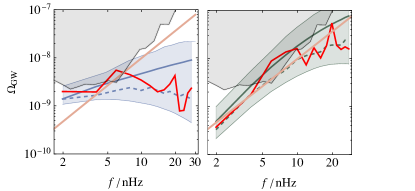
- GW-단독 모형에서 p_BH = 0.07_{-0.07}^{+0.05} (68% CL)인 반면, 환경 효과는 더 큰 p_BH 값을 선호한다.
- 환경 효과를 포함한 최적 매개변수: p_BH = 0.84, α = 2.0, f_ref ≈ 34 nHz.
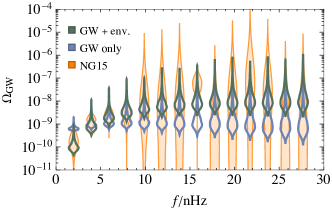
- 환경 모형은 GW-단독 모형에 비해 Δχ^2 ≈ 11의 우도 개선을 제공하고, 가우시안 근사에서 약 2σ 수준으로 환경 모형을 선호한다.
- 환경 에너지 손실로 인해 평균 Omega_GW와 그 변동을 더 잘 포착하며, GW-단독 모형이 재현하기 힘든 f = 2 nHz에서의 디프를 포함한다.
- 이 프레임워크는 고주파 GW 탐지기에 대해 저질량 BH 합병의 관측 가능 비율을 예측하고 LISA 및 양자/원자 간섭계 기반 검출기에 대한 시사점을 논의한다.
더 나은 연구,지금 바로 시작하세요
연구 설계부터 논문 작성까지, 연구 시간을 획기적으로 줄여보세요.
카드 등록 없음 · 무료 플랜 제공
이 리뷰는 AI가 만들고, 인간 에디터가 검토했습니다.