
[논문 리뷰] Inverse design of a pyrochlore lattice of DNA origami through model-driven experiments
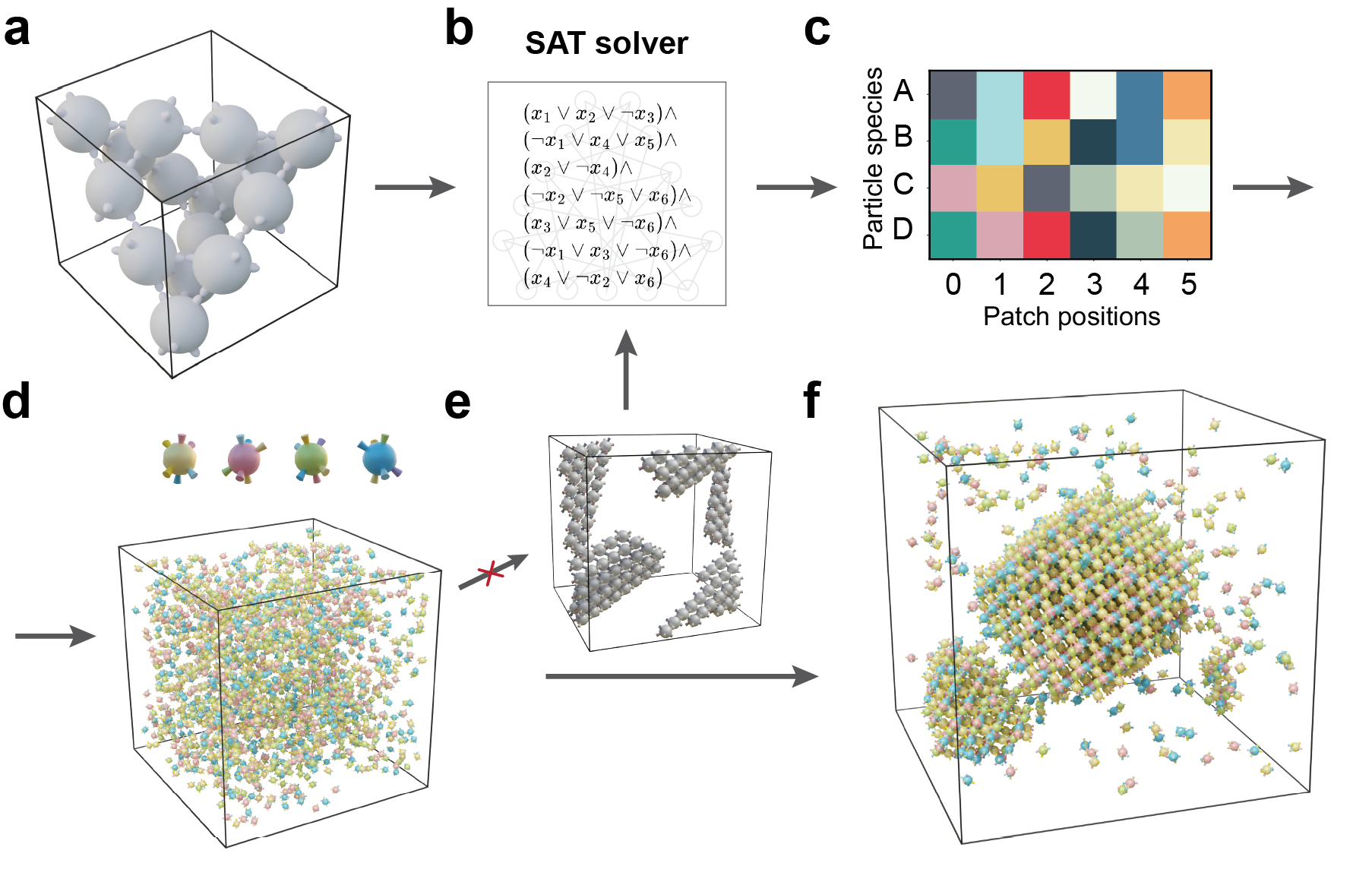
이 논문은 DNA 옹기로 피로클로르 구조체의 실험적으로 검증된 자가조립을 가능하게 하기 위해 SAT-어셈블리 최적화와 군집화된 시뮬레이션을 융합한 모델 기반의 역설계 파이프라인을 제시한다. 반복적으로 고립 상태와 경쟁하는 상을 금지함으로써, 목표로 하는 3차원 격자에 대해 고수율, 고립 상태 없는 자가조립을 달성하였으며, SAXS와 SEM으로 확인되었으며, 각각 정오각형 및 이십면체 설계에 대해 격자 상수는 156.4 nm와 159.1 nm였다.
Sophisticated statistical mechanics approaches and human intuition have demonstrated the possibility to self-assemble complex lattices or finite size constructs, but have mostly only been successful in silico. The proposed strategies quite often fail in experiment due to unpredicted traps associated to kinetic slowing down (gelation, glass transition), as well as to competing ordered structures. An additional challenge that theoretical predictions face is the difficulty to encode the desired inter-particle interaction potential with the currently available library of nano- and micron-sized particles. To overcome these issues, we conjugate here SAT-assembly -- a patchy-particle interaction design algorithm based on constrained optimization solvers -- with coarse-grained simulations of DNA nanotechnology to experimentally realize trap-free self-assembly pathways. As a proof of concept we investigate the assembly of the pyrochlore (also known as tetrastack) lattice, a highly coveted 3D crystal lattice due to its promise in construction of optical metamaterials. We confirm the successful assembly with two different patchy DNA origami designs via SAXS as well as SEM visualization of the silica-coated lattice. Our approach offers a versatile modeling pipeline that starts from patchy particles designed in silico and ends with wireframe DNA origami that self-assemble into the desired structure.
연구 동기 및 목표
- 복잡한 자가조립 나노구조체의 실험적 실현을 방해하는 일반적인 고립 상태와 경쟁 상을 극복하기 위해.
- 이론적 예측과 DNA 나노기술 분야의 실험적 성공을 연결하는 일반화 가능한 설계 프레임워크를 개발하기 위해.
- 광학 메타물질에 유망한 구조로 여겨지는 매우 갈망되는 피로클로르 격자를 실험적으로 실현하기 위해.
- 패치가 있는 입자 상호작용을 사용하여 장거리 및 유한 크기의 조립체를 설계하기 위한 확장 가능하고 오픈소스 파이프라인을 만들기 위해.
- 복잡한 격자 기하학이 계산 최적화, 시뮬레이션 및 표적 실험의 융합을 통해 달성될 수 있음을 보여주기 위해.
제안 방법
- SAT-어셈블리 알고리즘을 사용하여 격자 구조를 부울 문장으로 변환하고 단위 세포 제약 조건을 만족하는 상호작용 행렬을 해결함으로써 패치가 있는 입자 상호작용을 설계한다.
- 다양한 온도에서 군집화된 분자 동역학 시뮬레이션을 수행하여 고립 상태와 경쟁 상을 식별하고 걸러낸다.
- 불필요한 상태는 이후의 SAT 솔버 반복 과정에서 명시적으로 금지되어, 목표로 하는 피로클로르 격자만을 유리하게 만드는 상호작용 설계로 개선된다.
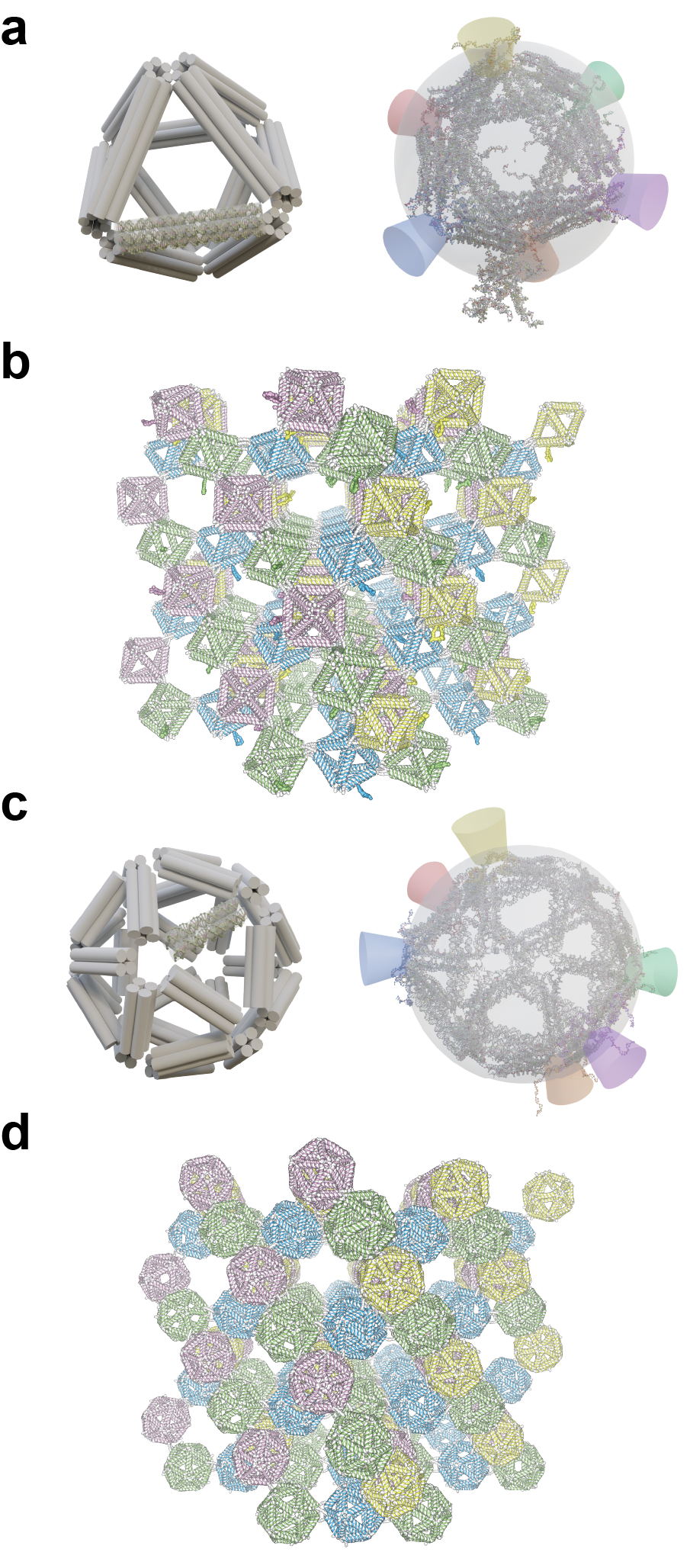
- 특정 DNA 서열과 부착 지점으로 방향성 있는 상호작용을 인코딩함으로써 최종 패치가 있는 입자 설계를 DNA 옹기로 실현한다.
- 소각형 X선 산란(SAXS)과 스캐닝 전자현미경(SEM)을 사용한 실험적 검증을 수행하였으며, 내부 구조 분석을 위해 FIB 가로절단을 포함한다.
- 핵산 수준의 군집화된 모델을 통해 설계된 패치 상호작용과 DNA 나노구조체 실현 간의 호환성을 검증한다.
실험 결과
연구 질문
- RQ1제약 조건이 있는 최적화와 시뮬레이션에 기반한 계산 설계 파이프라인이 피로클로르 격자와 같은 복잡한 3차원 격자 구조의 실험적 자가조립을 성공적으로 이끌 수 있는가?
- RQ2패치가 있는 입자 상호작용의 역설계 과정에서 고립 상태와 경쟁하는 순서 있는 상을 체계적으로 식별하고 제거할 수 있는가?
- RQ3이 설계 파이프라인이 피로클로르 격자를 초월하여 다른 복잡한 격자나 유한 크기의 조립체로 일반화될 수 있는 정도는 어느 정도인가?
- RQ4DNA 옹기를 통해 필요한 패치가 있는 입자 상호작용을 충분한 정밀도로 설계하여 3차원에서 장거리 질서를 달성할 수 있는가?
- RQ5메조스케일에서 격자 상수와 내부 질서를 포함하여 피로클로르 격자가 형성되었음을 신뢰성 있게 확인할 수 있는 실험 기법은 무엇인가?
주요 결과
- 역설계 파이프라인이 고립 상태와 경쟁 상을 성공적으로 제거하여, 목표로 하는 피로클로르 격자만을 형성하는 자가조립 경로를 확보하였다.
- SAXS 측정 결과, 정오각형 DNA 옹기 설계에 대해 격자 상수 156.4 nm, 이십면체 설계에 대해 159.1 nm로 격자 구조가 확인되었다.
- SEM 및 FIB 가로절단 영상 분석을 통해 명백한 결함 없이 장거리 내부 질서가 관찰되어 조립된 격자의 구조적 정밀도가 확인되었다.
- 두 가지 다른 DNA 옹기 설계를 통해 실험적 실현이 이루어졌으며, 이는 설계 파이프라인의 견고성과 유연성을 보여주었다.
- DNA 옹기 빌딩 블록의 크기와 내부 특성을 통해 격자 상수를 정밀하게 제어할 수 있으며, 이는 최종 격자의 광학적 성질에 영향을 준다.
- 전체 설계 및 시뮬레이션 파이프라인은 오픈소스 소프트웨어로 공개되어, 다른 복잡한 나노구조체에 광범위하게 적용 가능하다.
더 나은 연구,지금 바로 시작하세요
논문 읽기부터 검토까지, 연구 시간을 획기적으로 줄여보세요.
카드 등록 없음 · 무료 플랜 제공
이 리뷰는 AI가 만들고, 인간 에디터가 검토했습니다.