
[논문 리뷰] Merge, Ensemble, and Cooperate! A Survey on Collaborative Strategies in the Era of Large Language Models
이 조사(서베이)는 LLM 협력을 세 가지 접근 방식—Merging, Ensemble, Cooperation—으로 분류하고, 여러 LLM을 활용하기 위한 방법, 적응 및 향후 방향을 검토한다.
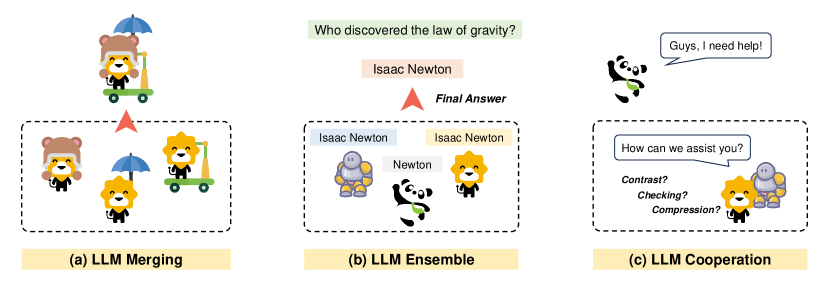
The remarkable success of Large Language Models (LLMs) has ushered natural language processing (NLP) research into a new era. Despite their diverse capabilities, LLMs trained on different corpora exhibit varying strengths and weaknesses, leading to challenges in maximizing their overall efficiency and versatility. To address these challenges, recent studies have explored collaborative strategies for LLMs. This paper provides a comprehensive overview of this emerging research area, highlighting the motivation behind such collaborations. Specifically, we categorize collaborative strategies into three primary approaches: Merging, Ensemble, and Cooperation. Merging involves integrating multiple LLMs in the parameter space. Ensemble combines the outputs of various LLMs. Cooperation} leverages different LLMs to allow full play to their diverse capabilities for specific tasks. We provide in-depth introductions to these methods from different perspectives and discuss their potential applications. Additionally, we outline future research directions, hoping this work will catalyze further studies on LLM collaborations and paving the way for advanced NLP applications.
연구 동기 및 목표
- 다양한 강점과 약점으로 인해 여러 LLM의 협력이 단일 모델보다 더 나은 성능을 내는 이유를 검토한다.
- 협력 전략을 merging, ensemble, 및 cooperation으로 정의하고 체계화한다.
- LLM 시대의 각 범주별 기법, 아키텍처 및 응용을 요약한다.
- LLM 협력의 도전 과제, 한계 및 향후 연구 방향을 강조한다.
제안 방법
- LLM 협력 방법을 세 가지 범주로 분류한다: merging (매개변수 공간 융합), ensemble (출력 융합), cooperation (작업별 조정).
- 각 범주 내 하위 접근법을 자세히 설명한다(예: M-ROS, M-MTC, task vectors, pruning, merging을 위한 incremental training).
- 사전, 추론 전, 추론 중, 추론 후의 앙상블 패러다임을 설명하고 이질적인 LLM의 어휘/정렬 문제를 다룬다.
- 효율성, 지식 이전 및 정렬을 위해 다양한 능력을 활용하는 cooperation 전략을 논의한다.
- 도구 키트 지원(MergeKit) 및 LLM 협력에 대한 실용적 고려사항에 대해 논의한다.
실험 결과
연구 질문
- RQ1LLM의 주된 협력 전략은 무엇이며 이들이 요건과 결과에서 어떻게 다른가?
- RQ2Merging, ensemble, cooperation 방법이 다양한 LLM 강점을 어떻게 활용하여 성능과 다재다능성을 향상시키는가?
- RQ3각 협력 범주(Merging, Ensemble, Cooperation)에서 핵심 기술, 도전과제 및 향후 방향은 무엇인가?
- RQ4실용적 도구 및 워크플로가 확장 가능한 LLM 협력을 어떻게 지원할 수 있는가?
주요 결과
- Merging 전략은 매개변수를 결합함으로써 더 강한 단일 모델을 만드는 것을 목표로 하며, M-ROS 및 M-MTC가 핵심 목표로 작용한다.
- Ensemble 접근은 추론의 서로 다른 단계에서 출력을 결합하는 데 집중하여 호환 가능한 어휘를 가진 모델 간의 신뢰성 및 품질을 개선한다.
- Cooperation 방법은 단순한 merging 또는 ensembling을 넘어 다양한 능력을 효율적으로 활용한 작업별 조정을 강조한다.
- 동일한 아키텍처의 merging이 가장 간단한 반면, ensemble 및 cooperation은 호환성 요구를 완화하여 더 넓은 협업을 가능하게 한다.
- Practical developments include task vectors, adaptive weighting, pruning techniques (DARE, DPPA), and toolkits (MergeKit) to support merging and related workflows.
- 이 설문은 정렬 비용, 망상, 프라이버시 문제, 확장 가능한 평가 벤치마크의 필요성과 같은 향후 방향과 도전 과제를 다양한 방향으로 제시한다.
이 논문 읽기
누빈트 뷰어에서 원문을 열고, 읽으면서 궁금한 곳을 바로 물어보세요.
누빈트에서 이 논문 읽기이 리뷰는 AI가 논문 원문을 바탕으로 만들었습니다. 인용하기 전에 원문을 확인해 주세요.