
[논문 리뷰] Phase-space analysis of a novel cosmological model in $f(Q)$ theory
이 논문은 공간적으로 평탄한 FLRW 시공간에서 비영인 애프린 연결을 사용하는 새로운 $f(Q)$ 중력 모델을 제안하며, $f(T)$ 이론과의 딱딱한 해소를 이루고자 한다. 동역적 시스템의 단계 공간 분석을 통해 저시기 가속화를 위한 안정적인 디Sitter 흡인점과 물질/복사 시대를 위한 불안정한 고정점을 규명하며, 스칼라 장을 도입하지 않고도 완전한 우주 진화 시퀀스를 설명함을 입증한다.
The vanishing affine connections have been used solely while adopting the modified $f(Q)$ gravity theory to the cosmology. Consequently, researchers could not get beyond what is already known in $f(T)$ theory earlier. To alleviate this problem, in the present manuscript we investigate a recently proposed construction of $f(Q)$ theory using non-vanishing affine connection in the spatially flat FLRW spacetime. We then investigate the cosmological solutions of $f(Q)$ theory for a perfect fluid through the phase space analysis. We introduce few variables and dimensionless parameters to construct the corresponding equations suitable for the dynamical system approach. The conservation of the energy-momentum tensor leads to a constraint equation that relates the dynamical variables. Briefly, both unstable and stable de Sitter solutions appear which correspond to early and late times accelerated expansions. Also, unstable points corresponding to the matter dominated and radiation dominated eras have been found which do exist for every $f(Q)$ function. As a result, the present discussion shows that $f(Q)$ gravity endowed by non-vanishing affine connections is capable of explaining a true sequence of cosmic eras.
연구 동기 및 목표
- 기존의 $f(Q)$ 우주론 연구에서 비영인 애프린 연결에만 의존하는 한계를 극복하고자 하며, 이는 $f(T)$ 결과를 재현한다.
- 시간에 따라 변하는 매개변수 $\gamma(t)$로 매개변수화된 비영인, 토르션 없는 애프린 연결을 사용하여 $f(Q)$ 중력의 새로운 제작을 개발하고자 한다. 이는 $f(T)$ 이론과 다른 역학을 보장한다.
- 동역적 시스템 이론을 사용하여 새로운 $f(Q)$ 모델의 우주론적 해를 분석하고, 고정점과 안정성에 집중하고자 한다.
- 이 모델이 초기 디Sitter(우주 팽창), 물질 지배, 후기 디Sitter(어둠의 에너지) 단계를 포함한 완전한 우주 시대의 순서를 기술할 수 있음을 입증하고자 한다.
- 이 모델이 보조 스칼라 장을 도입하지 않고도 이를 실현할 수 있음을 보여주고자 한다. 이는 오직 중력의 기하학적 수정에 의존한다.
제안 방법
- 비영인 애프린 연결 $\Gamma^\lambda_{\mu\nu}$ 를 사용하여 $f(Q)$ 중력을 제작하며, 곡률와 토르션이 모두 0인 조건을 만족시키고, 공간적으로 평탄한 FLRW 계량에서 시간에 따라 변하는 매개변수 $\gamma(t)$ 를 도입한다.
- 행동식 $\mathcal{L} = \sqrt{-g} f(Q)$ 에서 유도된 장 방정식, 에너지 밀도, 압력을 도출하며, 여기서 $Q$ 는 비측정성 스칼라이다.
- 에너지-모멘텀 텐서의 보존 조건을 강제로 적용하여 동적 변수들 사이의 제약 방정식을 유도함으로써 동적 시스템의 폐쇄를 가능하게 한다.
- 비차원 변수 $x_1, x_2, x_3$ 를 도입하여 시스템을 단계 공간 분석에 적합한 자동 시스템 형태로 변환한다.
- 선형화 및 고유값 분석을 통해 고정점의 안정성을 평가하고, 결과적으로 유도된 동적 시스템을 분석한다.
- 특정 모델을 조사한다: $f(Q) = \alpha Q^\beta$, $f(Q) = \eta Q + \zeta Q^\sigma$, 및 $f(Q) = \xi e^{\chi Q}$, 시간에 따라 변하는 $\gamma(t)$ 와 일정한 $\gamma(t)$ 의 경우를 모두 고려한다.
실험 결과
연구 질문
- RQ1비영인 애프린 연결이 $f(Q)$ 중력에서 $f(T)$ 이론과 다른 우주론적 역학을 만들어낼 수 있는가?
- RQ2시간에 따라 변하는 $\gamma(t)$ 를 갖는 제안된 $f(Q)$ 모델이 초기 및 후기 시기 모두에서 안정적인 디Sitter 해를 지닐 수 있는가?
- RQ3이 모델은 외부 스칼라 장 없이도 복사, 물질 지배, 후기 가속화 단계를 포함한 자연스러운 우주 시대의 순서를 기술할 수 있는가?
- RQ4$\gamma(t)$ 매개변수는 단계 공간의 구조와 고정점의 안정성에 어떤 역할을 하는가?
- RQ5다양한 $f(Q)$ 의 함수형태가 고정점의 존재성과 성격, 특히 가속 팽창에 해당하는 고정점에 어떤 영향을 미치는가?
주요 결과
- 비영인 애프린 연결을 갖는 모델은 $f(T)$ 이론과 다른 프리드만 유형 방정식을 생성하며, 이는 이전의 딱딱한 해소를 깨뜨린다.
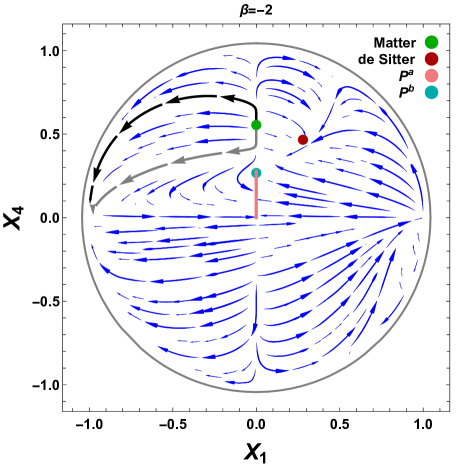
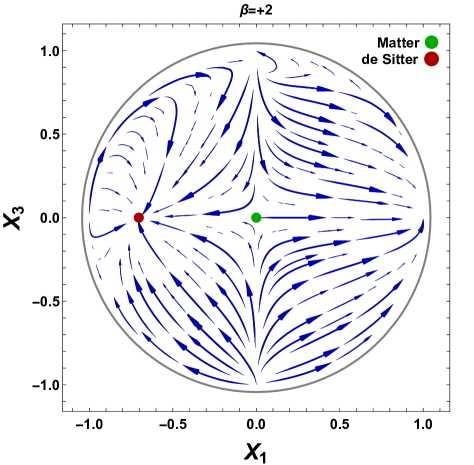
- $f(Q) = \alpha Q^\beta$ 의 경우 후기 시기에는 안정적인 디Sitter 고정점이 존재하고, 초기 시기에는 불안정한 물질 지배 고정점이 존재하며, 궤적은 후자를 전형적으로 전환하여 후자를 향해 진화한다.
- $f(Q) = \xi e^{\chi Q}$ 의 모델은 두 개의 디Sitter 고정점을 보이며, 하나는 불안정(초기 시기의 팽창)이고, 다른 하나는 안정(후기 시기의 가속화)이다. 이는 초기에서 후기 디Sitter 단계로의 전이를 가능하게 한다.
- $f(Q) = \xi e^{\chi Q}$ 모델의 단계 공간 궤적은 초기 디Sitter 상태 $R^{ds}_e$ 에서 후기 디Sitter 상태 $R^{ds}_l$ 으로의 진화를 보이며, 초기 값이 작을 경우 후기 시기에는 $x_1$ 이 0에 매우 가까운 상태로 유지된다.
- $f(Q) = \eta Q + \zeta Q^\sigma$ 의 모델은 물질 지배 고정점을 지지하지 못하며, 이는 표준 우주 진화와의 불일치를 시사한다.
- 일부 모델에서는 물질 지배 고정점과 연결되지 않은 안정적인 고정점이 존재하며, 이는 $w^{\text{eff}} < -1/3$ 인 가속 팽창을 나타내며, 후기 시기의 동역학이 다른 경로를 따를 수 있음을 시사한다.
이 논문 읽기
누빈트 뷰어에서 원문을 열고, 읽으면서 궁금한 곳을 바로 물어보세요.
누빈트에서 이 논문 읽기이 리뷰는 AI가 논문 원문을 바탕으로 만들었습니다. 인용하기 전에 원문을 확인해 주세요.