
[논문 리뷰] Revisiting oldest stars as cosmological probes: new constraints on the Hubble constant
이 연구는 가장 오래된 별—은하수개구조, 백색왜성, 초저광도은하를 독립적인 천체물리적 측정수단으로 삼아 허블 상수 $H_0$ 를 제약하는 데 목적이 있다. 평탄한 $\Lambda$CDM 모형 하에서 형성 적색편이에 대한 보수적인 균일한 사전분포($11 \leq z_f \leq 30$)와 $\Omega_{\rm M} = 0.30 \pm 0.02$ 를 사용한 베이지안 추론을 통해 가장 정확한 개별 연령 추정치로부터 $H_0 < 70.6$ km/s/Mpc 를 도출하였고, 부분집합을 평균화했을 때 90.3% 신뢰수준에서 $H_0 < 73.0$ km/s/Mpc 를 얻었다. 이는 SH0ES 결과보다 Planck2020 값을 지지한다.
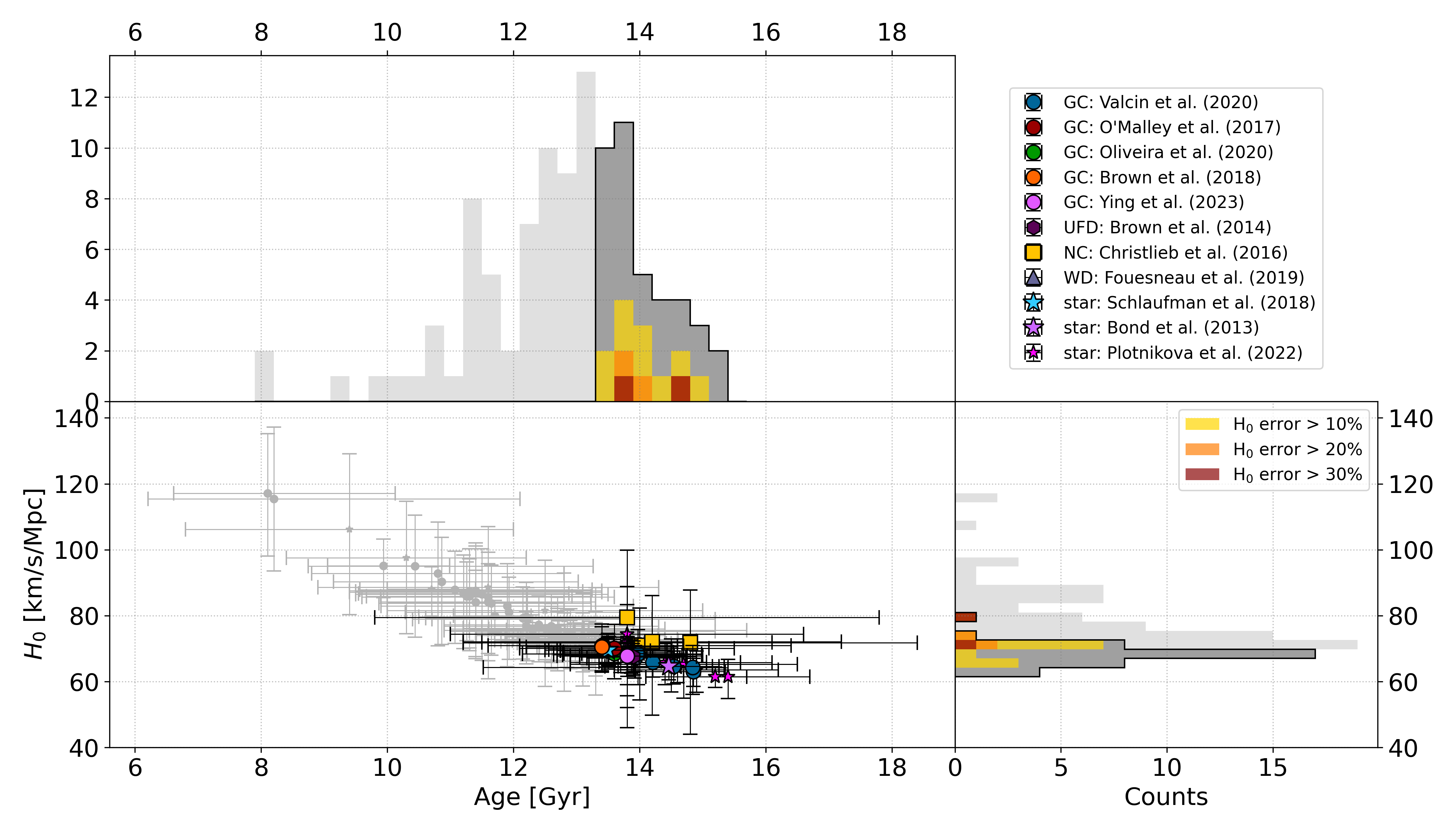
Despite the tremendous advance of observational cosmology, the value of the Hubble constant ($H_0$) is still controversial (the so called ``Hubble tension'') because of the inconsistency between local/late-time measurements and those derived from the cosmic microwave background. As the age of the Universe is very sensitive to $H_0$, we explored whether the present-day oldest stars could place independent constraints on the Hubble constant. To this purpose, we selected from the literature the oldest objects (globular clusters, stars, white dwarfs, ultra-faint and dwarf spheroidal galaxies) with accurate age estimates. Adopting a conservative prior on their formation redshifts ($11 \leq z_{ m f} \leq 30$) and assuming $Ω_{ m M} = 0.3 \pm 0.02$, we developed a method based on Bayesian statistics to estimate the Hubble constant. We selected the oldest objects ($>13.3$ Gyr) and estimated $H_0$ both for each of them individually and for the average ages of homogeneous subsamples. Statistical and systematic uncertainties were properly taken into account. The constraints based on individual ages indicate that $H_0<70.6$ km/s/Mpc when selecting the most accurate estimates. If the ages are averaged and analyzed independently for each subsample, the most stringent constraints imply $H_0<73.0$ with a probability of 90.3% and errors around 2.5 km/s/Mpc. We also constructed an ``accuracy matrix'' to assess how the constraints on $H_0$ become more stringent with further improvements in the accuracy of stellar ages and $Ω_{ m M}$. The results show the high potential of the oldest stars as independent and competitive cosmological probes not only limited to the Hubble constant.
연구 동기 및 목표
- 현재 시대의 가장 오래된 별들이 허블 상수 $H_0$ 를 제약하는 데 있어 독립적인 천체물리적 측정수단으로서의 잠재력을 평가하는 것.
- 우주의 연령보다 오래된 별의 연령을 활용하여 허블 긴장 문제를 해결하는 것.
- 별의 연령 추정치와 천체물리적 파rameter의 통계적 및 체계적 오차를 고려한 베이지안 프레임워크를 개발하는 것.
- 연령 및 $\Omega_{\rm M}$ 정확도 향상이 $H_0$ 제약에 어떤 영향을 미치는지 정량화하는 것.
- 관측된 별의 연령이 만능우주론적 측정값($H_0$)과 후기우주 측정값($H_0$) 간의 타당성, 특히 Planck2020 대비 SH0ES의 타당성을 평가하는 것.
제안 방법
- 평탄한 $\Lambda$CDM 모형 하에서 별의 연령을 이용해 $H_0$ 를 추정하기 위해 베이지안 추론을 적용한다.
- 모델 의존도를 최소화하기 위해 형성 적색편이 $z_f \in [11, 30]$ 에 대해 보수적인 균일한 사전분포를 적용한다.
- CMB 데이터와 독립적인 후기우주 측정을 바탕으로 $\Omega_{\rm M} = 0.30 \pm 0.02$ 에 대해 정규분포 사전분포를 사용한다.
- 연령 $t$ 와 $H_0$ 를 연결하기 위해 적분관계식 $H_0 = A / t \int_0^{z_f} [\Omega_{\rm M}(1+z)^3 + (1 - \Omega_{\rm M})]^{-1/2} dz$ 를 활용한다.
- 13.3 Gyr 이상의 연령을 가진 39개의 천체를 분석하여 개별적으로 $H_0$ 를 계산하고, 동질적인 부분집합(예: 은하수개구조, 백색왜성)으로 나누어 평균화한다.
- 미래의 별의 연령 및 $\Omega_{\rm M}$ 오차 향상이 $H_0$ 제약에 어떤 영향을 미칠지 예측하기 위해 '정확도 행렬'을 구축한다.

실험 결과
연구 질문
- RQ1현 시대의 가장 오래된 별의 연령이 허블 상수 $H_0$ 를 독립적으로 제약할 수 있는가?
- RQ2별의 연령 추정치에 대한 체계적 오차가 유도하는 $H_0$ 값에 어떤 영향을 미치며, 이를 완화할 수 있는가?
- RQ3관측된 가장 오래된 별의 연령이 Planck CMB 측정값과 SH0ES 지역 측정값의 $H_0$ 값과 얼마나 호환되는가?
- RQ4향후 별의 연령 정밀도 향상이 $H_0$ 의 불확실성에 얼마나 기여할 수 있는가?
- RQ5가장 오래된 별은 표준 $\Lambda$CDM 모형과 허블 긴장을 해결하고자 하는 초기 어둠료 에너지 모형을 구분하는 데 도움이 될 수 있는가?
주요 결과
- 가장 정확한 개별 연령 추정치로부터 $H_0 < 70.6$ km/s/Mpc 를 고신뢰도로 도출하였으며, 이는 낮은 $H_0$ 값을 지지한다.
- 동질적인 부분집합 내에서 연령을 평균화했을 때, $H_0$ 의 90.3% 신뢰도 상한선은 $73.0$ km/s/Mpc 로, SH0ES의 $73.04 \pm 1.04$ km/s/Mpc 보다 낮다.
- 결과는 별의 연령을 바탕으로 Planck2020의 $H_0$ 값($67.4 \pm 0.5$ km/s/Mpc)이 SH0ES 값보다 강하게 지지됨을 보여준다.
- $\Omega_{\rm M}$ 사전분포에서 기인하는 체계적 오차는 최대 $\sigma_{\rm syst} = 2.37$ km/s/Mpc 이며, 이는 이 방법이 사전가정에 대해 강건함을 시사한다.
- 정확도 행렬은 별의 연령 오차를 $\lesssim 0.3-0.4$ Gyr 수준으로 줄일 경우 $H_0$ 제약이 약 $1-2$ km/s/Mpc 수준으로 강화되어 다른 천체물리적 측정수단과 경쟁 가능해질 것임을 보여준다.
- 이 연구는 가장 오래된 별이 유망한 천체물리적 측정수단임을 입증하였으며, 향후 $H_0$ 제약 및 초기 어둠료 에너지 모형 검증에 기여할 잠재력을 지닌다.
이 논문 읽기
누빈트 뷰어에서 원문을 열고, 읽으면서 궁금한 곳을 바로 물어보세요.
누빈트에서 이 논문 읽기이 리뷰는 AI가 논문 원문을 바탕으로 만들었습니다. 인용하기 전에 원문을 확인해 주세요.