
[논문 리뷰] Star formation beyond galaxies: widespread in-situ formation of intra-cluster stars
이 연구는 TNG50 천체물리적 시뮬레이션을 사용하여, 은하단의 은하간 빛(ICL) 성성 중 8%~28%가 중심 은하에서 멀리 떨어진 은하단 주변 매질(CCM)에서 조밀한 가스 구름이 필라멘터리한 구조에 의해 응고되면서 현지에서 형성됨을 입증한다. 이러한 성성은 tidal stripping이 아니라 낮은 밀도 영역에서 직접 발생하며, 중심 은하의 성별 질량과 유사한 성별 질량 기여를 하며, 현재의 흩어진 별 형성률은 약 1 M☉/yr이다.
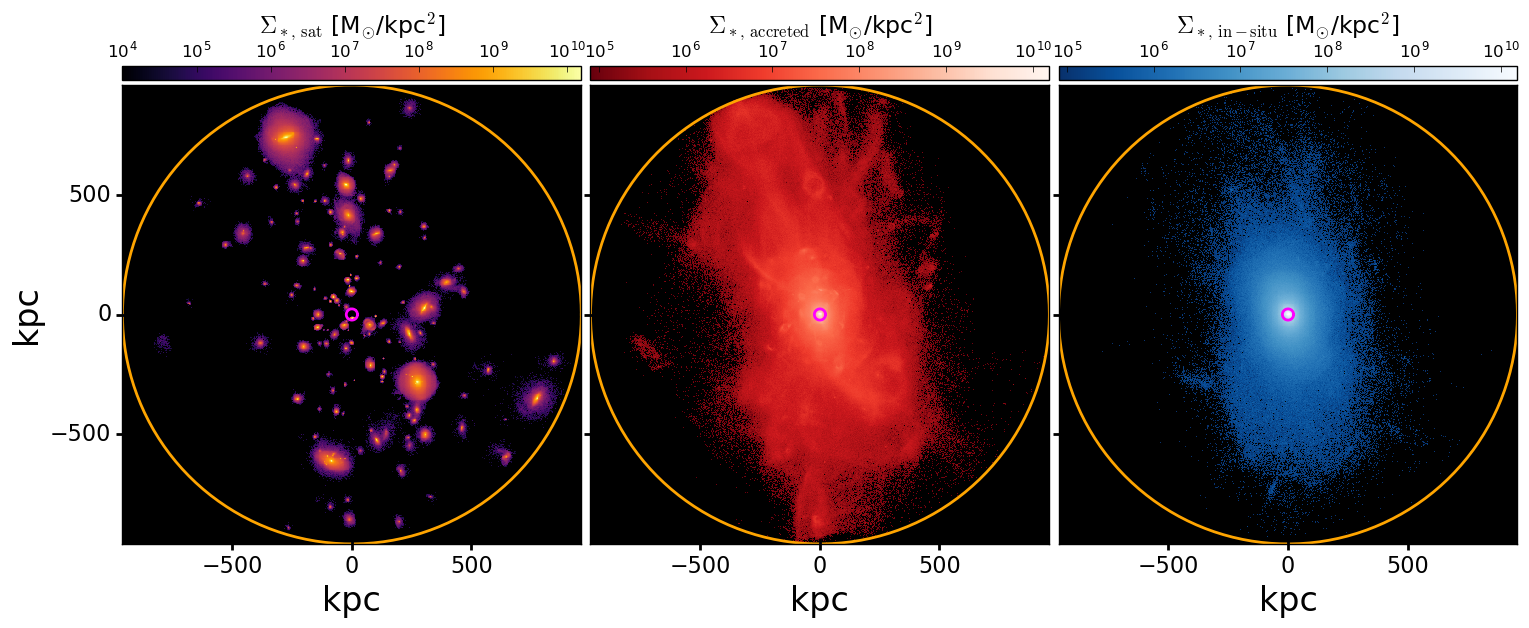
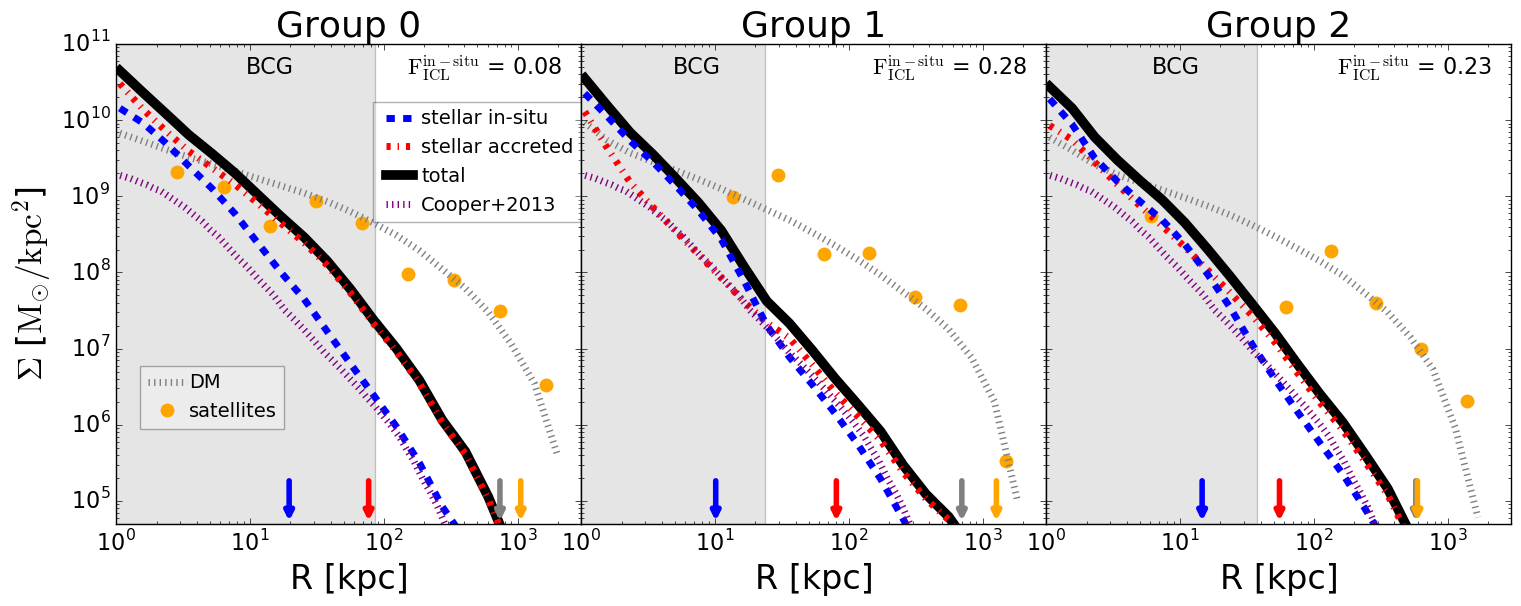
We study the fraction of the intra-cluster light (ICL) formed in-situ in the three most massive clusters of the TNG50 simulation, with virial masses $\sim 10^{14}$ M$_{\odot}$. We find that a significant fraction of ICL stars ($8\%$-$28\%$) are born in-situ. This amounts to a total stellar mass comparable to the central galaxy itself. Contrary to simple expectations, only a sub-dominant fraction of these in-situ ICL stars are born in the central regions and later re-distributed to more energetic orbits during mergers. Instead, many in-situ ICL stars form directly hundreds of kiloparsecs away from the central galaxy, in clouds condensing out of the circum-cluster medium. The simulations predict a present-date diffuse star formation rate of $\sim$1 $\mathrm{M}_{\odot}$/yr, with higher rates at higher redshifts. The diffuse star forming component of the ICL is filamentary in nature, extends for hundreds of kiloparsecs and traces the distribution of neutral gas in the cluster host halo. We discuss briefly how numerical details of the baryonic treatment in the simulation, in particular the density threshold for star formation and the equation of state, may play a role in this result. We conclude that a sensitivity of $1.6 imes 10^{-19} - 2.6 imes 10^{-18}$ erg s$^{-1}$ cm$^{-2}$ arcsec$^{-2}$ in H$_α$ flux (beyond current observational capabilities) would be necessary to detect this diffuse star-forming component in galaxy clusters.
연구 동기 및 목표
- 대규모 은하단에서 은하간 빛(ICL) 성성의 기원을 조사하고, 특히 상당수의 성성이 타원성 분리가 아닌 현지에서 형성되는지 여부를 밝히는 것.
- 특히 중심 은하에서 멀리 떨어진 영역에서 은하단 주변 매질(CCM) 내 현지 ICL 성성의 공간 분포 및 형성 메커니즘을 규명하는 것.
- 현재 및 향후 Hα 조사에서 흩어진, 저표면 밝기의 별 형성을 탐지할 수 있는지 평가하는 것.
- 수치 해상도와 별 형성 임계값이 CCM 내 저밀도 별 형성 시뮬레이션에 미치는 영향을 평가하는 것.
제안 방법
- 자기 일관성 있는 비가우스 물리와 이동 메쉬 방법(Areopo)을 포함한 TNG50 천체물리적 유체역학 시뮬레이션을 사용하여 은하 형성과 은하단 진화를 모델링하였다.
- 중앙 은하에서 200 kpc 이상 떨어진 클러스터 헬로에서 형성된 별을 현지 ICL 별로 정의하였으며, 이는 흩어진 CCM 내 조밀한 가스 덩어리에서 발생한 별 형성과 관련이 있다.
- IllustrisTNG 프로젝트의 합성수 나무와 은하단 목록을 사용하여 별 형성 역사 추적을 통해 현지 ICL 별과 유입되거나 타이달 스트립된 별을 구분하였다.
- Hα 표면 밝기를 계산하여 탐지 가능성 평가를 위해 Salpeter 초기 질량 함수와 초신성 비율 추정치를 사용하였다.
- 현지 별 형성 클러스터, 중성 가스, 암흑 물질 간의 공간 상관관계를 분석하여 필라멘터리한 구조와 환경적 촉매 요인을 식별하였다.
- 감도 테스트에서 별 형성 임계값을 변화시켜 저밀도 환경에서의 현지 ICL 형성의 수치적 안정성을 평가하였다.
실험 결과
연구 질문
- RQ1대규모 은하단에서 은하간 빛(ICL)의 어느 정도가 타원성 분리가 아닌 현지에서 형성되는가?
- RQ2현지 ICL 별은 중심 은하 근처에서 형성되는가, 아니면 은하단 주변 매질(CCM)의 먼 흩어진 영역에서 형성되는가? 어떤 조건에서 형성되는가?
- RQ3현재 또는 향후 Hα 조사로 ICL 내 흩어진 별 형성을 탐지할 수 있는가? 탐지에 필요한 감도는 어느 정도인가?
- RQ4현지 ICL 별 형성 결과가 수치적 오류일 가능성은 어느 정도이며, 시뮬레이션에서 별 형성 임계값의 선택에 얼마나 민감한가?
- RQ5현지 ICL 별의 공간 분포는 클러스터 헬로 내 암흑 물질 및 중성 가스 구조와 어떻게 관련되어 있는가?
주요 결과
- 세 개의 가장 무거운 TNG50 클러스터에서 현재 시점의 은하간 빛(ICL) 중 8%~28%가 현지에서 형성되었으며, 총 성별 질량은 중심 은하와 유사하다.
- 현지 ICL 별의 대부분은 중심 은하에서 수 킬로파섹 떨어진 흩어진 은하단 주변 매질(CCM)에서 직접 형성되었으며, 중심 영역에서 후속 재분포에 의해 발생한 것이 아니다.
- 현지 별 형성은 중성 가스와 암흑 물질 분포와 일치하는 필라멘터리한 클러스터 형태의 가닥에서 발생하며, 주로 유입되는 은하의 램 압력 스트립에 의해 유도되지 않는다.
- 현재 시점의 흩어진 별 형성률은 약 1 M☉/yr이며, 고적색 이동 시기에는 더 높은 비율을 보이며, 우주 시간 동안 지속적인 별 형성 여부를 시사한다.
- 이 흩어진 별 형성의 Hα 표면 밝기는 약 6.8 × 10⁻¹⁹ erg s⁻¹ cm⁻² arcsec⁻²이며, 현재의 조사(예: VESTIGE)에서 3 arcsec 해상도로는 탐지 한계 이하이다.
- 현지 ICL 별 형성은 시뮬레이션의 별 형성 임계값에 민감하게 영향을 받는 것으로 나타나 수치적 의존성이 있을 수 있으나, 테스트된 조건에서는 결과가 탄탄하다.
이 논문 읽기
누빈트 뷰어에서 원문을 열고, 읽으면서 궁금한 곳을 바로 물어보세요.
누빈트에서 이 논문 읽기이 리뷰는 AI가 논문 원문을 바탕으로 만들었습니다. 인용하기 전에 원문을 확인해 주세요.