
[논문 리뷰] The Gas-Phase Mass--Metallicity Relation for Massive Galaxies at $z\sim0.7$ with the LEGA-C Survey
이 연구는 LEGA-C 조사의 깊은 VLT/VIMOS 스펙트럼을 사용하여, z ≈ 0.7에서 log(M⋆/M☉) ≈ 11.1까지 기체상 질량-금속성관계(MZR)를 확장한다. 고질량 영역에서 MZR가 평탄해지는 경향을 규명하였으며, 이는 시뮬레이션 예측과 배치되며 은하 진화에서 AGN 피드백 모델에 대한 중요한 관측적 제약 조건을 제공한다.
The massive end of the gas-phase mass--metallicity relation (MZR) is a sensitive probe of active galactic nuclei (AGN) feedback that is a crucial but highly uncertain component of galaxy evolution models. In this paper, we extend the $z\sim0.7$ MZR by $\sim$0.5 dex up to log$(M_\star/ extrm{M}_\odot)\sim11.1$. We use extremely deep VLT VIMOS spectra from the Large Early Galaxy Astrophysics Census (LEGA-C) survey to measure metallicities for 145 galaxies. The LEGA-C MZR matches the normalization of the $z\sim0.8$ DEEP2 MZR where they overlap, so we combine the two to create an MZR spanning from 9.3 to 11.1 log$(M_\star/ extrm{M}_\odot)$. The LEGA-C+DEEP2 MZR at $z\sim0.7$ is offset to slightly lower metallicities (0.05-0.13 dex) than the $z\sim0$ MZR, but it otherwise mirrors the established power law rise at low/intermediate stellar masses and asymptotic flattening at high stellar masses. We compare the LEGA-C+DEEP2 MZR to the MZR from two cosmological simulations (IllustrisTNG and SIMBA), which predict qualitatively different metallicity trends for high-mass galaxies. This comparison highlights that our extended MZR provides a crucial observational constraint for galaxy evolution models in a mass regime where the MZR is very sensitive to choices about the implementation of AGN feedback.
연구 동기 및 목표
- z ≈ 0.7에서 거대 은하의 기체상 금속성을 측정하여 질량-금속성관계(MZR)의 고질량 영역을 탐구한다.
- 기존 MZR를 약 0.5데크스 이상의 은하 질량 범위로 확장하여 log(M⋆/M☉) ≈ 11.1까지 연장한다.
- 관측된 MZR를 우주론적 시뮬레이션(IllustrisTNG 및 SIMBA)의 예측과 비교하여 은하 진화에서 AGN 피드백의 역할을 제약한다.
- 은하 형성 모델에서 AGN 피드백 조정을 위한 고정밀 관측 기준을 제공한다.
제안 방법
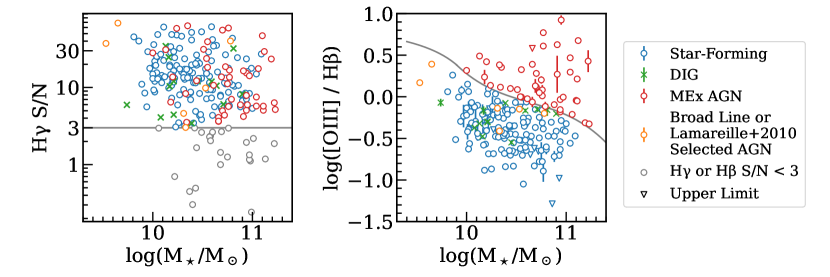
- 레드시프 범위 0.6 < z < 1.0 내에서 LEGA-C 조사의 145개 거대 은하에 대해 매우 깊은 VLT VIMOS 스펙트럼을 확보하였다.
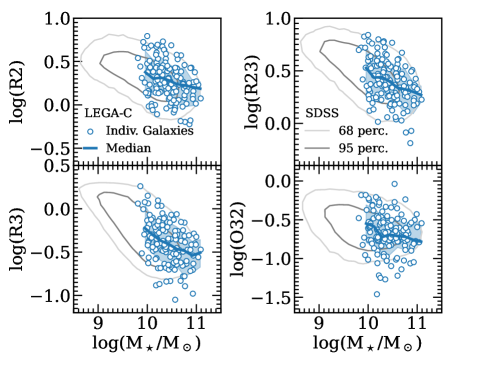
- 강한 방출선(예: [O III] λ5007, Hβ, [O II] λ3727)을 사용하여 스펙트럼 피팅 및 개구부 보정을 통해 기체상 산소 농도(12 + log(O/H))를 측정하였다.
- LEGA-C 데이터를 z ≈ 0.8의 DEEP2 MZR와 융합하여 log(M⋆/M☉) = 9.3에서 11.1까지 연속적인 MZR를 구축하였다.
- 시뮬레이션(IllustrisTNG 및 SIMBA)의 MZR를 log(M⋆/M☉) = 10.4에서 LEGA-C+DEEP2 MZR와 일치하도록 정규화하여 직접 비교하였다.
- 통계적 피팅(LMFIT, emcee)을 사용하여 금속성과 불확실성을 유도하였으며, 먼지 흡수 및 개구부 효과를 고려했다.
- 선택 효과에 대한 민감도를 평가하기 위해 SFR 가중 및 질량 가중 금속성 추정 방법을 적용하였다.
실험 결과
연구 질문
- RQ1z ≈ 0.7에서 기체상 MZR의 고질량 영역은 어떻게 진화하는가? log(M⋆/M☉) ≈ 11.1에서 평탄해지거나 감소하는가?
- RQ2우주론적 시뮬레이션(IllustrisTNG 및 SIMBA)의 예측은 고질량 은하에서 관측된 MZR와 어떻게 비교되는가?
- RQ3관측된 MZR는 은하 진화 모델에서 AGN 피드백의 구현 방식을 어느 정도 제약하는가?
- RQ4시뮬레이션에서의 경향을 고려할 때, 관측된 MZR는 열모드 또는 라디오 모드 AGN 피드백 메커니즘과 일치하는가?
- RQ5z ≈ 0.7에서 MZR의 정규화 및 형태는 국소(z ≈ 0) MZR과 어떻게 비교되는가?
주요 결과
- LEGA-C MZR는 MZR의 고질량 영역을 log(M⋆/M☉) ≈ 11.1까지 확장하였으며, 이는 이전 측정치 대비 약 0.5데크스의 동적 범위 증가를 의미한다.
- z ≈ 0.7에서의 LEGA-C+DEEP2 MZR는 국소 z ≈ 0 MZR보다 0.05–0.13 덱스 낮은 금속성으로 오프셋되어 있으며, 이는 우주적 금속성 진화와 일치한다.
- 관측된 MZR는 고질량 영역(log(M⋆/M☉) > 10.6)에서 평탄해지며, 금속성은 약 12 + log(O/H) ≈ 8.75로 점 渐진하여, IllustrisTNG의 시뮬레이션 예측과 배치되는 금속성 감소 경향을 보이지 않는다.
- IllustrisTNG는 금속 농도가 높은 기체를 제거하는 배출형 AGN 피드백으로 인해 log(M⋆/M☉) ≈ 10.6에서 금속성 감소를 예측하지만, 이는 관측 결과와 일치하지 않는다.
- SIMBA는 log(M⋆/M☉) = 11까지 금속성이 계속 증가한다고 예측하지만, 고질량 영역에서는 여전히 관측된 MZR보다 높은 금속성을 보이며, 이는 과도한 금속 생성 또는 부족한 풍속 금속 적재를 시사한다.
- 관측된 MZR는 시뮬레이션에서 AGN 피드백을 校정하는 데 중요한 제약 조건을 제공하며, 금속 배출가 억제되거나 밀폐상자 유사 진화를 따르는 모델을 선호한다.
이 논문 읽기
누빈트 뷰어에서 원문을 열고, 읽으면서 궁금한 곳을 바로 물어보세요.
누빈트에서 이 논문 읽기이 리뷰는 AI가 논문 원문을 바탕으로 만들었습니다. 인용하기 전에 원문을 확인해 주세요.