
[논문 리뷰] The vertical structure of T Tauri accretion disks II. Physical conditions in the disk
이 논문은 평면-평행 기하학에서 수직 방향 복사 전달을 고려한 얇은 디스크 근사에 기반하여 T 타우리 적응 디스크의 물리적 조건을 계산하기 위한 자기 일관된 분석 모델을 제시한다. 점성 소산과 항성 조사 등 여러 가열 원천을 포함시켜 온도, 압력, 밀도에 대한 분석 공식을 유도함으로써 정확한 스펙트럼 에너지 분포(Spectral Energy Distribution, SED) 및 간섭계 관측량을 가능하게 하며, 주요 결과로는 디스크의 부풀어림 현상으로 인해 SED가 더 평탄해지고 내부 디스크의 물리적 구조에 대한 제약 조건이 향상됨을 보여준다.
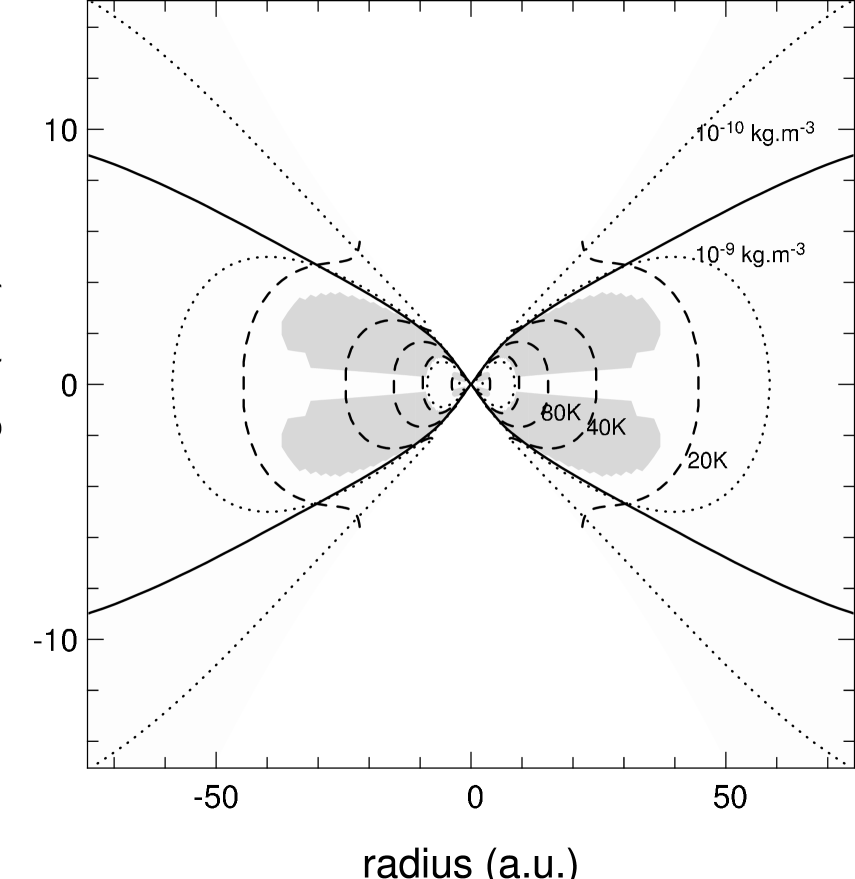
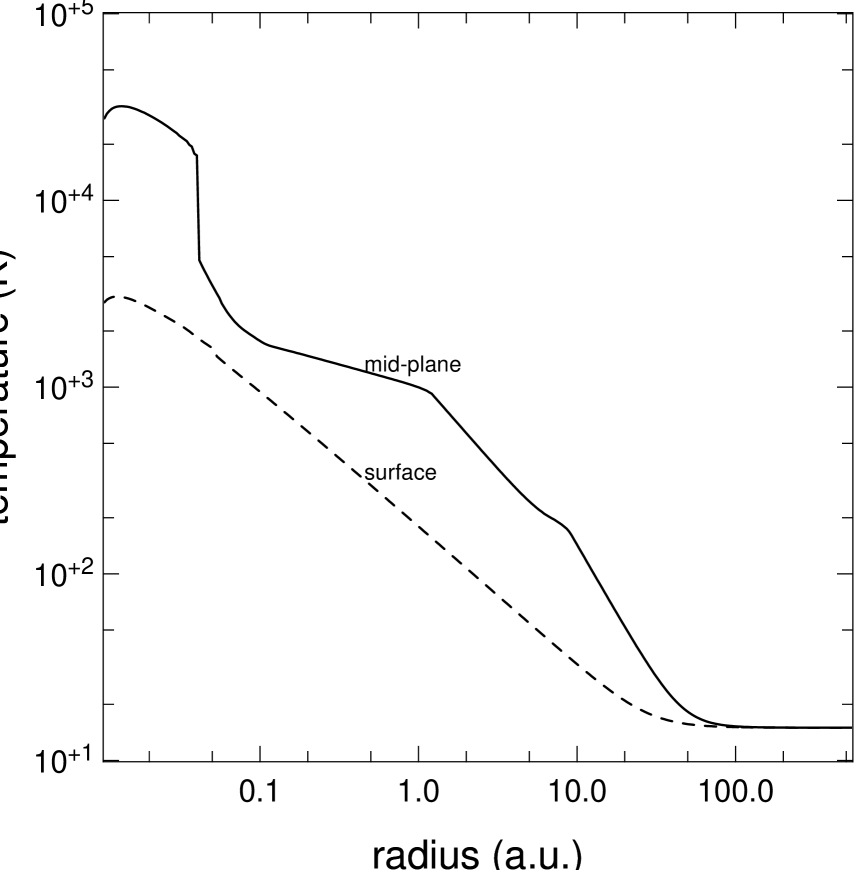
We present a self-consistent analytical model for the computation of the physical conditions in a steady quasi-Keplerian accretion disk. The method, based on the thin disk approximation, considers the disk as concentric cylinders in which we treat the vertical transfer as in a plane-parallel medium. The formalism generalizes a work by Hubeny (1990), linking the disk temperature distribution to the local energy dissipation and leads to analytical formulae for the temperature distribution which help to understand the behaviour of the radiation propagated inside the disks. One of the main features of our new model is that it can take into account many heating sources. We apply the method first to two sources: viscous dissipation and stellar irradiation. We show that other heating sources like horizontal transfer or irradiation from the ambiant medium can also be taken into account. Using the analytical formulation in the case of a modified Shakura & Sunyaev radial distribution that allow the accretion rate to be partly self-similar in the inner region, and, for an alpha and beta prescription of the viscosity, we obtain two-dimensional maps of the temperature, pressure and density in the close environment of low mass young stars. We use these maps to derive the observational properties of the disks such as spectral energy distributions, high resolution spatial images or visibilities in order to underline their different behaviours under different input models.
연구 동기 및 목표
- T 타우리 적응 디스크의 수직 구조를 다중 가열 원천을 고려한 물리적으로 자기 일관된 모델로 개발하기 위해.
- 평면-평행 기하학에서 복사 전달을 사용하여 디스크 내 온도, 압력, 밀도 분포에 대한 분석 표현식을 유도하기 위해.
- 관측 데이터(예: SED, 고해상도 이미지, 간섭계 복사율)의 해석을 향상시키기 위해 경험적 제곱법 가정을 물리적으로 근거 있는 모델로 대체하기 위해.
- 자기 유사성 적응 흐름을 허용하는 α 및 β 점성 법칙을 사용한 모듈러 형식의 에너지 원천 기반으로 향후 자기장 및 점성 운반을 포함한 모델의 기초를 마련하기 위해.
제안 방법
- 얇은 디스크 근사와 평면-평행 매질에서의 수직 복사 전달을 모델링하며, Hubeny(1990)의 형식을 확장한다.
- 지역 에너지 소산과 탈출 복사 간의 연결을 통해 국소 에너지 균형을 고려하여 수직 온도 프로파일에 대한 분석 공식을 유도하며, Eddington 근사법을 사용한다.
- 에너지 분율이 총 소산에 정규화된 개별 원천 기여의 가중 평균을 통해 다중 가열 원천(예: 점성 소산, 항성 조사)을 통합한다.
- 내부 디스크 영역에서 자기 유사성 적응 흐름을 허용하는 수정된 Shakura & Sunyaev의 반경 방향 점성 프로파일을 적용하며, α 및 β 점성 법칙을 사용한다.
- 유도된 물리적 지도에서 스펙트럼 에너지 분포(SED), 공간 이미지, 간섭계 복사율과 같은 관측 가능량을 계산한다.
- 각 에너지 원천을 독립적으로 처리함으로써 향후 자기장 또는 국소 외 에너지 운반을 포함한 확장이 가능한 형식을 사용한다.
실험 결과
연구 질문
- RQ1점성 소산과 항성 조사 등 다중 가열 원천의 포함이 T 타우리 디스크의 수직 온도 구조에 어떤 영향을 미치는가?
- RQ2반경 방향 온도 및 척도 높이 변화에 의해 유도되는 디스크 부풀어림 현상이 표준 얇은 디스크 모델 대비 스펙트럼 에너지 분포를 얼마나 평탄하게 만드는가?
- RQ3복사 전달과 에너지 균형에서 일관적으로 유도된 온도, 압력, 밀도에 대한 분석 공식이 관측 결과와 직접 비교 가능하게 할 수 있는가?
- RQ4α 및 β 점성 법칙의 다른 설정이 디스크의 반경 및 수직 구조와 그 관측 가능 특성에 어떤 영향을 미치는가?
- RQ5이 모델이 몽테카를로 산산각산 코드에 사용될 수 있는 물리적으로 타당한 초기 조건으로서 기능할 수 있는가? 이는 원형주위 디스크의 편광 지도를 예측하기 위함이다.
주요 결과
- 디스크의 부풀어림 현상과 더 넓은 반경에서의 증가된 항성 조사로 인해 T 타우리 항성에서 기대보다 더 평탄한 SED를 성공적으로 재현한다.
- 수직 온도 프로파일에 대한 분석 공식이 도출되었으며, 이는 디스크 대기권에서의 온도 상승이 주로 점성 가열과 항성 조사의 조합 효과에 의해 주도됨을 보여준다.
- 추가 가열 원천(예: 수평 복사 전달, 환경 매질 조사)의 포함이 가능하여 모델의 유연성이 향상된다.
- 저질량 주진행 전 주기의 별에 대해 자기 유사성 적응 프로파일과 α/β 점성 법칙을 사용하여 온도, 압력, 밀도의 2차원 지도를 계산한다.
- SED, 고해상도 이미지, 간섭계 복사율과 같은 관측 가능량을 직접 계산할 수 있으며, 경험적 제곱법보다 더 정확하게 디스크 파라미터를 제약 조건화할 수 있다.
- 각 에너지 원천(예: 점성 또는 조사)의 효과적 온도에 대한 유도된 표현식을 통해 총 가열 기여를 분해할 수 있으며, 디스크 복사의 물리적 기원을 명확히 할 수 있다.
이 논문 읽기
누빈트 뷰어에서 원문을 열고, 읽으면서 궁금한 곳을 바로 물어보세요.
누빈트에서 이 논문 읽기이 리뷰는 AI가 논문 원문을 바탕으로 만들었습니다. 인용하기 전에 원문을 확인해 주세요.