
[Paper Review] 142 GHz Multipath Propagation Measurements and Path Loss Channel Modeling in Factory Buildings
This study presents the first 142 GHz sub-THz channel measurements in indoor factory environments, modeling path loss for line-of-sight (LOS) and non-LOS (NLOS) conditions across four factories. It demonstrates that low receiver heights (0.5 m) suffer 10.7 dB and 6.0 dB higher path loss than high receivers (1.5 m) in LOS and NLOS, respectively, and shows passive reflecting surfaces (PRS) can boost omnidirectional gain by up to 22 dB with a mean of 6.5 dB, enabling viable sub-THz links for smart factories in 6G.
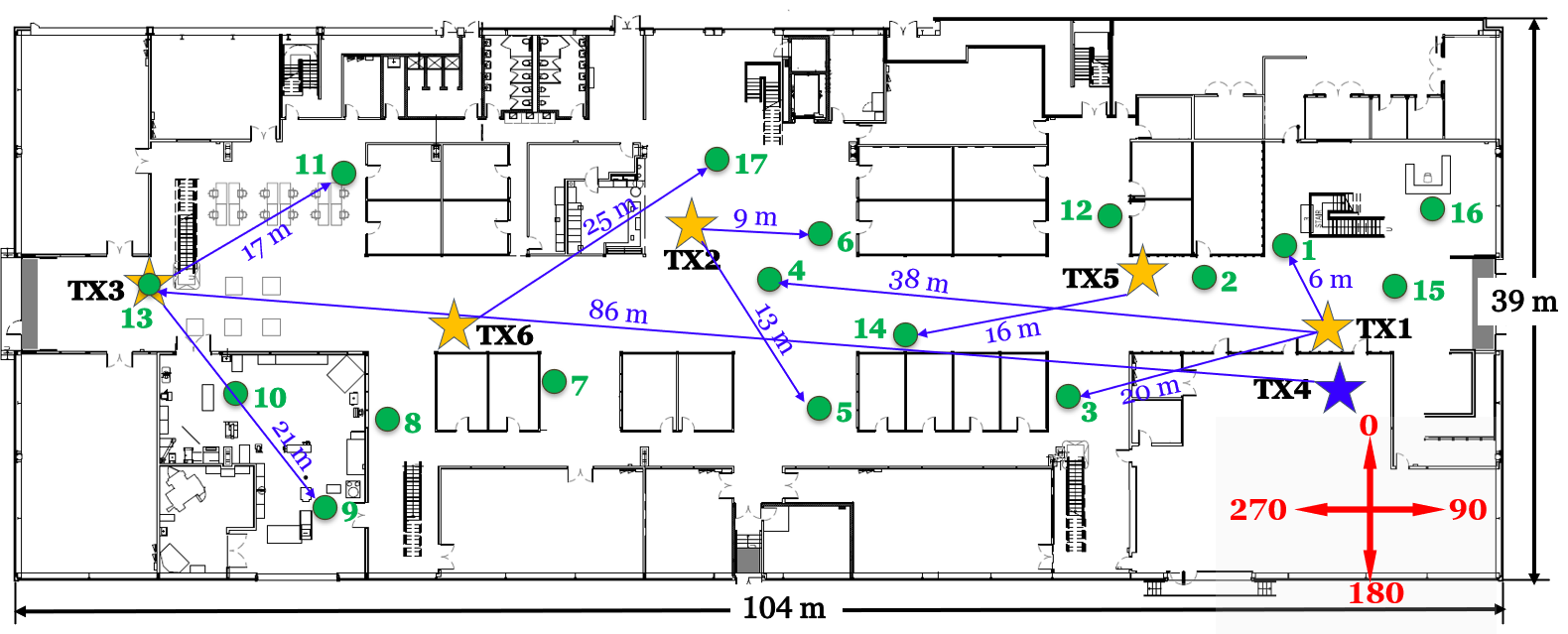
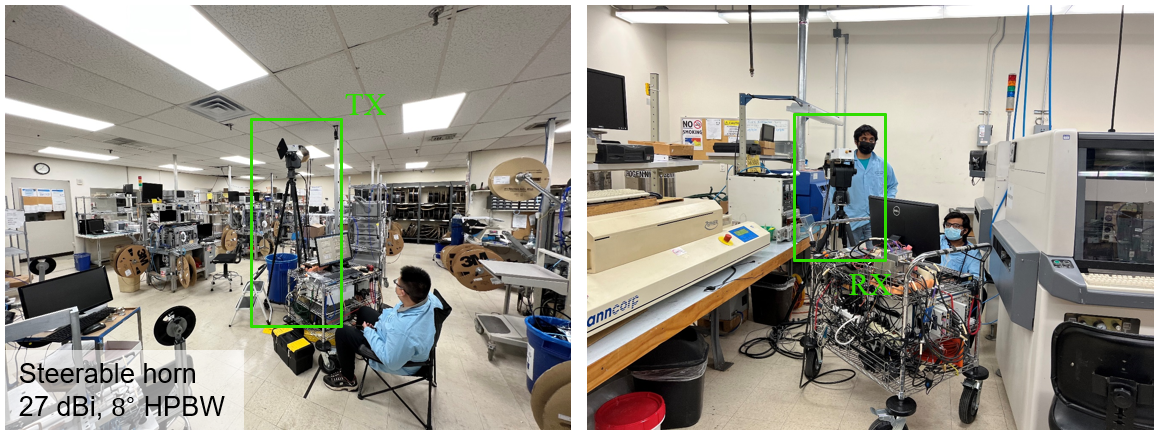
This paper presents sub-Terahertz (THz) radio propagation measurements at 142 GHz conducted in four factories with various layouts and facilities to explore sub-THz wireless channels for smart factories in 6G and beyond. Here we study spatial and temporal channel responses at 82 transmitter-receiver (TX-RX) locations across four factories in the New York City area and over distances from 5 m to 85 m in both line-of-sight (LOS) and non-LOS (NLOS) environments. The measurements were performed with a sliding-correlation-based channel sounder with 1 GHz RF bandwidth with steerable directional horn antennas with 27 dBi gain and 8\degree~half-power beamwidth at both TX and RX, using both vertical and horizontal antenna polarizations, yielding over 75,000 directional power delay profiles. Channel measurements of two RX heights at 1.5 m (high) emulating handheld devices and at 0.5 m (low) emulating automated guided vehicles (AGVs) were conducted for automated industrial scenarios with various clutter densities. Results yield the first path loss models for indoor factory (InF) environments at 142 GHz and show the low RX height experiences a mean path loss increase of 10.7 dB and 6.0 dB when compared with the high RX height at LOS and NLOS locations, respectively. Furthermore, flat and rotatable metal plates were leveraged as passive reflecting surfaces (PRSs) in channel enhancement measurements to explore the potential power gain on sub-THz propagation channels, demonstrating a range from 0.5 to 22 dB improvement with a mean of 6.5 dB in omnidirectional channel gain as compared to when no PRSs are present.
Motivation & Objective
- To characterize sub-THz radio propagation at 142 GHz in real indoor factory environments with diverse layouts and clutter densities.
- To model directional and omnidirectional path loss for LOS and NLOS conditions in factory buildings.
- To investigate the impact of receiver height on path loss, particularly for near-the-ground mobile devices like AGVs.
- To evaluate the potential of passive reflecting surfaces (PRS) for enhancing sub-THz channel performance in industrial settings.
- To provide foundational data for future reconfigurable intelligent surface (RIS) deployment and standardization of 6G sub-THz channels.
Proposed method
- Conducted 82 TX-RX link measurements across four factories in New York City, covering 5–85 m distances in both LOS and NLOS conditions.
- Used a sliding-correlation-based wideband channel sounder with 1 GHz RF bandwidth and steerable 27 dBi gain horn antennas with 8° HPBW.
- Performed directional measurements with both vertical and horizontal polarization at two RX heights: 1.5 m (high) and 0.5 m (low), emulating handheld devices and AGVs.
- Systematically rotated a 1 m × 1 m flat aluminum PRS in the horizontal plane to find optimal reflection angles, mimicking RIS beamforming.
- Collected over 75,000 directional power delay profiles and derived path loss models for co- and cross-polarized configurations.
- Compared natural channel performance with PRS-aided performance to quantify omnidirectional and directional path loss reduction.
Experimental results
Research questions
- RQ1How does path loss vary with distance and environment type (LOS vs. NLOS) at 142 GHz in real indoor factory buildings?
- RQ2What is the impact of receiver height (1.5 m vs. 0.5 m) on path loss in factory environments, particularly for AGV-mounted devices?
- RQ3To what extent can a passive reflecting surface (PRS) enhance sub-THz channel performance in factory scenarios?
- RQ4How does the placement and orientation of a PRS affect directional and omnidirectional path loss at 142 GHz?
- RQ5What are the statistical characteristics of cross-polarization discrimination (XPD) in sub-THz factory channels?
Key findings
- The omnidirectional path loss exponent (PLE) for NLOS conditions in factories is 3.1, higher than in office (2.7) and urban (2.9) environments, indicating greater path loss due to heavy clutter.
- Low RX height (0.5 m) results in a mean path loss increase of 10.7 dB in LOS and 6.0 dB in NLOS conditions compared to high RX height (1.5 m), due to increased blockage and scattering.
- A single PRS can achieve a maximum directional path loss reduction of 37.8 dB and a mean of 25 dB in the optimal reflection direction, with the highest gain observed at the shortest TX-RX distance.
- PRS-aided omnidirectional channel gain improves by up to 22 dB and as low as 0.5 dB, with a mean improvement of 6.5 dB, indicating significant benefit in NLOS and near-outage scenarios.
- The PRS effect is most pronounced in NLOS conditions, where the PRS-enhanced path becomes dominant, while in LOS, other MPCs often remain the primary contributors.
- Cross-polarization discrimination (XPD) is statistically characterized, supporting co- and cross-polarized path loss modeling for diverse antenna configurations.
Read this paper
Open the full text in the Nubint reader and ask about any passage as you read.
Read this paper on NubintThis review was generated by AI from the original paper. Please check the paper before citing it.