
[Paper Review] 4D Millimeter-Wave Radar in Autonomous Driving: A Survey
A comprehensive survey on 4D mmWave radar for autonomous driving, covering theory, signal processing, calibration, learning-based point cloud generation, datasets, perception, localization, mapping, and future trends.
The 4D millimeter-wave (mmWave) radar, proficient in measuring the range, azimuth, elevation, and velocity of targets, has attracted considerable interest within the autonomous driving community. This is attributed to its robustness in extreme environments and the velocity and elevation measurement capabilities. However, despite the rapid advancement in research related to its sensing theory and application, there is a conspicuous absence of comprehensive surveys on the subject of 4D mmWave radar. In an effort to bridge this gap and stimulate future research, this paper presents an exhaustive survey on the utilization of 4D mmWave radar in autonomous driving. Initially, the paper provides reviews on the theoretical background and progress of 4D mmWave radars, encompassing aspects such as the signal processing workflow, resolution improvement approaches, and extrinsic calibration process. Learning-based radar data quality improvement methods are present following. Then, this paper introduces relevant datasets and application algorithms in autonomous driving perception, localization and mapping tasks. Finally, this paper concludes by forecasting future trends in the realm of 4D mmWave radar in autonomous driving. To the best of our knowledge, this is the first survey specifically dedicated to the 4D mmWave radar in autonomous driving.
Motivation & Objective
- Motivate and consolidate the study of 4D mmWave radar in autonomous driving, highlighting its advantages and current research gaps.
- Summarize the theoretical background, signal processing flow, and resolution-enhancement techniques for 4D mmWave radars.
- Survey available datasets and learning-based methods for radar point-cloud generation.
- Review perception, localization, and mapping algorithms using 4D radar, and discuss future directions.
Proposed method
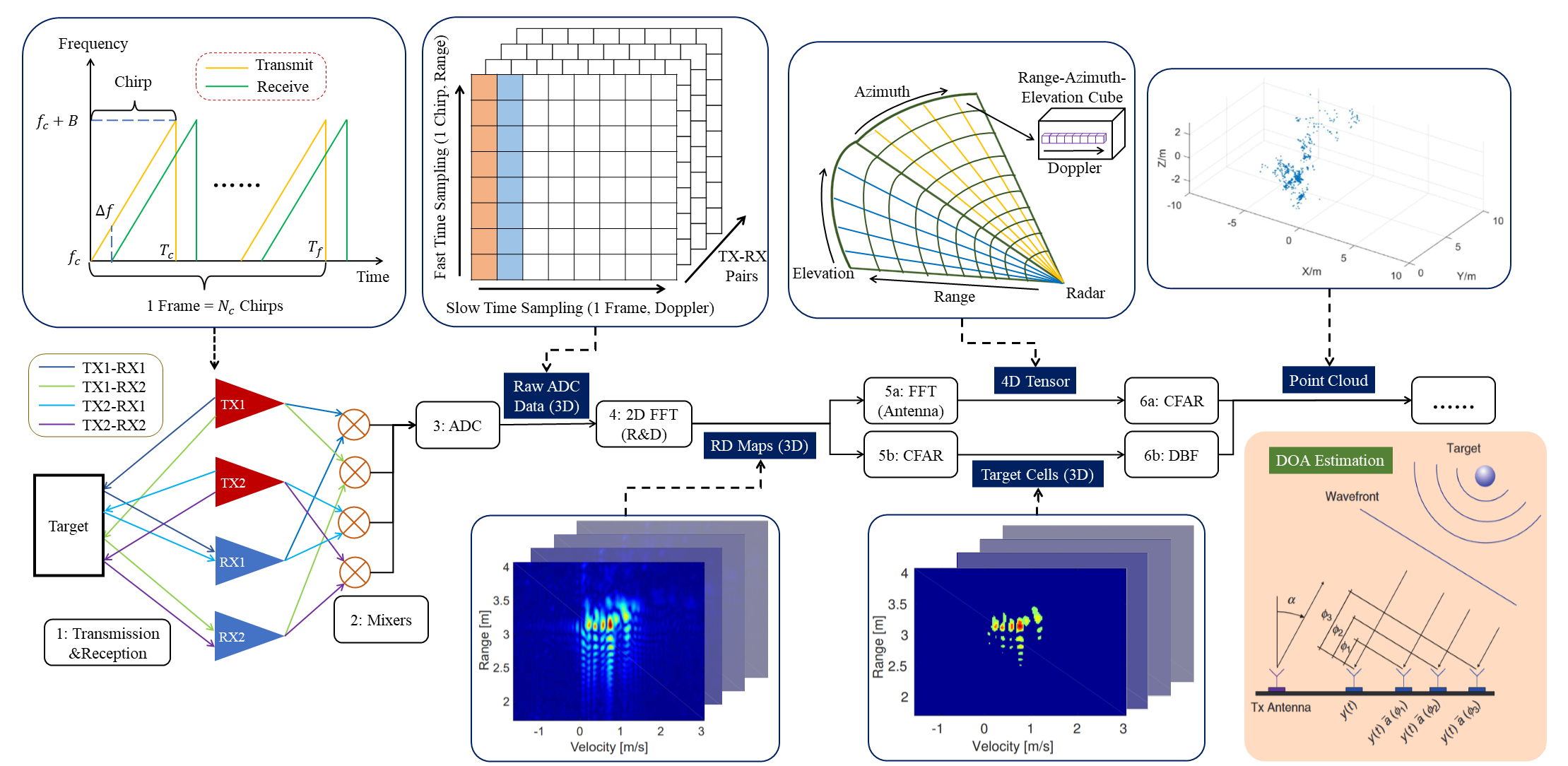
- Describe the 4D mmWave radar signal processing flow and data formats.
- Explain resolution improvement approaches at hardware and software levels.
- Summarize extrinsic calibration methods for 4D radar systems.
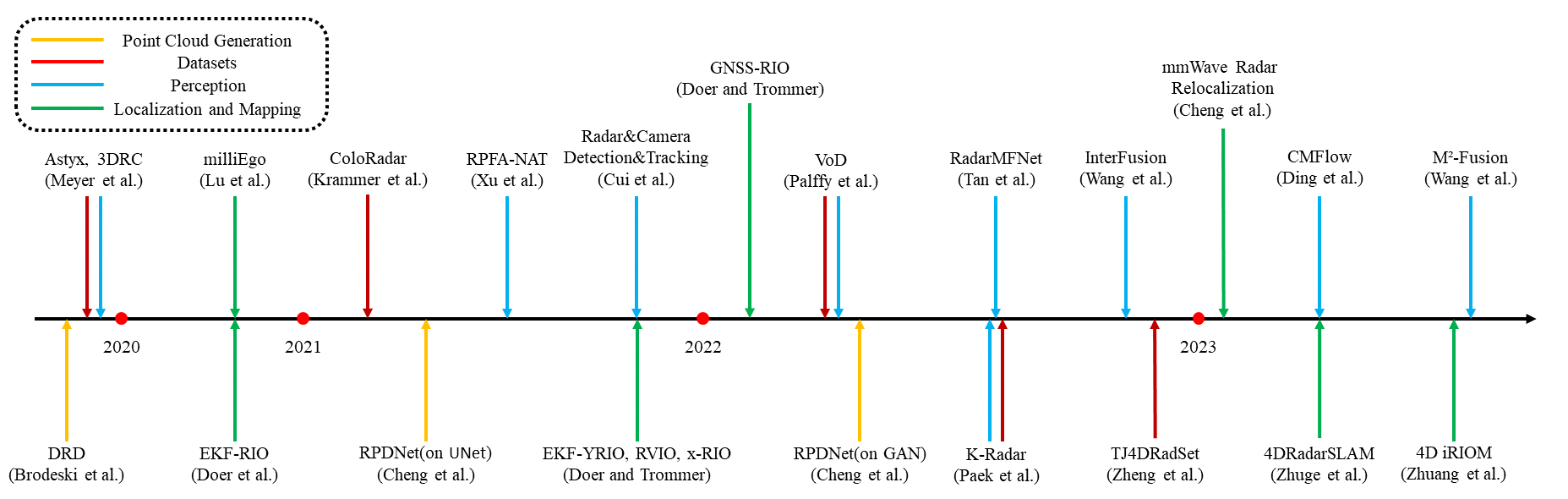
- Review learning-based radar point cloud generation methods and their datasets.
- Categorize and discuss perception, localization, and mapping applications using 4D radar.
- Discuss future trends and research directions in 4D radar technology.
Experimental results
Research questions
- RQ1What is the theoretical and processing pipeline for 4D mmWave radar in autonomous driving?
- RQ2What datasets and learning-based methods exist for 4D radar point-cloud generation and downstream tasks?
- RQ3How are 4D radar data used for perception, localization, and mapping, and what fusion strategies exist with other sensors?
- RQ4What are the anticipated future directions and challenges in 4D mmWave radar research for autonomous driving?
Key findings
- Identifies this work as the first survey focused specifically on 4D mmWave radar in autonomous driving.
- Outlines the signal processing flow, data formats, and resolution-improvement techniques for 4D mmWave radars.
- Reviews extrinsic calibration methods and learning-based radar point-cloud generation approaches.
- Provides a consolidated view of datasets and applications in perception, localization, and mapping with 4D radar.
- Discusses multi-modal fusion strategies and future trends, including pre-point-cloud data utilization and dataset enrichment.
- Notes that 4D radar demonstrates robustness in adverse conditions and enables elevation, range, azimuth, and velocity measurements.
Read this paper
Open the full text in the Nubint reader and ask about any passage as you read.
Read this paper on NubintThis review was generated by AI from the original paper. Please check the paper before citing it.