
[Paper Review] A Benchmark and Scoring Algorithm for Enriching Arabic Synonyms
This paper introduces a benchmark dataset of 3,000 candidate synonyms annotated with fuzzy synonymy scores by four linguists and proposes a graph-based algorithm that computes fuzzy similarity scores to enrich Arabic synsets. The algorithm achieves high accuracy (up to 99.1% at level 3) in retrieving masked synonyms and produces fuzzy scores closely matching human judgments (RMSE: 0.32, MAE: 0.27).
This paper addresses the task of extending a given synset with additional synonyms taking into account synonymy strength as a fuzzy value. Given a mono/multilingual synset and a threshold (a fuzzy value [0-1]), our goal is to extract new synonyms above this threshold from existing lexicons. We present twofold contributions: an algorithm and a benchmark dataset. The dataset consists of 3K candidate synonyms for 500 synsets. Each candidate synonym is annotated with a fuzzy value by four linguists. The dataset is important for (i) understanding how much linguists (dis/)agree on synonymy, in addition to (ii) using the dataset as a baseline to evaluate our algorithm. Our proposed algorithm extracts synonyms from existing lexicons and computes a fuzzy value for each candidate. Our evaluations show that the algorithm behaves like a linguist and its fuzzy values are close to those proposed by linguists (using RMSE and MAE). The dataset and a demo page are publicly available at https://portal.sina.birzeit.edu/synonyms.
Motivation & Objective
- To address the lack of standardized evaluation benchmarks for synonymy in low-resource languages like Arabic.
- To model synonymy as a fuzzy relation rather than a binary equivalence, reflecting linguistic nuance and human disagreement.
- To develop an algorithm that automatically extracts and scores new synonyms from existing lexicons using graph connectivity and fuzzy logic.
- To evaluate the algorithm’s performance against human-annotated fuzzy scores to assess its linguistic plausibility.
- To provide a publicly available dataset and demo for future research in Arabic lexical resource expansion.
Proposed method
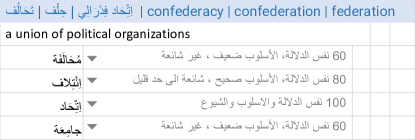
- Constructed a benchmark dataset with 500 synsets and 3,000 candidate synonyms, each annotated with a fuzzy synonymy score (0–1) by four linguists.
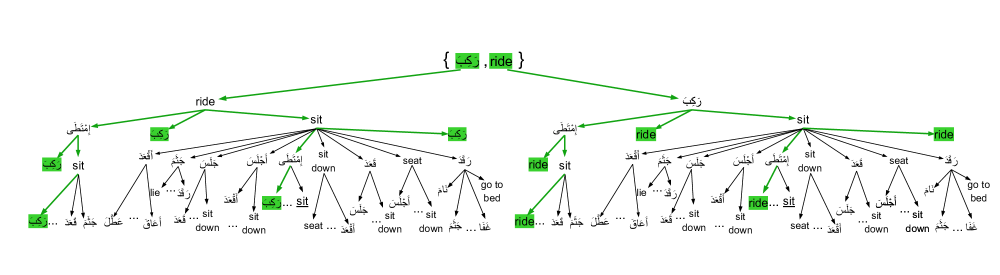
- Built a directed graph from Arabic WordNet, where nodes represent words and edges represent synonymy/translation relations at levels k=3 and k=4.
- Identified cyclic paths in the graph to detect potential synonym candidates, as cycles indicate mutual synonymy relations.
- Assigned fuzzy scores to candidates based on their connectivity within the graph, using a learned fuzzy model trained on the human-annotated dataset.
- Used the average of human scores as a baseline for evaluating algorithmic performance via RMSE and MAE.
- Evaluated the algorithm via a masking experiment: removing a term from a synset and checking if the algorithm retrieved it with the highest fuzzy score.
Experimental results
Research questions
- RQ1How much do linguists disagree on synonymy in Arabic, and what is the range of their fuzzy similarity judgments?
- RQ2Can an algorithm mimic human-like fuzzy synonymy scoring when enriching Arabic synsets?
- RQ3How effective is the graph-based synonym discovery method in retrieving masked synonyms from Arabic WordNet?
- RQ4How does the frequency of a word in the lexicon affect the algorithm’s ability to retrieve it as a synonym?
- RQ5To what extent does the algorithm’s fuzzy scoring correlate with human-annotated scores?
Key findings
- Linguists exhibit moderate disagreement on synonymy, with RMSE between 0.16 and 0.22 and MAE between 0.12 and 0.16 across the dataset.
- The proposed algorithm achieves a root mean squared error (RMSE) of 0.32 and mean absolute error (MAE) of 0.27 when comparing its fuzzy scores to the average of human annotations.
- The algorithm retrieves 99.1% of high-frequency terms with top rank at level 3 and 95.2% at level 4 in the masking experiment.
- Accuracy decreases for low-frequency terms (88.4% at level 3, 62.0% at level 4), indicating that connectivity in the graph is a key factor in performance.
- The algorithm maintains high accuracy (98.7% at level 3, 92.0% at level 4) for average-frequency terms and 98.1% (level 3) and 89.3% (level 4) for random-frequency terms.
- The algorithm’s performance is highly dependent on the structure of the underlying lexicon, such as Arabic WordNet, and may vary with different resource configurations.
Read this paper
Open the full text in the Nubint reader and ask about any passage as you read.
Read this paper on NubintThis review was generated by AI from the original paper. Please check the paper before citing it.