
[Paper Review] A Bilingual, OpenWorld Video Text Dataset and End-to-end Video Text Spotter with Transformer
This paper introduces BOVText, a large-scale, bilingual, open-world video text dataset with 2,000+ videos and 1.75M+ frames, supporting diverse scenarios and multilingual annotations. It proposes TransVTSpotter, an end-to-end video text spotting framework using a Transformer-based attention mechanism with rotation-aware tracking, achieving 44.1% MOTA on ICDAR2015(video), setting a new state-of-the-art performance.
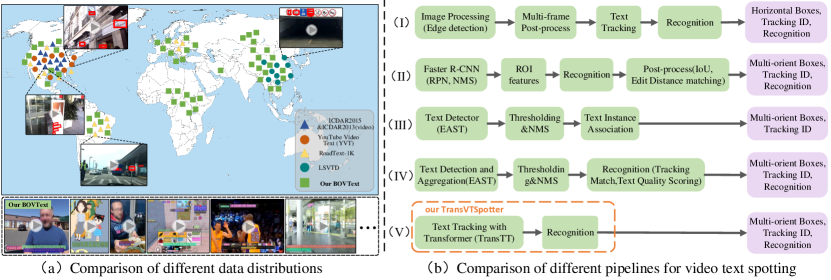
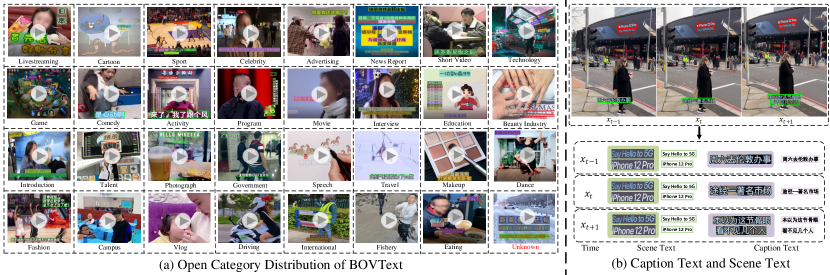
Most existing video text spotting benchmarks focus on evaluating a single language and scenario with limited data. In this work, we introduce a large-scale, Bilingual, Open World Video text benchmark dataset(BOVText). There are four features for BOVText. Firstly, we provide 2,000+ videos with more than 1,750,000+ frames, 25 times larger than the existing largest dataset with incidental text in videos. Secondly, our dataset covers 30+ open categories with a wide selection of various scenarios, e.g., Life Vlog, Driving, Movie, etc. Thirdly, abundant text types annotation (i.e., title, caption or scene text) are provided for the different representational meanings in video. Fourthly, the BOVText provides bilingual text annotation to promote multiple cultures live and communication. Besides, we propose an end-to-end video text spotting framework with Transformer, termed TransVTSpotter, which solves the multi-orient text spotting in video with a simple, but efficient attention-based query-key mechanism. It applies object features from the previous frame as a tracking query for the current frame and introduces a rotation angle prediction to fit the multiorient text instance. On ICDAR2015(video), TransVTSpotter achieves the state-of-the-art performance with 44.1% MOTA, 9 fps. The dataset and code of TransVTSpotter can be found at github:com=weijiawu=BOVText and github:com=weijiawu=TransVTSpotter, respectively.
Motivation & Objective
- To address the lack of large-scale, diverse, and multilingual video text datasets for realistic video text spotting evaluation.
- To overcome limitations in existing benchmarks, which are restricted to single languages, limited scenarios, and small-scale data.
- To enable end-to-end video text spotting with improved tracking and recognition of multi-orient text in videos.
- To support broader applications such as video understanding, automatic translation, and video retrieval through rich text-type annotations.
- To provide open-source resources (dataset and code) for advancing research in video text spotting and related video-and-language tasks.
Proposed method
- BOVText is constructed from 1,494 KuaiShou and 356 YouTube videos, covering 30+ open-world scenarios including Life Vlog, Game, Sportscast, and Driving.
- The dataset includes bilingual (Chinese and English) annotations for three text types: titles, captions, and scene text, enabling cross-cultural understanding and multilingual applications.
- TransVTSpotter employs a Transformer-based detection head with an attention-based query-key mechanism that uses object features from the previous frame as tracking queries.
- A rotation angle prediction head is integrated to handle multi-orient text instances, improving detection robustness in video sequences.
- The framework enables end-to-end video text spotting by jointly detecting, recognizing, and tracking text across frames without post-processing steps like NMS.
- The model is trained and evaluated on ICDAR2015(video), with inference speed of 9 fps, demonstrating efficiency and scalability.
Experimental results
Research questions
- RQ1Can a large-scale, open-world, bilingual video text dataset improve the generalization and robustness of video text spotting models across diverse real-world scenarios?
- RQ2How effective is a Transformer-based end-to-end framework with attention-based tracking and rotation-aware detection for multi-orient text spotting in video?
- RQ3To what extent can rich text-type annotations (title, caption, scene text) enhance downstream tasks like video understanding and retrieval?
- RQ4Can the proposed dataset and model support practical applications such as multilingual video translation and semantic video retrieval?
- RQ5How does the proposed method compare to existing multi-stage or two-stage pipelines in terms of accuracy, speed, and end-to-end simplicity?
Key findings
- BOVText contains over 1.75 million frames across 2,000+ videos, making it 25 times larger than the previous largest video text dataset.
- The dataset supports 30+ open-world scenarios, including previously underrepresented domains such as NBA broadcasts, game streams, and life vlogs.
- TransVTSpotter achieves a new state-of-the-art MOTA of 44.1% on the ICDAR2015(video) benchmark, demonstrating superior performance.
- The model runs at 9 fps, indicating strong inference efficiency suitable for real-time applications.
- Bilingual annotations and multi-type text labeling (title, caption, scene text) significantly enhance the potential for video-and-language tasks like video description and retrieval.
- The open-source release of both the dataset and code under CC-BY 4.0 license enables reproducible research and fosters community development in video text spotting.
Read this paper
Open the full text in the Nubint reader and ask about any passage as you read.
Read this paper on NubintThis review was generated by AI from the original paper. Please check the paper before citing it.