
[Paper Review] A characterization of limiting functions arising in Mod-* convergence
This paper characterizes the limiting functions in mod-∗ convergence, a refinement of the central limit theorem where characteristic functions are renormalized by those of a reference family (e.g., Gaussian, Poisson, or Cauchy). It proves that such limiting functions are dense in the space of continuous functions with unit value at zero and conjugate symmetry, and provides new examples of mod-Cauchy convergence from number theory, including Dedekind sums and linking numbers of modular geodesics.
In this note, we characterize the limiting functions in mod-Gausssian convergence; our approach sheds a new light on the nature of mod-Gaussian convergence as well. Our results in fact more generally apply to mod-* convergence, where * stands for any family of probability distributions whose Fourier transforms do not vanish. We moreover provide new examples, including two new examples of (restricted) mod-Cauchy convergence from arithmetics related to Dedekind sums and the linking number of modular geodesics.
Motivation & Objective
- To characterize the set of all possible limiting functions arising in mod-∗ convergence, where ∗ denotes a family of distributions with non-vanishing Fourier transforms.
- To clarify the nature of mod-Gaussian and mod-Poisson convergence by identifying the functional class to which the limiting functions belong.
- To extend the framework to restricted mod-∗ convergence, where convergence holds only on a finite interval of the Fourier variable.
- To provide new arithmetically motivated examples of mod-Cauchy convergence, demonstrating the relevance of the framework in number theory and geometry.
Proposed method
- Uses analytic techniques involving the convolution of polynomials with scaled Gaussian densities to construct approximating functions in the space of characteristic functions.
- Applies the operator $ P(D) $, where $ D $ is differentiation, to the Gaussian density $ f_\sigma $, and constructs a perturbed density $ g_{P,\sigma} $ that remains nonnegative for large $ \sigma $.
- Establishes that the ratio of the characteristic function of such a perturbed density to that of a Gaussian is dense in the space $ S $ of continuous functions with $ \phi(0)=1 $, $ \phi(-\lambda)=\overline{\phi(\lambda)} $.
- Applies the general framework to specific number-theoretic settings: Dedekind sums via the Dedekind eta function and linking numbers of modular geodesics via the Rademacher map.
- Uses known asymptotic results (e.g., Selberg's Prime Geodesic Theorem) to derive the convergence of characteristic functions in the restricted mod-Cauchy sense.
- Performs summation by parts to remove logarithmic weights in the measure when needed, ensuring the convergence remains valid under reweighting.
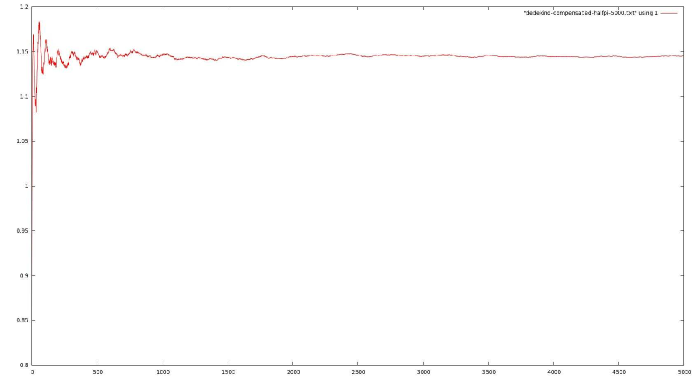
Experimental results
Research questions
- RQ1Which continuous functions $ \phi: \mathbb{R} \to \mathbb{C} $ with $ \phi(0) = 1 $ and $ \phi(-\lambda) = \overline{\phi(\lambda)} $ can arise as limiting functions in mod-∗ convergence?
- RQ2Can the set of limiting functions for mod-Gaussian convergence be characterized as dense in the space of such continuous functions?
- RQ3What are the arithmetically meaningful examples of mod-Cauchy convergence beyond the classical mod-Gaussian and mod-Poisson cases?
- RQ4How far can the convergence in mod-Cauchy convergence hold—i.e., is the restriction to $ |t| < 4\pi/3 $ or $ |t| \leq \pi/12 $ optimal, or can it be extended?
- RQ5To what extent do limiting functions in mod-∗ convergence encode information about dependence structures in number-theoretic objects, such as primes or geodesics?
Key findings
- The set $ S_0 $ of limiting functions in mod-Gaussian convergence is dense in the space $ S $ of continuous functions $ \phi: \mathbb{R} \to \mathbb{C} $ with $ \phi(0) = 1 $ and $ \phi(-\lambda) = \overline{\phi(\lambda)} $, under uniform convergence on compact sets.
- The limiting function $ \Phi(t) = \frac{1}{1 - \frac{3|t|}{\pi}} $ arises in the mod-Cauchy convergence of linking numbers of modular geodesics, valid for $ |t| \leq \pi/12 $, with $ \gamma_x = \frac{3}{\pi} \log x $.
- For Dedekind sums, the characteristic function of the normalized sum $ D_N $ satisfies $ \mathbb{E}[e^{itD_N}] \exp(\gamma_N |t|) \to \Phi(t) $ for $ |t| < 4\pi/3 $, with $ \gamma_N = \frac{N}{4} $, and $ \Phi(t) $ involving the Dedekind eta function.
- The limiting function in the linking number example is related to the inverse Laplace transform of the distribution function of $ \log(y|\eta(z)|^4) $, indicating deep connections to modular forms.
- The convergence in both new examples is restricted to a finite interval in the Fourier variable, and numerical evidence suggests the restriction may be sharp.
- The framework of mod-∗ convergence, especially in restricted form, provides a powerful tool to analyze arithmetic and geometric objects where classical central limit theorems fail to capture dependence structures.

Read this paper
Open the full text in the Nubint reader and ask about any passage as you read.
Read this paper on NubintThis review was generated by AI from the original paper. Please check the paper before citing it.