
[Paper Review] A Comparative Analysis of Energy Consumption Between The Widespread Unreal and Unity Video Game Engines
This study compares energy consumption between Unity and Unreal Engine across three core game development scenarios—Physics, Static Meshes, and Dynamic Meshes—using controlled power measurements on a standard gaming PC. Results show Unity is 351% more energy-efficient than Unreal in Physics, 17% more in Static Meshes, and Unreal is 26% more efficient in Dynamic Meshes, highlighting significant potential for annual global energy savings of 51 TWh.
The total energy cost of computing activities is steadily increasing and projections indicate that it will be one of the dominant global energy consumers in the coming decades. However, perhaps due to its relative youth, the video game sector has not yet developed the same level of environmental awareness as other computing technologies despite the estimated three billion regular video game players in the world. This work evaluates the energy consumption of the most widely used industry-scale video game engines: Unity and Unreal Engine. Specifically, our work uses three scenarios representing relevant aspects of video games (Physics, Statics Meshes, and Dynamic Meshes) to compare the energy consumption of the engines. The aim is to determine the influence of using each of the two engines on energy consumption. Our research has confirmed significant differences in the energy consumption of video game engines: 351% in Physics in favor of Unity, 17% in Statics Meshes in favor of Unity, and 26% in Dynamic Meshes in favor of Unreal Engine. These results represent an opportunity for worldwide potential savings of at least 51 TWh per year, equivalent to the annual consumption of nearly 13 million European households, that might encourage a new branch of research on energy-efficient video game engines.
Motivation & Objective
- To evaluate the energy consumption differences between Unity and Unreal Engine, the two most widely used game engines.
- To identify which engine is more energy-efficient across key game development workloads.
- To quantify the potential global energy savings from selecting energy-efficient engines in video game development.
- To encourage research into energy-efficient game engine design and sustainable software engineering practices.
Proposed method
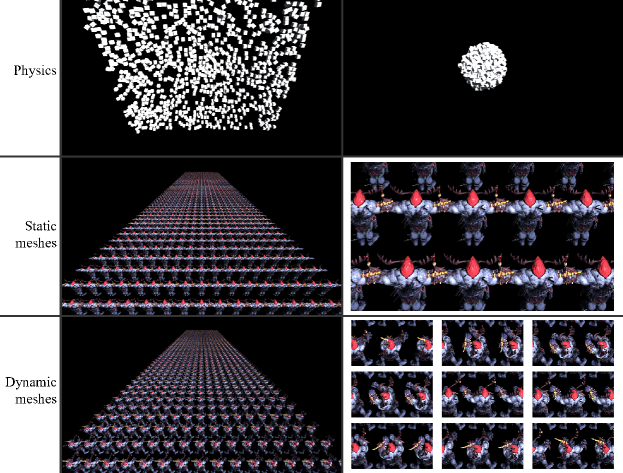
- Three representative game development scenarios were implemented: Physics simulation, Static Meshes rendering, and Dynamic Meshes rendering.
- Power consumption was measured using a calibrated power meter (Fluke 435 II) on a standardized gaming PC under controlled conditions.
- Each scenario was implemented identically in both Unity and Unreal Engine to ensure fair comparison.
- Measurements were taken over identical execution times to ensure energy consumption was directly proportional to power draw.
- The study used a validated measurement process with a single DUT (Device Under Test) to ensure reliability and repeatability.
- Results were analyzed to determine relative energy efficiency differences between the two engines across each scenario.
Experimental results
Research questions
- RQ1Which game engine—Unity or Unreal Engine—consumes less energy in physics simulations?
- RQ2How does energy consumption compare between Unity and Unreal Engine in static mesh rendering?
- RQ3What is the relative energy efficiency of Unity and Unreal Engine in dynamic mesh rendering?
- RQ4What is the potential global energy savings if developers selected the more energy-efficient engine for each workload type?
- RQ5Can engine selection significantly influence the overall energy footprint of video games?
Key findings
- Unity is 351% more energy-efficient than Unreal Engine in physics simulation workloads.
- Unity is 17% more energy-efficient than Unreal Engine in static meshes rendering.
- Unreal Engine is 26% more energy-efficient than Unity in dynamic meshes rendering.
- The combined energy efficiency differences across all three scenarios suggest a potential annual global energy saving of at least 51 TWh.
- These savings are equivalent to the annual electricity consumption of nearly 13 million European households.
- The results indicate that engine selection can have a substantial impact on the environmental footprint of video games.
Read this paper
Open the full text in the Nubint reader and ask about any passage as you read.
Read this paper on NubintThis review was generated by AI from the original paper. Please check the paper before citing it.