
[Paper Review] A Comparison of Pre-trained Vision-and-Language Models for Multimodal Representation Learning across Medical Images and Reports
This study evaluates four pre-trained vision-and-language (V+L) models—LXMERT, VisualBERT, UNITER, and PixelBERT—for learning joint image-text representations from chest X-rays and radiology reports. It demonstrates that these models outperform a CNN-RNN baseline in thoracic findings classification, with ablation studies confirming the superiority of joint embeddings and pre-training over text-only or random-weight models.
Joint image-text embedding extracted from medical images and associated contextual reports is the bedrock for most biomedical vision-and-language (V+L) tasks, including medical visual question answering, clinical image-text retrieval, clinical report auto-generation. In this study, we adopt four pre-trained V+L models: LXMERT, VisualBERT, UNIER and PixelBERT to learn multimodal representation from MIMIC-CXR radiographs and associated reports. The extrinsic evaluation on OpenI dataset shows that in comparison to the pioneering CNN-RNN model, the joint embedding learned by pre-trained V+L models demonstrate performance improvement in the thoracic findings classification task. We conduct an ablation study to analyze the contribution of certain model components and validate the advantage of joint embedding over text-only embedding. We also visualize attention maps to illustrate the attention mechanism of V+L models.
Motivation & Objective
- To evaluate the performance of four pre-trained vision-and-language models in learning joint image-text representations from medical images and reports.
- To compare the effectiveness of pre-trained V+L models against a conventional CNN-RNN baseline (TieNet) in a multi-label thoracic findings classification task.
- To analyze the contribution of joint image-text embeddings versus text-only embeddings through ablation studies.
- To investigate the impact of pre-training versus training from scratch on model performance in the biomedical domain.
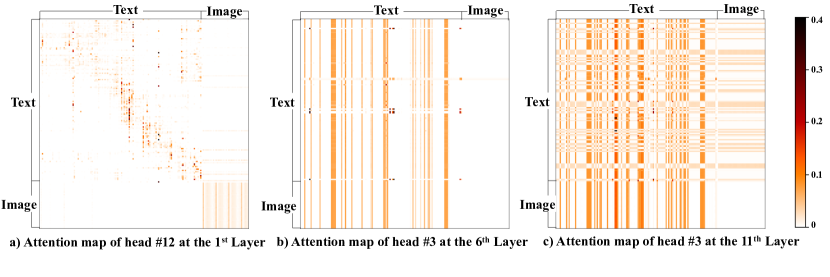
- To visualize attention mechanisms and understand modality interactions in V+L models using attention maps and modality importance scores.
Proposed method
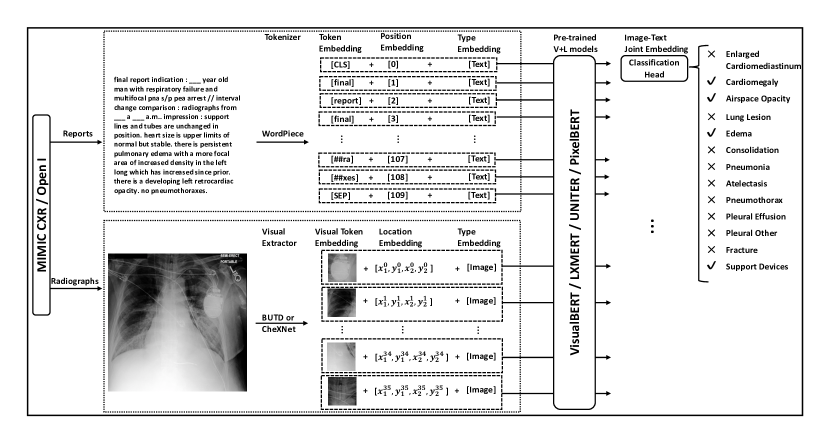
- Fine-tuned four pre-trained V+L models—LXMERT, VisualBERT, UNITER, and PixelBERT—on the MIMIC-CXR dataset for joint image-text representation learning.
- Used a multi-label classification head on top of the [CLS] token to predict 13 thoracic findings from paired CXR images and radiology reports.
- Applied data preprocessing to retain only the first frontal-view X-ray per report and re-categorized labels from four to two classes (positive/negative).
- Conducted ablation studies comparing joint image-text embeddings, text-only embeddings, and random-weight models to isolate the contribution of joint learning.
- Visualized attention maps from the best-performing model (VisualBERT) across different layers to analyze modality interactions and attention patterns.
- Calculated layer-level Modality Importance (MI) scores to quantitatively assess the relative attention contribution of visual and textual modalities.
Experimental results
Research questions
- RQ1How do pre-trained vision-and-language models compare to a CNN-RNN baseline in learning joint representations for thoracic findings classification?
- RQ2What is the relative contribution of joint image-text embeddings versus text-only embeddings in medical V+L tasks?
- RQ3Does pre-training provide a significant performance advantage over training from random weights in the biomedical domain?
- RQ4How do attention mechanisms in V+L models distribute between visual and textual modalities across different layers?
- RQ5What are the failure modes of V+L models in medical image-text classification, and how do tokenization and report truncation affect predictions?
Key findings
- Pre-trained V+L models significantly outperformed the CNN-RNN baseline (TieNet) on the OpenI dataset, with a 15% improvement in mean F1-score for thoracic findings classification.
- Ablation studies confirmed that joint image-text embeddings consistently outperformed text-only embeddings, demonstrating the value of multimodal fusion.
- Pre-training provided a substantial performance boost over training from random weights, highlighting the importance of pre-training on large-scale data.
- VisualBERT achieved the best performance among the four models, with a mean F1-score of 0.54 on the OpenI test set.
- Layer-level Modality Importance (MI) scores showed that textual modality received significantly higher attention than visual modality, especially in intermediate layers.
- Error analysis revealed that subword tokenization (e.g., WordPiece) could lead to false positives when rare terms like 'hydropneumothorax' were split into subwords that matched more common terms like 'pneumothorax'.
Read this paper
Open the full text in the Nubint reader and ask about any passage as you read.
Read this paper on NubintThis review was generated by AI from the original paper. Please check the paper before citing it.